


 Uber Bets Big on Autonomous Vehicles with $10 Billion Commitment
  Pentagon Taps Auto Giants to Supercharge U.S. Weapons Production
  Japan Opens Arms Export Floodgates: New Policy Draws Global Defense Interest
  SK Hynix Shares Hit Record High Amid AI Memory Demand Surge
  ASML Raises 2026 Revenue Outlook as AI Chip Demand Surges
  CSN's Cement Unit Sale Could Exceed $2 Billion as Global Giants Circle
  TSMC Posts Record Q1 Profit Fueled by AI Chip Demand
  Qantas Raises Fuel Cost Forecast Amid Middle East Oil Crisis
  Elliott Investment Takes ~3% Stake in Daikin, Pushes for Buybacks and Strategic Overhaul
  CATL Stock Hits Record High After Q1 2025 Earnings Surge
  Amazon in Advanced Talks to Acquire Globalstar in Starlink Rivalry Move
  DEEPX Partners with Hyundai to Power Next-Gen AI Robots Ahead of IPO
  Goldman Sachs FICC Revenue Falls 10% Amid Iran War Market Volatility
  Elon Musk's Terafab Foundry Courts Top Chipmaking Giants for AI Self-Sufficiency Push
  Tesla's Terafab: AI Chip Factory Eyes Taiwan's Semiconductor Talent
  Japan to Subsidize Sony's Image Sensor Plant in Kumamoto with $380 Million
  KKR's $820M Investment Fuels Samsung SDS AI Expansion, Sending Group Shares Soaring


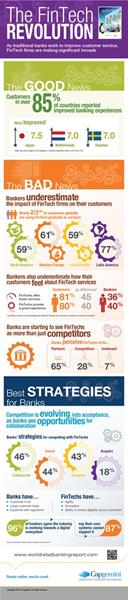
FinTech providers are making increasingly significant inroads with customers, yet the vast majority of banks admit they are not adequately prepared to manage this emerging FinTech threat, according to the 2016 World Retail Banking Report (WRBR), released today by Capgemini and Efma. The report found that nearly two-thirds of customers (63 percent) are now using FinTech products or services, and are much more likely to refer friends and family to their FinTech provider (55 percent) than to their bank (38 percent). However, while 96 percent of banking executives agree that the industry is evolving toward a digital banking ecosystem, where FinTech providers play a much bigger role, only 13 percent say they have the systems in place to support it.
With penetration highest in the emerging markets and among younger customers, FinTech service providers are gaining popularity among consumers thanks to the perception that they are easy to use (82 percent), offer fast service (81 percent), and provide a good user experience (80 percent). Banks, however, underestimate the value placed on these services with only 36 percent agreeing that FinTechs offer fast service (a 45 percentage point gap) and only 40 percent agreeing that FinTechs provide a good experience (a 40 percentage point gap).
Banking Customer Experience Gains Not Slowing Down FinTech Firms
Globally, banks improved their customer experience performance by 2.9 points on Capgemini’s Customer Experience Index (CEI)1, with gains in more than 85 percent of the countries surveyed. However, this overall advancement did not translate into tangible results in profitable customer behavior, such as retention, referrals and cross sales. Only 16 percent of customers, for example, said they are likely to purchase an additional product from their bank.
Banks view trust as their greatest strength (70 percent), but while they currently enjoy higher rates of customer trust, FinTech firms are quickly catching up, with the percentage of customers who completely or somewhat trust their FinTech provider reaching more than 88 percent across all regions. However, despite the rapid pace of change continuing to accelerate, a concern recognized by 90 percent of banking executives, less than one quarter feel they have an advantage over FinTech firms in terms of agility or ability to innovate to address these challenges.
“The inability of banks to innovate leaves the door wide open for FinTech providers to attract new customers,” said Anirban Bose, Head of Global Banking and Financial Services, Capgemini. “There is opportunity for banks to begin working collaboratively with these companies, but they must formulate a rapid response plan to do so before the swiftly evolving bank environment outpaces their window for change.”
New Strategies for a New Era in Banking
In order to respond to the threat these companies pose to more traditional models, nearly two-thirds of bank executives say they need to view FinTechs as partners, with the majority of bank development strategies taking the form of collaboration (46 percent) and investment (44 percent). Less than one-fifth (18 percent) say they plan to acquire FinTech firms or their technology.
“The willingness to partner with FinTech firms is a recognition that banks are unprepared to operate in a future that consists of a series of secure digital interconnections,” said Vincent Bastid, Secretary General, Efma. “By partnering with these companies, banks can gain much needed guidance in product development, as well as a stronger voice in defining a central role for themselves in the current banking environment.”
Banks and FinTechs have strengths that are complementary and which should be leveraged to create a stronger central financial experience for customers. While FinTechs excel in agility, innovation and exploiting new technology, banks offer capital, deep customer bases and expertise in working with regulators. According to the report, banks need to “think big” as they strive to meet evolving customer demands in the digital age. Revamping core systems and establishing full competency in API-based software2 development will be high priorities. Banks will only be able to achieve their full growth potential by fully accepting the growing role of FinTech providers and creating pathways to work with them as the digital financial network continues to evolve.
The World Retail Banking Report 2016 features data from more than 16,000 customers across 32 countries making it one of the largest customer experience surveys of its kind. It also includes qualitative data from in-depth banking executive interviews.
1 Based on responses from polling over 16,000 retail banking customers in 32 countries, Capgemini's proprietary Customer Experience Index analyzes customer experience across 80 data points to calculate a customer experience score. The score provides insight on how customers perceive the quality of their bank interactions.
2 Application programming interfaces (API) are software tools that let mobile or web application providers securely access bank-owned data for use in customer-focused digital services.







