


 Indonesia Passes New Central Bank Law, Raising Investor Concerns Over Policy Independence
  Senegal Appoints Economist Ahmadou Al Aminou Lo as Prime Minister Amid IMF Debt Crisis
  China Trade Surplus Surges in May 2026 as Exports and AI-Driven Imports Accelerate
  BOJ Governor Ueda Warns Oil Price Shock Could Trigger Persistent Inflation
  South Korea Q1 GDP Growth Revised Higher as AI-Driven Exports Boost Economic Outlook
  Asian Currencies Gain as U.S. Dollar Softens Ahead of Key Inflation Data in 2026
  US Stock Futures Rebound as Tech Shares Recover Despite Rising Middle East Tensions
  BOJ Signals Possible Rate Hike as Middle East Tensions Fuel Inflation Concerns


As inflation expectations rise globally, the US Federal Reserve is expected to hike rates at a faster pace next year. Last week, FOMC forecasted 3 rate hikes, compared to just one each in previous two years. Then why the governments are still able to sell bonds at negative rates? Last Friday, the United Kingdom for the first time sold bonds at negative rates. The government was able to borrow £1 billion at minus 0.1038 percent. The negative bond universe is squeezed but still close to $10.8 trillion. In August, this universe was as big as $13 trillion.
Part of the answer lies with Quantitative Easing. Several major central banks around the world are still pursuing quantitative easing. The European Central Bank (ECB) earlier this month announced a further purchase of €540 billion bonds till December 2017, once the current program expires in March 2017. Not only that, the ECB announced that it would now purchase below the deposit rate, which is at -0.4 percent. Since the ECB announcement, German 2-year yield has been declining to record low and currently trading at -0.8 percent.
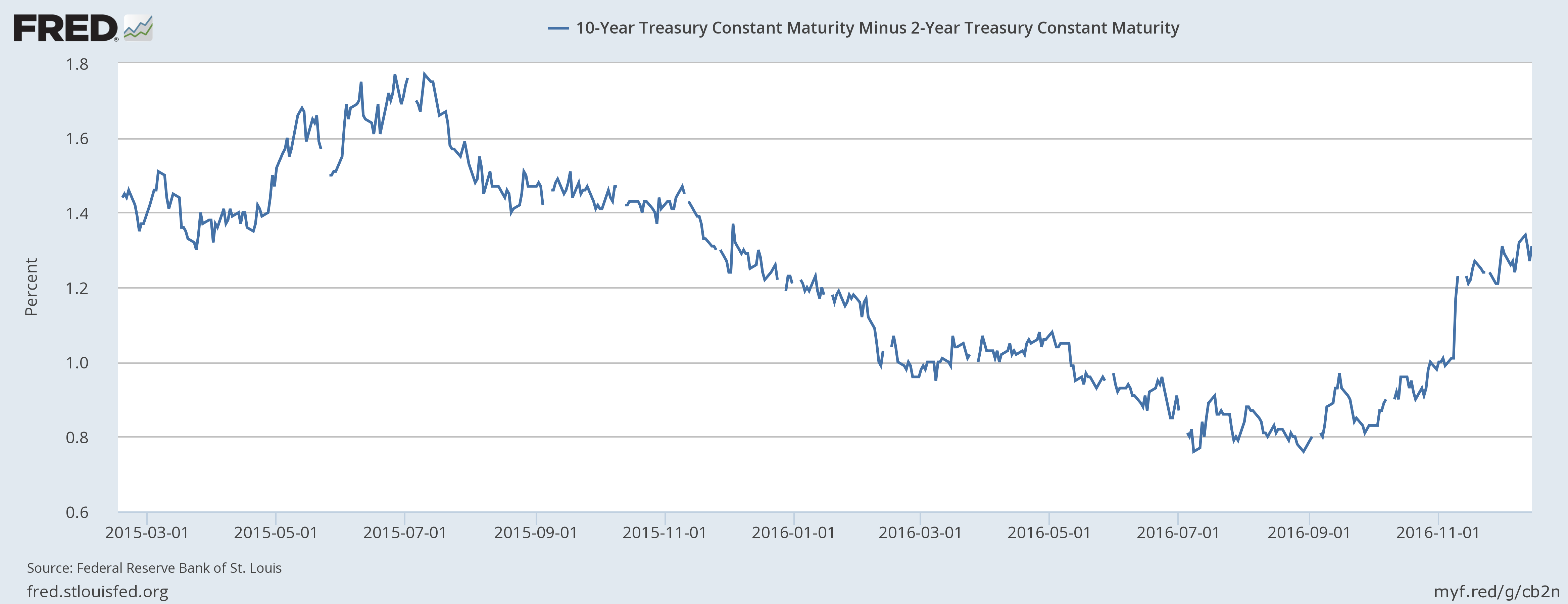
With rising inflation expectation globally, the market is and will return to the very fundamental that the central banks can control the short term rates but have hardly any control over the longer end of the curve, which gets determined by a variety of factors in the economy. The spread between the US 2-year and 10-year treasury has jumped by 56 basis points since September to 1.32 percent.







