


 Japanese Pharmaceutical Stocks Slide as TrumpRx.gov Launch Sparks Market Concerns
  China Extends Gold Buying Streak as Reserves Surge Despite Volatile Prices
  Japan Economy Poised for Q4 2025 Growth as Investment and Consumption Hold Firm
  Trump Endorses Japan’s Sanae Takaichi Ahead of Crucial Election Amid Market and China Tensions
  South Africa Eyes ECB Repo Lines as Inflation Eases and Rate Cuts Loom
  Bank of England Expected to Hold Interest Rates at 3.75% as Inflation Remains Elevated
  U.S.-India Trade Framework Signals Major Shift in Tariffs, Energy, and Supply Chains
  BOJ Holds Interest Rates Steady, Upgrades Growth and Inflation Outlook for Japan
  JPMorgan Lifts Gold Price Forecast to $6,300 by End-2026 on Strong Central Bank and Investor Demand
  Trump Signs Executive Order Threatening 25% Tariffs on Countries Trading With Iran
  Jerome Powell Attends Supreme Court Hearing on Trump Effort to Fire Fed Governor, Calling It Historic
  RBI Holds Repo Rate at 5.25% as India’s Growth Outlook Strengthens After U.S. Trade Deal
  Trump’s Inflation Claims Clash With Voters’ Cost-of-Living Reality
  Dollar Near Two-Week High as Stock Rout, AI Concerns and Global Events Drive Market Volatility


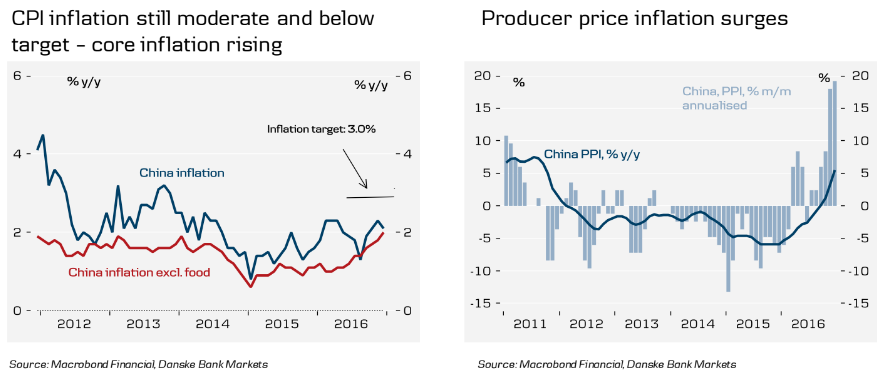
China Statistics Bureau report on January 10th showed China’s headline CPI inflation came in at 2.1 percent y/y in December, missing market expectations of 2.3 percent and below 2.3 percent recorded in November. On a monthly basis, CPI inflation rose 0.2 percent, up from 0.1 percent in the previous month.
However, China's producer prices rose for the fourth consecutive month in December to hit a 5-year high. China's producer prices rose in December at their fastest pace since September 2011 on strong raw material prices, signalling stabilization in the world's second largest economy. The producer price index gained 5.5 percent y/y compared with a 3.3 percent increase in November. The index increased 1.6 percent m/m in December, compared to 1.5 percent in November.
Rise in PPI inflation was fully in line with rise in commodity prices. Sharp rise in metal prices were observed over the past year, which accelerated post-Trump. Analysts expect PPI inflation to moderate again in 2017 as metal prices likely flatten out. That said, rise in PPI inflation is very supportive for profits. Higher producer prices improve profitability and thereby alleviate some of the liquidity pressure of corporates. That said, PPI inflation should moderate again in 2017 if metal prices flatten out.
Data suggests that "deflation is over", a trend analysts say could lead to less aggressive monetary policy. China normally hikes when CPI inflation rises which is not the case currently. Policy rates are likely to stay unchanged in the next 12-month horizon. The People's Bank of China (PBOC) is likely to hold a neutral position in its monetary policy as it pushes for structural reforms, such as tackling leverage in the property sector.
"The bottom line is that as long as the Chinese government is able to prevent deflation, (they can) buy time in order to fix some of the structural problems such as overcapacity, the economic outlook of China is not entirely pessimistic," said ANZ's chief economist for Greater China, Raymond Yeung.
Meanwhile, Shanghai Composite (SSEC) fell 0.30 percent to 3,161.67 and Shenzhen Composite (SZSE) Index slipped 0.25 percent to 10,306.34 by 07:15 GMT. FxWirePro's Hourly Yuan Strength Index remained neutral at 16.14 (a reading above +75 indicates a bullish trend, while that below -75 a bearish trend). For more details, visit http://www.fxwirepro.com/currencyindex













