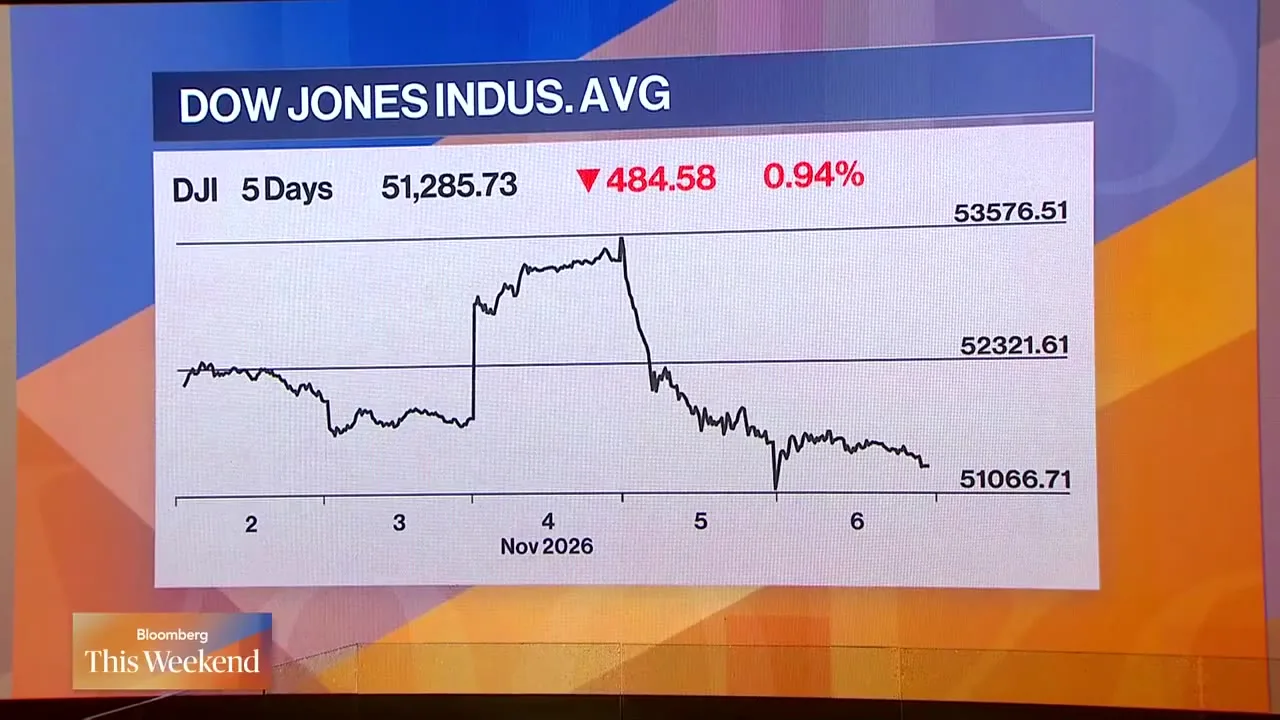
Asian investors expect artificial intelligence spending to continue, but uncertainty over US data centre approvals has sharpened concerns about when investments will generate cash, Bloomberg Television reported on Nov. 8.
The debate centres on how delays could change company valuations and leave some businesses struggling to refinance debt. Retail investors have continued buying while hedge funds have cut their holdings.
In the interview on “Asia Markets Brace for More AI Volatility,” hedge fund selling and retail buying formed the starting point for a discussion of investment risks.
Hedge funds suffered losses on Thursday and Friday and reduced their positions. Information from the businesses that serve hedge funds at Morgan Stanley, Goldman Sachs and JPMorgan showed withdrawals from the market, with hedge funds accounting for 30% to 40% of trading volume during their exit.
Retail investors bought into the selling. US exchange-traded funds designed to deliver three times an underlying market's daily move attracted large inflows on Thursday, and retail favourites rebounded on Friday.
Some of that recovery reflected the end of heavy selling. Hedge funds accounted for 30% to 40% of trading volume during their exit, but the subsequent US rally involved relatively few stocks.
Attention then turned to uncertainty over Democratic senators' plans and the approval process for US data centres. Investors in Asia have been examining which government bodies must approve projects and how many steps construction requires.
Democrats take power in the first week of January, leaving uncertainty about implementation before then. The discussion put hedge fund losses at 10% in October and another 10% in November's first week.
Retail investors' confidence in AI contrasted with those losses. Record exports from South Korea, Taiwan and China were cited alongside the money available to wealthy Asian investors who continued backing the technology.
The discussion then turned to whether restrictions would prevent large US technology companies from building data centres. Google, Microsoft and SpaceX were expected to proceed, potentially in Australia, Canada or Malaysia if necessary.
Google's commitment in Malaysia was put at $15 billion. The central concern was the schedule for investment, with confidence that spending would reach the region.
Delays could bear more heavily on newer cloud computing companies that need to refinance debt. An additional one or two years could create difficulties for those businesses.
For Asian AI suppliers, receiving cash after two years instead of one would change how investors value their shares. A longer schedule would also ease some supply shortages.
“What happens after 2028, 2029?” was the question posed in the interview. Expectations for strong business in 2027 left open whether companies could sustain the same pace of growth beyond it.