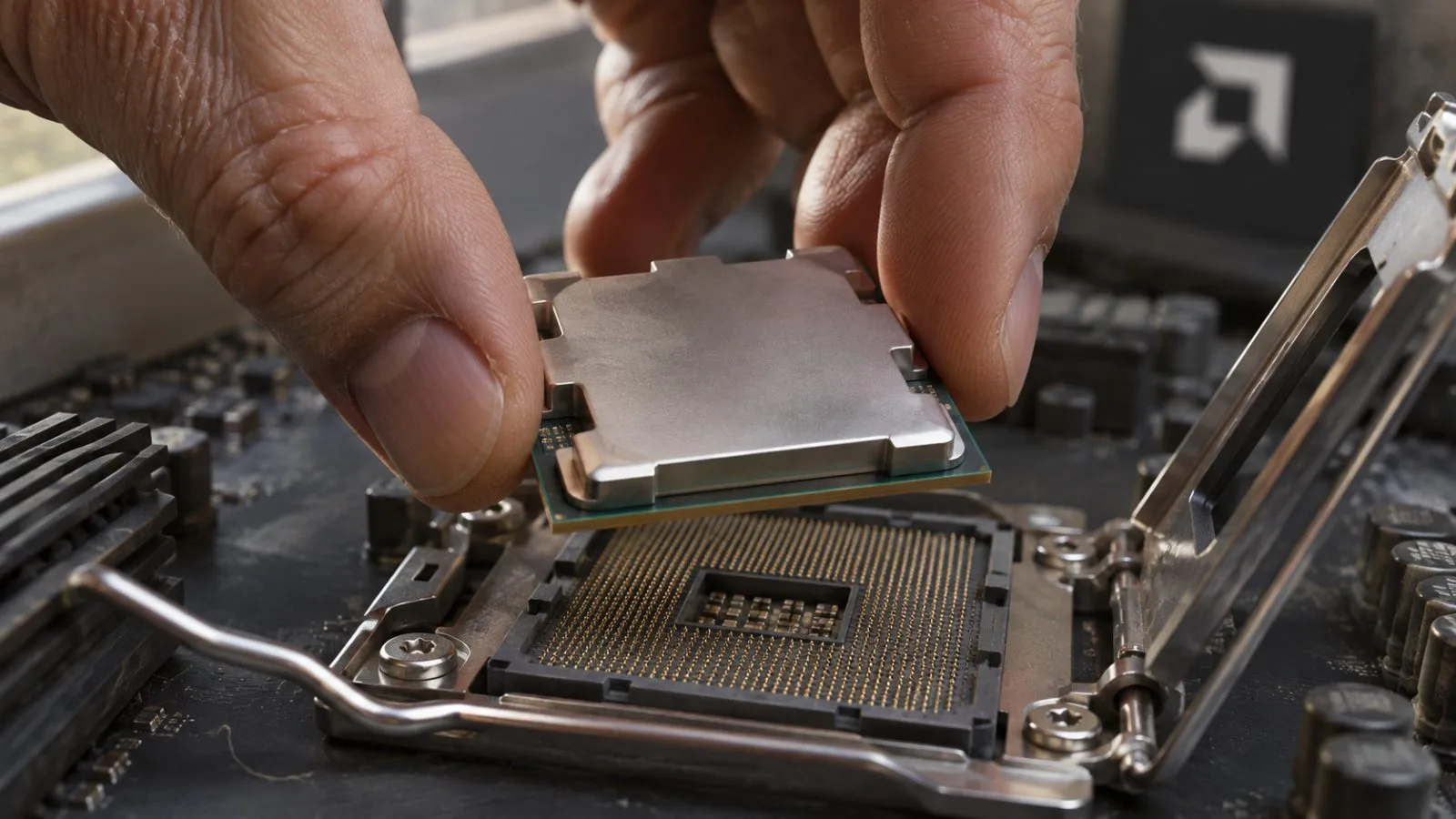
Advanced Micro Devices (AMD) said Tuesday its 6th Gen EPYC server processors are generally available, while cloud deployments remain at different stages and AMD says AI is expanding CPUs’ role alongside GPUs.
The Zen 6-based SP7 family reaches up to 256 cores and 512 threads per socket. AMD lists speeds of up to 5.3 GHz for 96-core configurations and memory bandwidth of up to 1.6 terabytes per second per socket with MRDIMM-12800 memory. As of Nov. 5, AMD listed the EPYC 9996 at $14,904 per processor for orders of 1,000 units. The listing covers the processor, not a complete server.
AMD argues that AI agents add CPU work alongside GPUs by requesting models, collecting data, running code and connecting with business systems. Microsoft’s Azure HDv2 virtual machines, built with 6th Gen EPYC, are in preview. Microsoft lists more than 500 physical cores and 3.8 terabytes of DDR5-8800 memory for the platform. Rafael Dietrich, OpenAI’s head of CPU and storage capacity planning, said more cores let researchers divide dataset preparation among parallel jobs when memory can support each task.
Oracle Cloud Infrastructure (OCI) says its upcoming Compute E7 instances will use the processors. The Microsoft and Oracle announcements do not specify general-availability dates for those cloud offerings.
AMD claims a two-socket EPYC 9996 system can deliver up to 3.7 times the performance of a system using Nvidia Vera and 2.2 times that of an Intel Xeon 6980P system. The comparison uses SPECrate 2017 integer-base results; AMD says the Vera score is an internal estimate and that results vary by system, software and BIOS configuration. The benchmark differs from a prior EconoTimes comparison of Nvidia Vera and EPYC 9755, which used a Python workload.
Tom’s Hardware reported a 93% gain for a dual-socket EPYC 9996 over a dual-socket EPYC 9965 in its SPEC CPU 2026 intrate throughput test. The outlet described the figures as unofficial because it had not submitted the estimates to SPEC; the test systems had 1,024 and 768 threads, respectively.