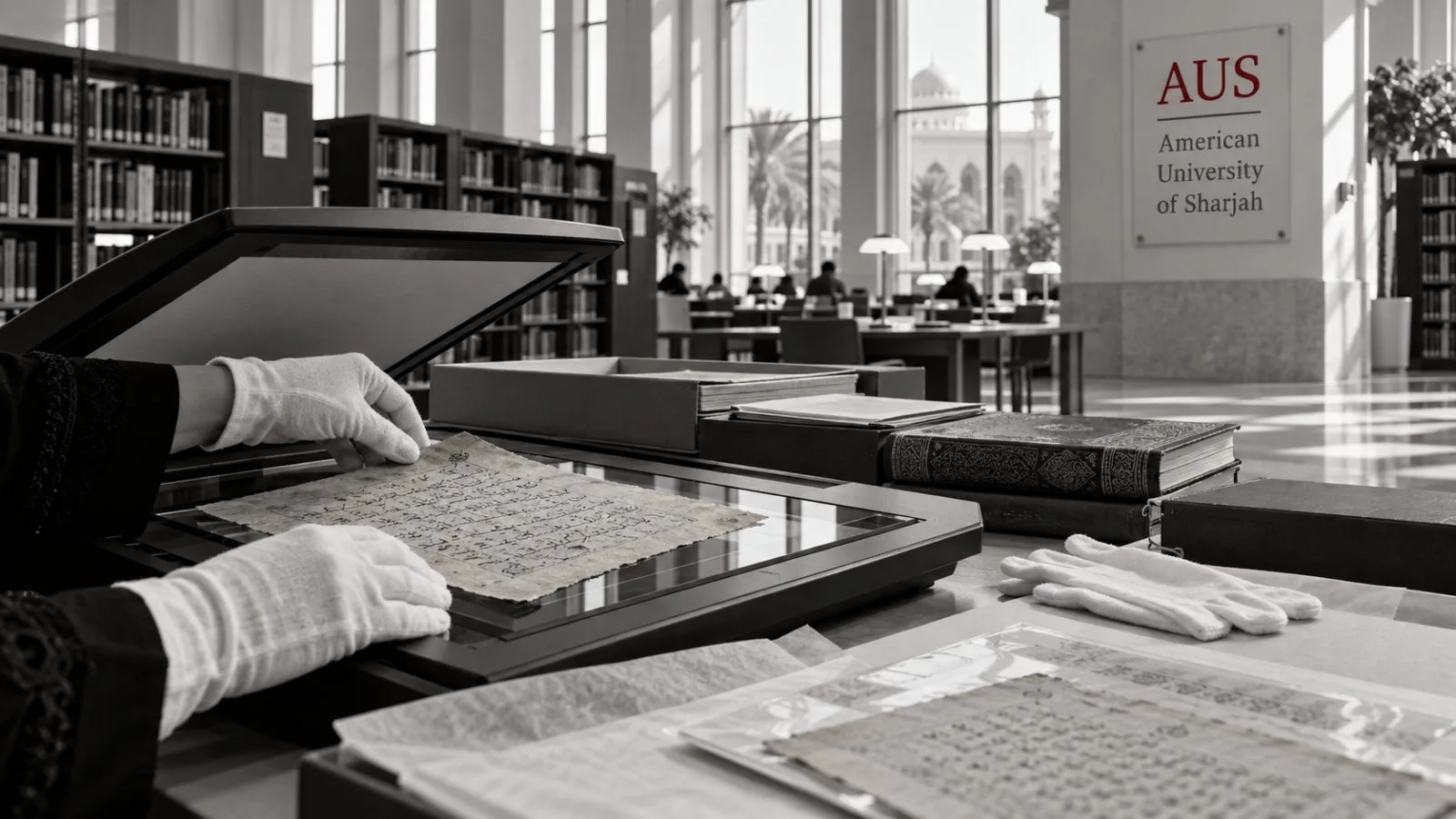
The American University of Sharjah said Oct. 19 it had agreed with the United Nations Educational, Scientific and Cultural Organization (UNESCO) to establish a chair aimed at preserving Arabic language and heritage through digital research.
The UNESCO Chair in Arabic Language, Artificial Intelligence and Digital Heritage appears in UNESCO’s register with 2026 as its establishment year.
The university plans to collect and digitize cultural materials, including records of endangered Arabic dialects. It says multilingual metadata will help organize the collections, while the research program will produce scholarly publications and open-access resources. Artificial intelligence (AI) and other digital tools will be used in the work.
University Chancellor Tod A. Laursen said the initiative addresses gaps left by archives that have not been digitized and dialects that have not been documented. The university says the planned resources are intended to widen access for communities and researchers.
Irakli Khodeli, chief of the Management of Social Transformations (MOST) and Foresight Section in UNESCO’s Sciences Sector, said more than 500 million people use Arabic each day. He said the language should benefit from advances in AI, especially large language models.
The chair will draw on the university’s Center for Arab Studies and Islamic Civilizations. It plans workshops and certification programs for media professionals, cultural practitioners and scholars beginning their careers. The university also plans open-access digital projects with institutions in Asia-Pacific, Africa and the Arab States, along with work involving UNESCO networks.