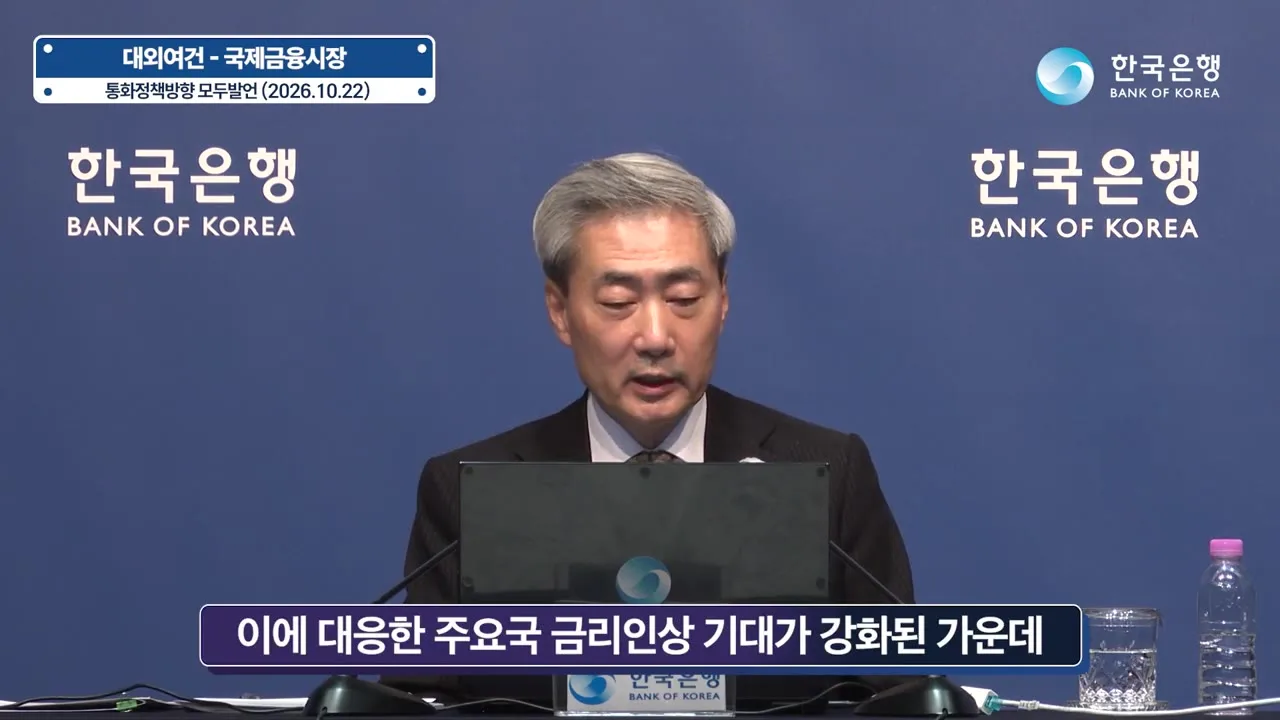
South Korea’s central bank held its benchmark interest rate at 3% on Oct. 22 while assessing earlier increases and uncertainty overseas, the Bank of Korea’s monetary policy board said.
The unanimous decision leaves further increases in view, with growth exceeding expectations and inflation expected to stay above target for some time. The board wants more data before deciding when and how quickly to raise rates again.
The central bank announced its decision in its Monetary Policy Decision opening remarks, published that day on its own channel. It expected global growth to continue despite widening Middle East tensions, supported by spending on artificial intelligence.
The bank projected U.S. growth above 2% this year, supported by investment in the technology and consumer spending. It expected euro-area growth of about 1%, with defence and technology infrastructure spending helping offset weak manufacturing.
Energy prices and disrupted supply chains were expected to keep inflation elevated abroad. Long-term government bond yields rose sharply as expectations of interest-rate increases strengthened, while the dollar gained and concerns about continued technology investment increased stock-market volatility.
At home, exports and investment drove stronger growth than expected. September exports exceeded $120 billion, a record, the central bank said. It expected full-year customs-cleared exports to exceed $1 trillion.
The bank also expected the current account surplus, a measure of trade and investment income with the world, to exceed its August forecast of $450 billion. Semiconductor-related investment continued to rise strongly.
Consumption temporarily slowed amid falling share prices and an automobile industry strike, but the bank judged that a gradual recovery continued. It expected growth this year and next to exceed its August forecasts by a wide margin.
September consumer prices rose 2.9% from a year earlier, while underlying inflation reached 2.8%, the central bank said. Short-term inflation expectations stayed in the upper 2% range.
The bank expected rising oil and semiconductor prices, alongside stronger demand, to keep inflation above target despite a stronger won. This year’s inflation was broadly in line with its August forecast, but next year’s was expected to exceed it.
The won strengthened despite the dollar’s rise, helped by the large current account surplus and a change in monetary policy. Domestic bond yields rose before partly retreating, while shares fell sharply amid concerns about semiconductor profitability.
Household lending declined as repayments of other loans outweighed new borrowing, but housing-related loans continued to increase. Home-price gains widened again in lower- and middle-priced parts of Seoul and some areas of Gyeonggi province.
The board cited uncertainty over the Middle East, foreign monetary and fiscal policies, and possible U.S. policy changes after the midterm elections. It also wanted to assess forthcoming output and October inflation data.
Two earlier rate increases were feeding through financial markets, but their effects on growth, prices and financial stability required further assessment. Rising global long-term yields and doubts about continued artificial intelligence investment also warranted monitoring.
“We need to continue responding until we are confident that inflation will settle at the target,” the board said in translated remarks. It left the timing and pace of further increases dependent on incoming data, without committing to a date.