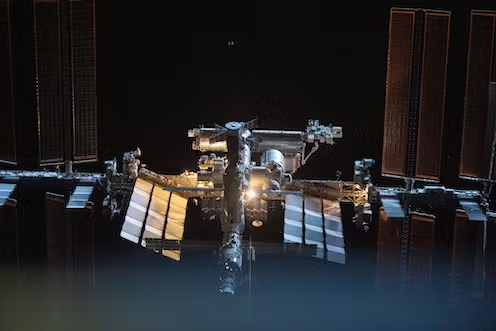
Commercial companies are increasingly becoming involved in transporting astronauts to the International Space Station (ISS), as well as other activities in orbit. Some, such as Houston-based Axiom Space, eventually want to build their own space stations in orbit, where commercial astronauts could make extended stays.
This could also provide more money and opportunities for science to be carried out in low Earth orbit. But it also raises a host of safety concerns, because it will add to the already troublesome issue of space junk. There are also implications for the environment, because rockets produce greenhouse gas emissions that contribute to climate change.
Axiom, which was founded in 2016, was the first company to conduct privately funded missions to the ISS. Under Axiom’s Space Access Program, it has been offering different countries the opportunity to design customised missions to orbit aboard SpaceX’s Crew Dragon spacecraft. As such, it recently signed an agreement with the UK Space Agency for an all-UK astronaut mission to the ISS.
Nasa is increasingly partnering with private companies to accomplish its space missions. However, initiatives such as the one with Axiom to fly multiple tourist missions to the ISS mark a new kind of commercialisation of space.
Axiom’s planned commercial space station will first be built as an add-on to the ISS. It will then be detached so that it becomes independent. Space tourism is a key part of its business model.
Axiom is not alone in its aims. Jeff Bezos’ Blue Origin, aerospace giant Northop Grumman, and smaller companies such as Nanoracks and Sierra Space are all developing their own space station designs. These are aimed at operating in low Earth orbit within the next decade.
Blue Origin, Northrop Grumman and Nanoracks have been awarded US$415 million (£335 million) by Nasa under the agency’s Low Earth Economy strategy to develop their space station concepts. In effect, the Nasa strategy uses public money to enable private companies to bring in commercial money. This private investment then helps provide the infrastructure needed for science and operations in low Earth orbit.
The scientific case for putting humans in space has historically been very weak – though not non-existent. Modern robotics and remote-control systems are now so good that the case is even weaker today than it ever was.
To most scientists, human space missions are vanity projects to do with national prestige. However, most will concede that there are huge benefits in terms of public engagement and inspiration. If they were fully costed, though, it’s unlikely that some experiments would be funded by the peer review panels of the science funding agencies.
Space junk concerns
There are also major concerns about risks posed by the increase in the general number of space missions, particularly because space junk is already a major problem in low Earth orbit. In 1978, Nasa scientist Donald J Kessler described the “Kessler syndrome” – a potential runaway effect where a collision in space could spark many more debris impacts, leading to the destruction of multiple spacecraft, or even the majority of low Earth orbit spacecraft.
Since 1999, the ISS has had to manoeuvre to avoid large pieces of space junk 32 times. Recently, the risk has been raised by a huge increase in the number of craft in low Earth orbit. In particular, since 2019, SpaceX and its competitors, such as OneWeb and Amazon Kuiper have embarked on programmes of launching tens of thousands of satellites into low Earth orbit to provide internet access.

A representation of space debris around Earth. NASA ODPO
However, less than 0.5% of internet traffic is currently carried by satellite communications. Despite the potential benefits to unconnected people in rural areas, upfront and subscription costs mean that Starlink’s current subscribers, make up less than 0.02% of the global population. They include many cruise ships, private jets and luxury yachts.
Environmental concerns
The other area of great concern is the environmental effect of sending more people to space. It would increase the climate impacts of space activities by an order of magnitude. This would exacerbate the problems society is already experiencing.
At present, the richest 1% of humans are emitting about 100 times more CO₂ than the poorest 10%. Internationally, policymakers are increasingly aware of the way that certain populations around the world may be affected more harshly by climate change than others. They are also aware of the pressures and instability generated by mass migration caused by climate change. Space tourism adds to this inequality.
There are other serious environmental concerns. Launches, particularly with solid rocket boosters, cause stratospheric ozone depletion. There are also worrying levels of atmospheric pollution by metals caused by so many launches and so much, re-entering debris.
This is an area that is moving forward with astounding speed. At first sight, it seems that we can harness the excitement and wonder of space travel to fund new opportunities for science and develop technology that’s of great benefit to humankind.
However, it would be wise to take the time to think through the potential consequences carefully. The human, or crewed, element means that the financial model of commercial human spaceflight is vulnerable to just a single failure, as the recent Titan submersible implosion proved.
Even more importantly, activities in low Earth orbit are a hugely valuable, yet vulnerable resource. They provide us with environmental and disaster monitoring systems, weather and climate monitoring, vegetation and crop growth measurements, geolocation and navigation (such as GPS) as well as communications.
Despite my previous comments about their main rationale not being scientific, space stations such as the ISS have provided some unique opportunities for working in zero gravity. There have been some remarkable impacts in, for example, medical and materials research.
We must not destroy the vital resource of low Earth orbit with space junk. And we cannot just ignore the implications for the climate and environmental justice.