

A player drives to the basket. As the defense collapses, he passes the ball to his teammate, anchored at the corner, for the open three-point shot.
This corner shot is one of the most efficient shots in basketball, as measured through the expected points per shot. It’s second only to shots at the rim, followed by three-point shots above the break – that is, the location on the court where the three-point line changes from arc to a straight line.
Thanks to data like this, teams now distribute their shots in a different way than they did a decade ago. Three-point shots and shots around the rim are on the rise, while midrange attempts are declining. The media refers to this shift as “Moreyball” after Daryl Morey, the Rockets’ general manager, who has been recognized as the pioneer for this trend.

A typical ‘drive and kick’ corner three-point shot. Konstantinos Pelechrinis, CC-BY-ND
Looking beyond shot distance
Why are corner three-point shots more efficient compared to the ones above the break? A common misconception among fans, media and even analysts is that this is solely due to the shorter distance from the basket. While distance certainly plays a role, it cannot explain the degree of discrepancy in the data.
To understand better what is going on, I looked at a detailed data set of shots from the 2013-14 and 2014-15 NBA seasons. I estimated, through a simple logistic regression model, the expected difference in the field goal percentage – that is, the success rate – for corner and above-the-break three-point shots, based on their average distance from the basket.
While the model expects a slight difference of about 1.5 percent, it is not as high as the 4 percent I saw in the data.
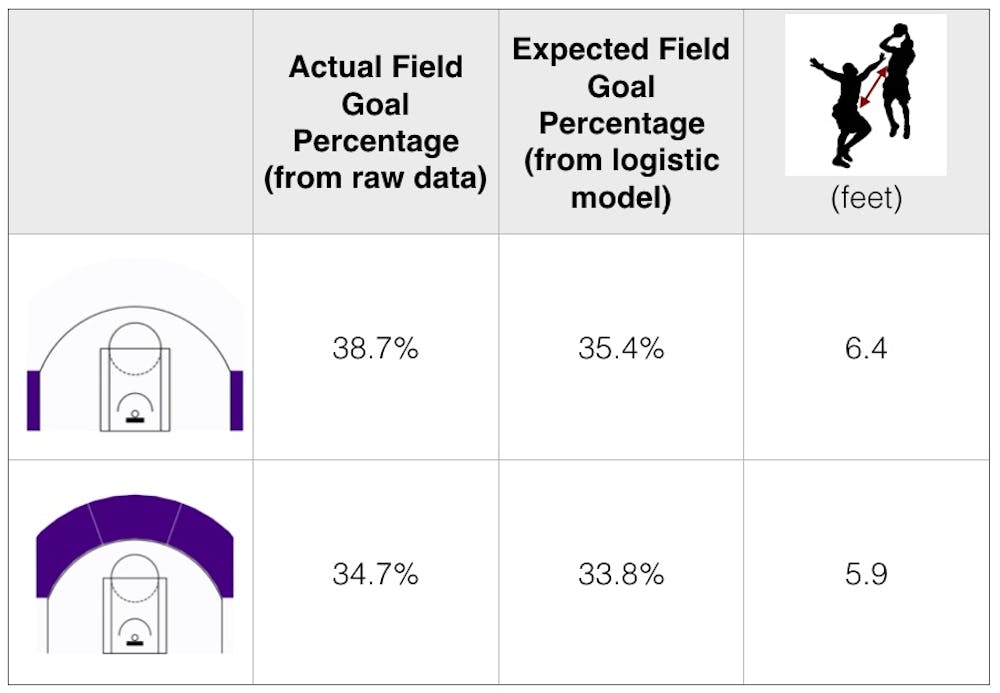
Corner threes are more open compared to above-the-break threes. Konstantinos Pelechrinis
So what is going on? Of course, models are simplifications of reality. But there is another important difference between the two types of three-point shots: the distance to the closest defender. Corner three-pointers are on average more open as compared to above-the-break three-pointers, making them higher-quality shots.
Why though? Because of assists. Assisted shots are, on average, more open compared to unassisted shots. More than 90 percent of corner three-point shots are assisted, while shots above the break are assisted at a rate just above 70 percent. Midrange shots are assisted at an even lower rate, not helping their case for efficiency.
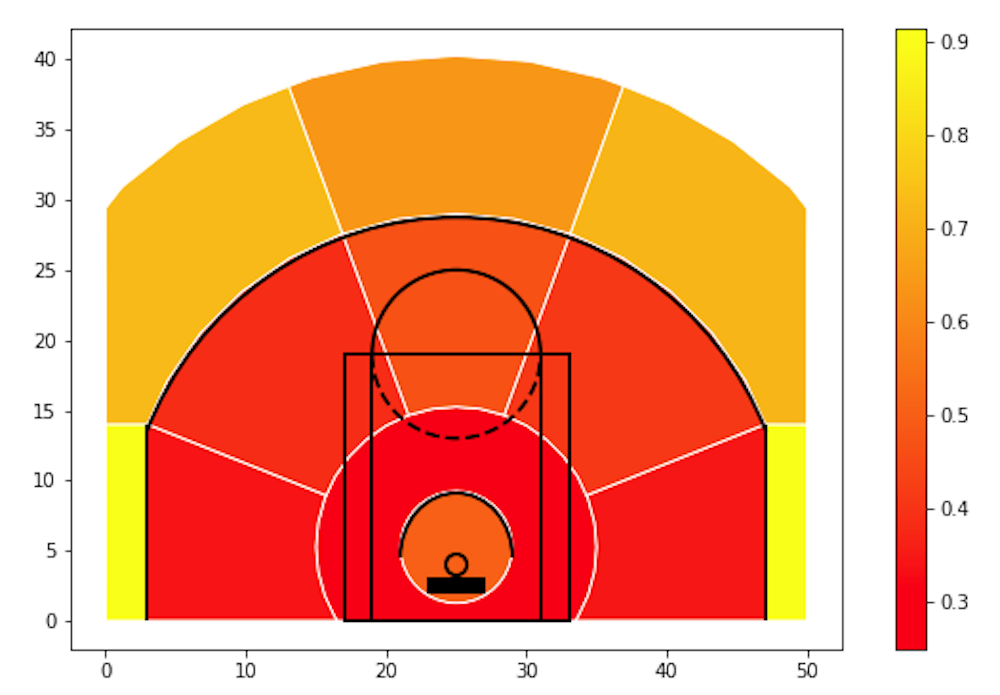
Percentage of assisted shots from the different court zones. Konstantinos Pelechrinis
Previously, in what resembles a natural experiment, I performed the same analysis on an International Basketball Federation competition, where the distance to the basket is almost the same over the whole three-point range. The same pattern emerged. Corner three-point shots were more efficient – and were assisted at a much higher rate.
Using these results, one can start estimating the expected contribution of an assist to a shot. For example, an assist to a left corner three-point shot increases the league-average field goal percentage to 38.7 percent from the 34.9 percent for an unassisted shot from the same zone. This corresponds to +0.114 expected points per left corner three-point shot, when assisted.
During the seasons covered in the data set I used, the teams took on average approximately 82 shots per game, half of which were assisted. On average, an assisted shot added 0.16 expected points more compared to an unassisted shot. If teams looked for the extra pass on 15 of their unassisted shots, this corresponds to approximately 2.4 additional expected points over the course of the game, enough to neutralize the home field advantage in the NBA.
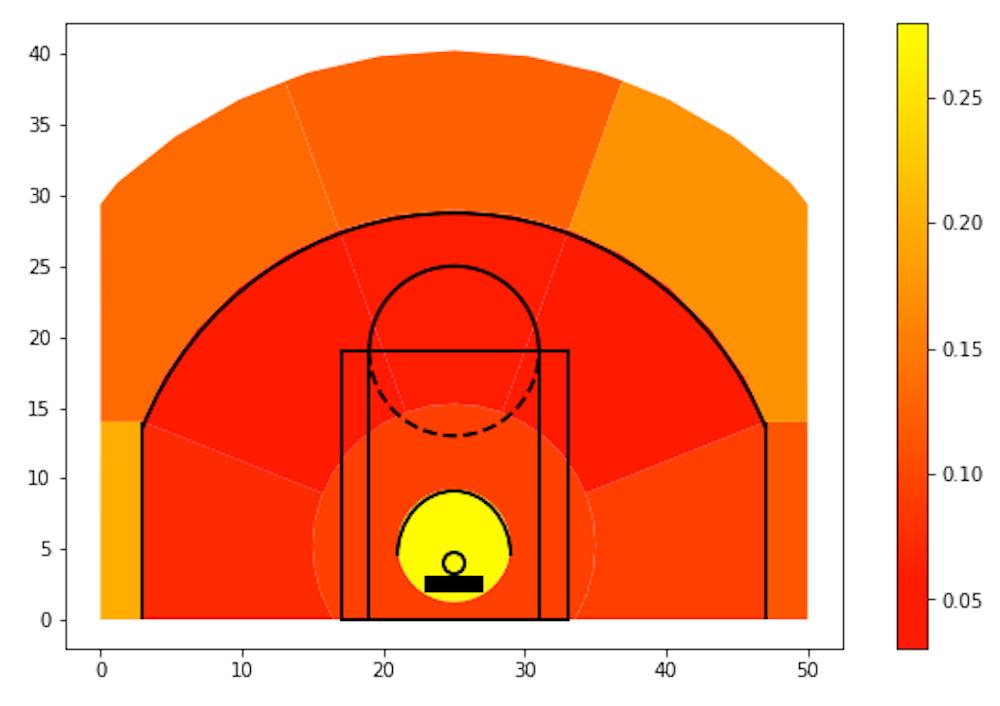
Expected points added per assisted shot for different court zones. Konstantinos Pelechrinis
Assisting STEM education
A large part of my sports research revolves around analyzing spatio-temporal data. The availability of such detailed data is, quite literally, changing the game. While simple statistics can provide valuable insights, more complex models now drive applications that sports practitioners and researchers could not even think of 10 years ago.
For instance, my colleagues and I have developed Deep Hoops, a system that is able to evaluate micro-actions – such as screens and off-ball cuts – to holistically evaluate a player’s contributions to winning. Other researchers have developed systems that allow a coach to anticipate the reaction of a defense to a specific offensive scheme.
Most importantly, though, I believe that sports offer a great vehicle through which educators can provide data literacy to younger generations. In my personal teaching experience, students associate better and engage more with technically challenging concepts when they are introduced through sports, as compared to abstract settings. This is particularly crucial for introductory courses, which are very important for attracting students to a major.

