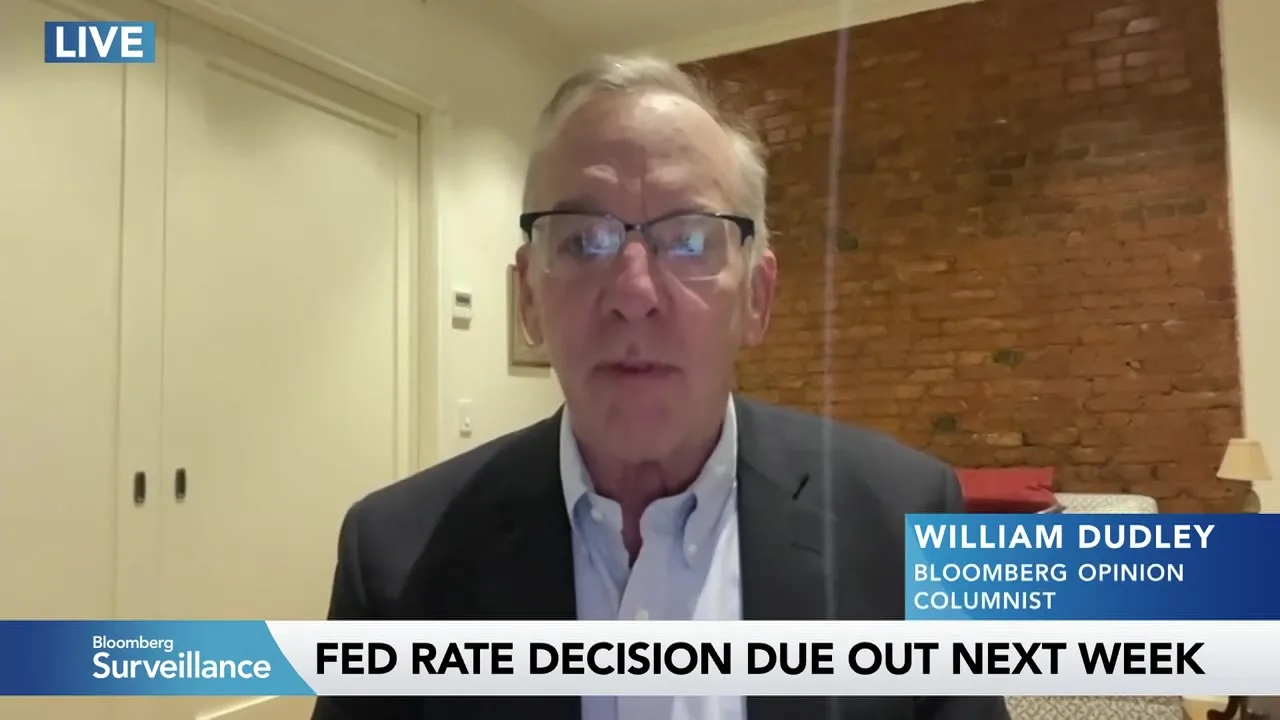
The Federal Reserve will likely hold interest rates steady in October before raising them in December if economic conditions stay on course, former New York Fed President Bill Dudley said.
A pause would leave further increases on the table. Dudley cited the central bank's economic projections, which he described as showing a consensus for one more increase this year, more likely in December than October.
Dudley appeared on Bloomberg Television's “Dudley Sees Fed Likely to Hold With a Hike Coming in December,” published Oct. 23. He linked his expectation for a hold to signals from the Fed's leadership and investors' expectations.
He suggested that Williams and Jefferson would at least have secured the chair's blessing before making their remarks. He described coordination among the chair and those two policymakers as an arrangement dating back to Ben Bernanke, about 20 years ago.
A surprise increase at the coming meeting would call that arrangement into question. The chair's comments in Bangkok, describing developments as consistent with expectations, also pointed indirectly toward a hold.
Dudley questioned whether the chair could avoid explaining his thinking while relying on markets to signal the appropriate policy decision. Other Fed policymakers would fill that gap, drawing investors' attention to their own remarks.
He distinguished explaining policy from promising a particular decision. The Fed should explain what matters to its decisions and how it sees the economy developing without committing to a future course.
An October increase would surprise investors and add to confusion about policy. Dudley described market pricing as anticipating two or three further increases over six to 12 months, followed by an extended period of higher rates.
He expected the chair could justify a hold by describing the energy shock as temporary and pointing to an absence of wage pressure. He also expected limited explanation at the press conference.
Dudley rejected the suggestion that a hold would necessarily appear politically motivated. Investors had expected an increase at the previous meeting, putting more pressure on the chair to act then than now.
He questioned how the chair expected to lower inflation without hurting employment. In Dudley's view, excessive demand for resources pushes prices up, requiring higher interest rates to reduce that demand.
He also rejected the suggestion that holding rates would mean the Fed was unwilling to disrupt investment linked to artificial intelligence. “I think it just means it's a pause,” Dudley said.
His December expectation remained conditional on the economy following the same course. A larger energy price shock and an Iran war that appeared harder to resolve kept pressure on the Fed to raise rates further, without settling the next decision.