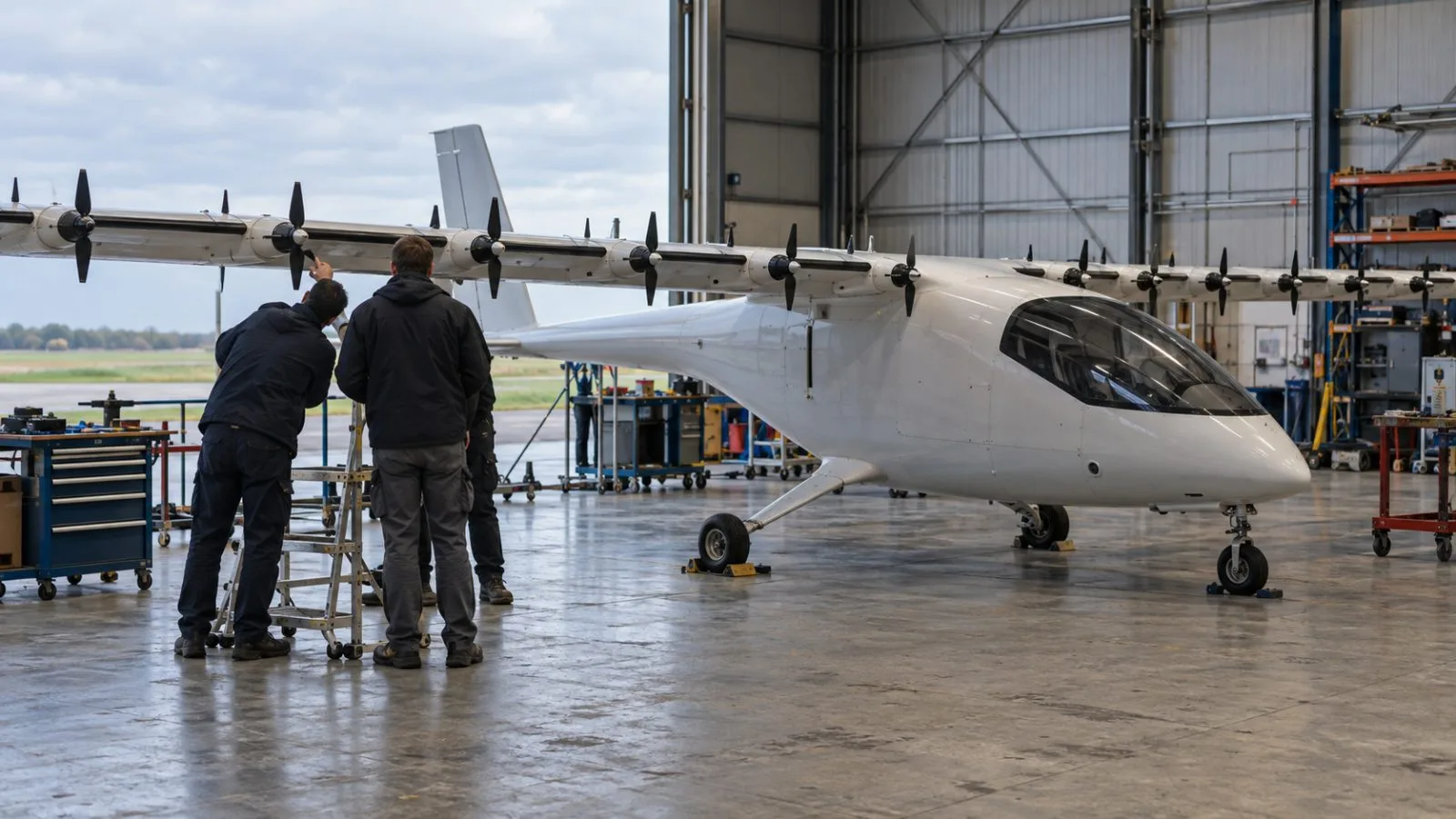
Elysian Aircraft has advanced its E9X electric airliner to preliminary design, while battery research and Dutch grid analysis underline the technical and infrastructure conditions for its development and potential operation.
On April 10, 2026, Elysian said it had completed the conceptual design review and was moving into preliminary design. The company also reported the first test flight of a scaled demonstrator, which it said was intended to assess handling and distributed-propulsion controls. That test did not demonstrate the full-size aircraft’s planned capacity or range.
Elysian lists the E9X for 88 to 100 passengers and a range of 750 kilometers or more. It says battery improvements could eventually make a 1,000-kilometer range possible.
A wing-battery study by the German Aerospace Center (DLR) used pack-level energy-density assumptions of 360 watt-hours per kilogram in the near term and up to 440 Wh/kg over a longer period. For a 90-passenger aircraft, the study projected ranges of 800 kilometers and 1,000 kilometers, respectively, excluding reserves. DLR describes the work as fundamental research at a low technology-readiness level and said aircraft subsystem details were not yet known.
CE Delft’s 2025 report compared climate impact per passenger-kilometer for aviation options in 2035. Its modeling placed the E9X lowest among the options studied, with electricity generation for charging as the largest contributor to the aircraft’s modeled impact. The report said added national grid capacity for Dutch electric aviation was expected to be manageable overall, though local upgrades could be difficult by 2035 amid capacity constraints.
In June 2025, Elysian, KLM and Transavia said they would hold workshops on the aircraft’s technical, operational and commercial requirements. Transavia identified short-haul, high-frequency routes with too little passenger demand for larger aircraft as a possible market. Elysian’s April 2026 announcement gave no commercial-entry date.