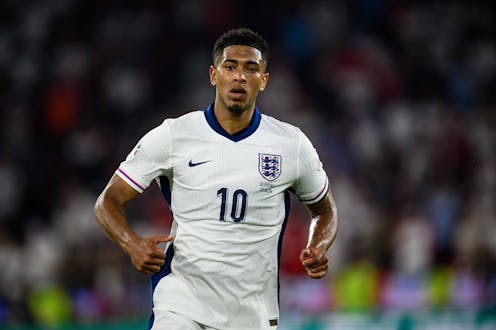
Before the start of Euro 2024, England’s football squad was widely considered one of the favourites to win the tournament. Manager Gareth Southgate had a wealth of talent at his disposal with some of Europe’s finest players travelling to Germany.
They included the likes of Jude Bellingham, who has quickly become one of Real Madrid’s most influential players. Then there was Phil Foden, the Premier League’s player of the season. Striker Harry Kane had been scoring at will for Bayern Munich.
So the squad has a lot of top footballers from some of the world’s best and richest clubs. But many of these players honed their skills in less glamorous surroundings, further down the tiered English system known as the football pyramid.
And the England side is indebted to that pyramid. Before they landed their current positions in Europe’s elite top teams, 16 players out of the 26-strong England squad spent time playing and developing in the lower leagues.
Bellingham was a youth player at Birmingham City (now League One), with the club retiring his number 22 shirt to inspire future generations of academy players. Harry Kane once spent loan spells at Leyton Orient, Millwall and Norwich City.
England’s first-choice goalkeeper Jordan Pickford has also travelled, on loan, at teams including Sunderland, Carlisle United and Preston North End, as well as non-league clubs Darlington and Alfreton Town.
Others who have spent time further down the pyramid include John Stones (Barnsley), Mark Guehi (Swansea City), Kieran Trippier (Barnsley, Burnley), Kyle Walker (Northampton, QPR), Anthony Gordon (Preston) Ollie Watkins (Exeter City) and Ivan Toney (Barnsley, Shrewsbury, Scunthorpe, Wigan, Peterborough).
These teams have been a common part of the careers of today’s stars, giving them a chance to experience competitive games away from the harsh spotlight of the Premier League.
Yet far from being valued as a vital part of English players’ development, many clubs from the lower divisions face huge financial struggles.
One recent report shows that the English Premier League shared revenues of more than £6 billion in the 2022-2023 season, way more than the sums available to the lower leagues. Collective revenue in the Championship (England’s second tier) across all 24 clubs was £749 million, League One (third tier) was £236 million, and League Two (fourth tier) just £131 million.
The English Premier League and the English Football League (which represents the three divisions below) are currently in a standoff regarding how to share the money the Premier League earns from television. At the moment, around 15% of it is shared with the lower leagues, although a lot of this is used for the “parachute payments” handed to the three clubs relegated to the Championship from the top tier each season.
A sporting chance
Over the past 20 years, revenue gaps between the Premier League and those below it have been growing significantly. Research also shows that many lower league clubs are living on the edge of insolvency and more than half are technically insolvent. Some take financial risks to gain promotion and higher revenues.
A reason for this may be the fractured governance of English football, with multiple organisations running the sport. The FA manages the England team and grass-roots football, but has little to do with the operators of the various leagues.
That may be about to change. Before the 2024 general election, all the major political parties made manifesto commitments to introduce an independent football regulator with the intention of improving the finances of clubs in the top five leagues.
One possible outcome of regulatory intervention could be the harmonising of current governing powers, helping them to work more closely together. This could potentially help England squads by providing more support to lower league clubs and strengthening the development of future stars.
But there is no sign of a government intervention when it comes to financial distribution between the leagues.
And for future England teams to be successful, the pipeline of talent must keep coming, unhindered by a financially distressed and fractured system. If a forthcoming regulator were to impose a greater volume of revenue sharing, a side effect could be a stronger England team in tournaments to come – and who knows, one day, maybe even a trophy.