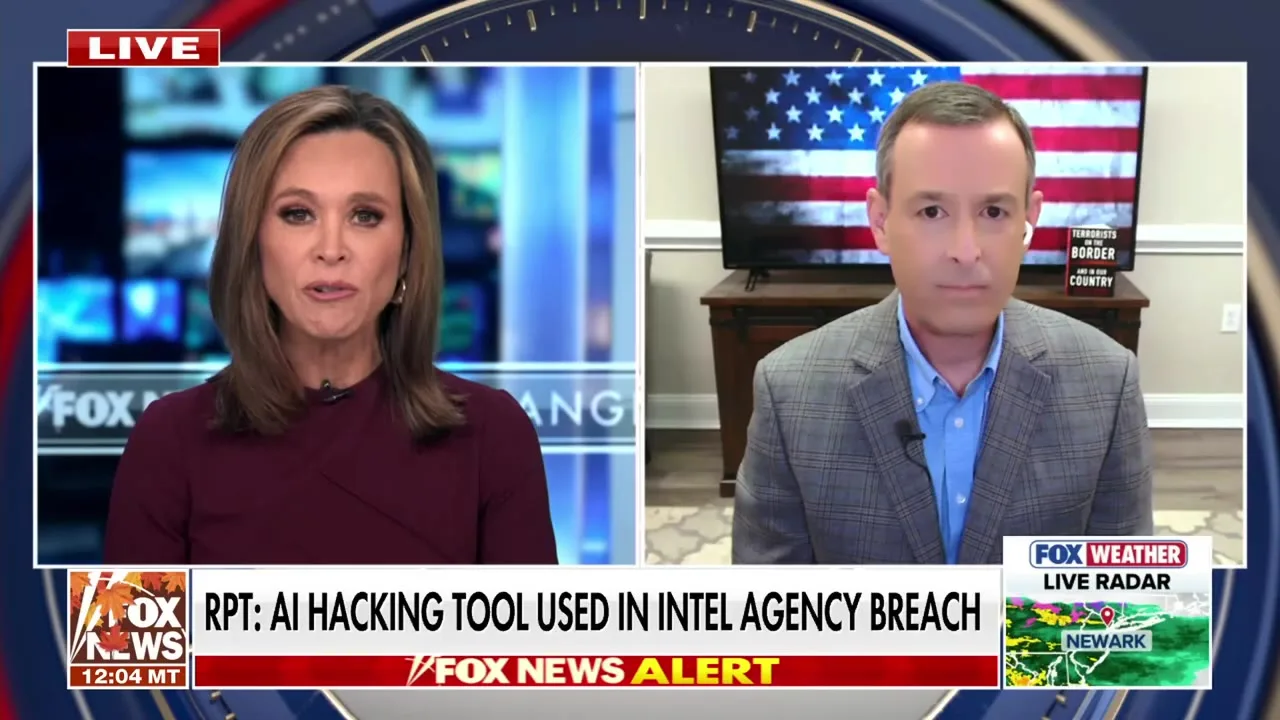
The United States needs to resolve cybersecurity and policy gaps faster as artificial intelligence threats evolve, former Department of Homeland Security adviser Charles Marino said. He spoke in a Fox News Live interview published by Fox Business on Nov. 27.
Marino said recent cyber breaches had raised questions about whether government, private-sector and critical infrastructure systems could withstand such attacks. He also questioned whether U.S. laws and penalties were keeping pace.
The interview followed a New York Times report that hackers used an artificial intelligence tool released by a Chinese engineer to breach unclassified information at U.S. intelligence agencies. No classified information was exposed, officials said.
Marino said the United States had often responded to national security threats after they emerged, citing the laws, policies and agencies created following the Sept. 11 attacks.
Congress must consider whether laws and penalties address threats involving artificial intelligence and hostile countries, he said. The United States also has yet to make clear what kinds of cyberattacks could constitute an act of war, Marino said.
He cited potential attacks on critical infrastructure, the Defense Department and the Federal Bureau of Investigation as examples. He did not say what legal changes or penalties Congress should adopt.
Marino said individuals also needed to prepare for disruptions to services such as energy and water. He said households should be able to manage for one or two weeks during an outage.
In a clip played during the interview, Microsoft co-founder Bill Gates said hospitals, electricity networks and banks depended on complex software that artificial intelligence models could exploit. He said such attacks could shut down or scramble those systems.
Gates said cyberattacks would increase in the coming years and that monitoring could be disabled. The clip did not specify when or where he made the remarks.
Marino said some organisations would respond by keeping sensitive computing systems and data centres disconnected from the internet. He compared such systems to a home emergency generator that could take over when needed.
He did not identify organisations planning such changes or give a timetable for them.