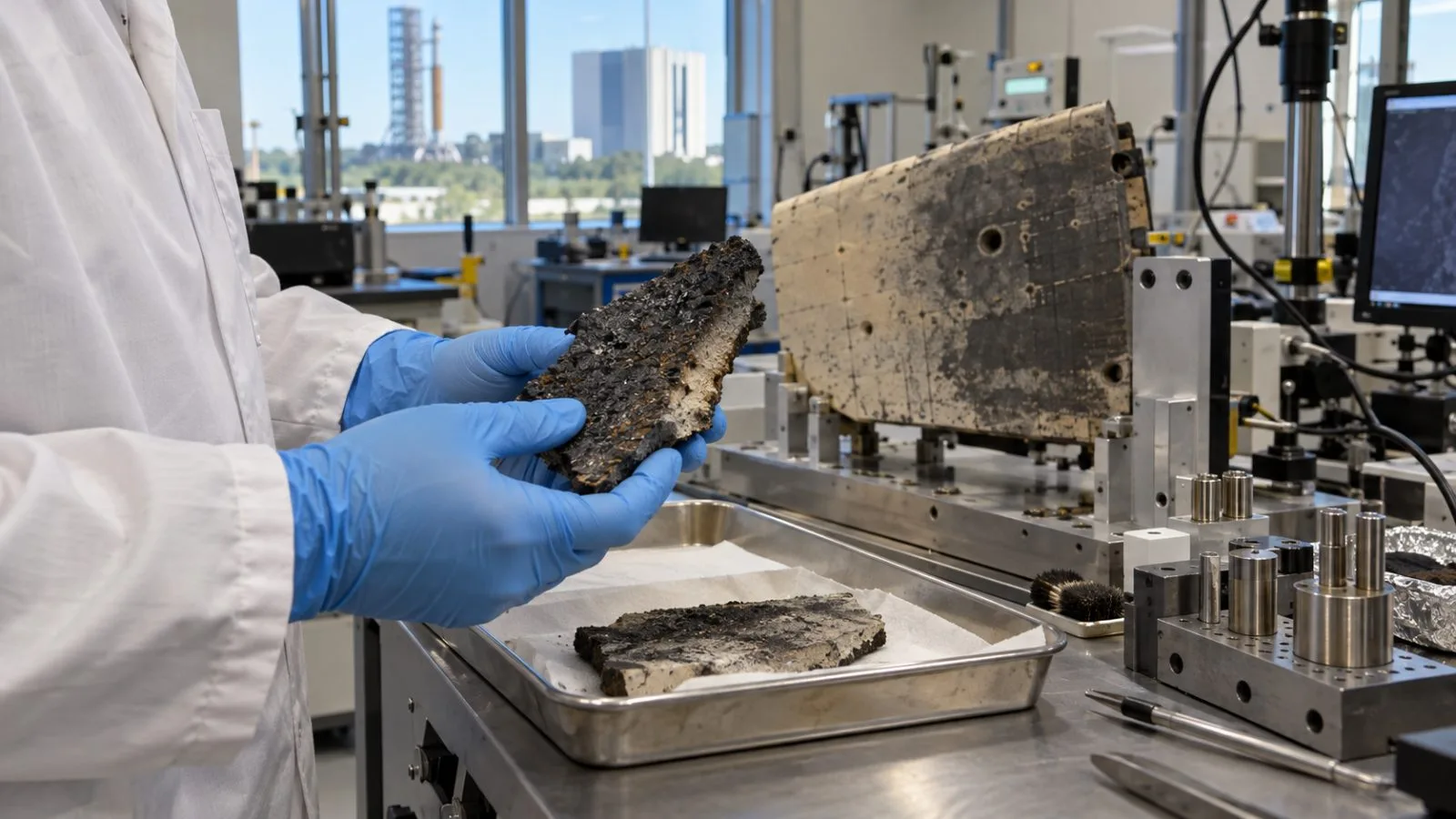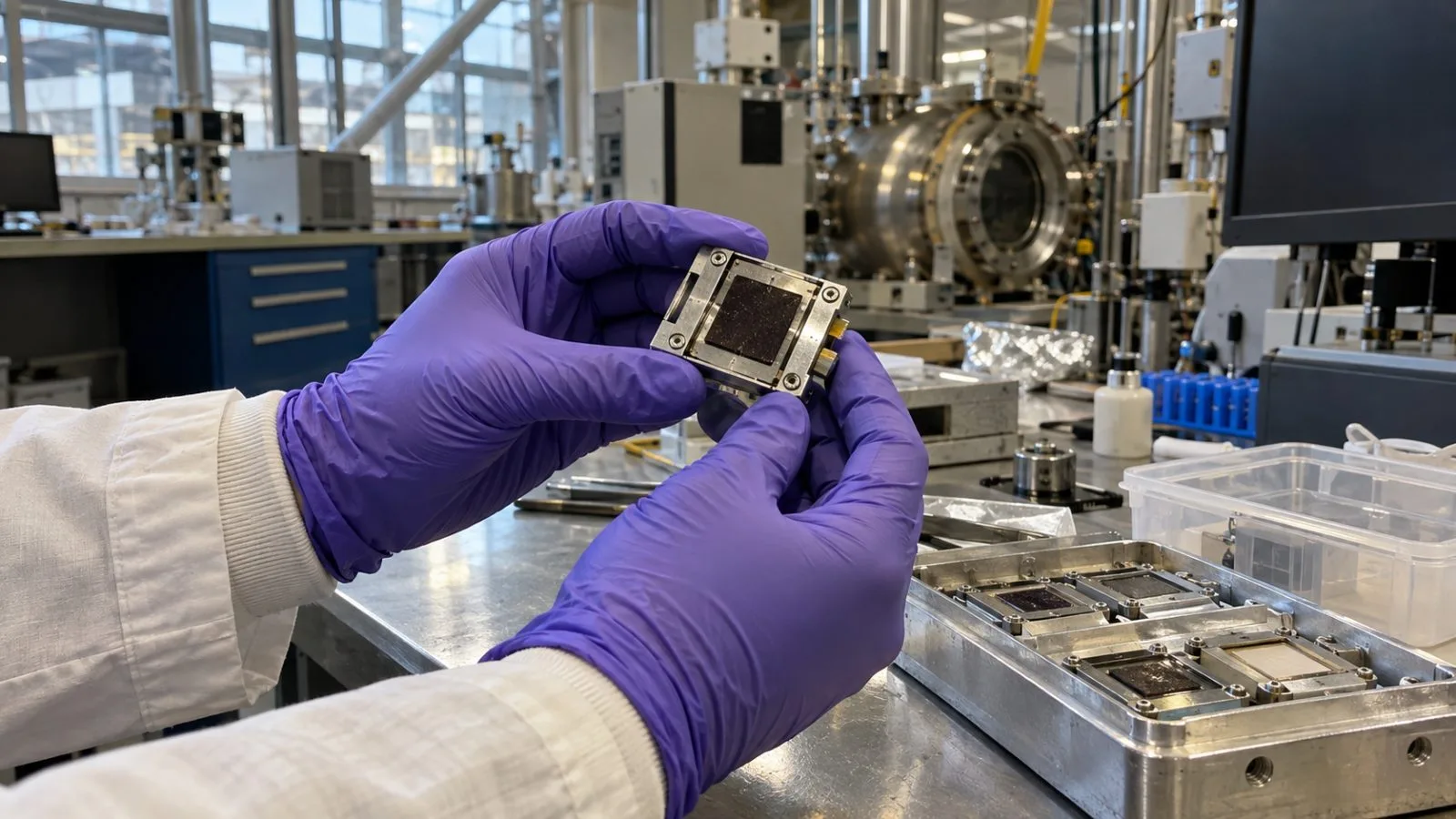
Fungal-melanin polylactic acid lost 88.6% less mass than plain plastic in one International Space Station test orientation, though the result offers only an early measure of the material’s durability for space use.
Published May 6, 2025, in Proceedings of the National Academy of Sciences, the study examined polylactic acid (PLA), a biodegradable polymer derived from renewable feedstocks such as corn starch. Researchers mounted samples on an external platform at the station. They were exposed for 166 days in a zenith-facing position and 161 days facing the station’s wake, then returned to Earth on Jan. 13, 2021.
Plain PLA lost 0.132% of its mass in both positions. The fungal-melanin composite lost 0.015% in the zenith-facing test and 0.060% in the wake-facing test. Compared with plain PLA, those amounts represent reductions of 88.6% and 54.5%, respectively. NASA’s International Space Station Annual Highlights of Results: 2025 rounded the zenith result to about 89% less mass loss.
The study’s statistical tests compared samples flown in space with Earth controls. In the zenith-facing test, that comparison for the fungal composite was not statistically significant (P = 0.124); the value does not test the 88.6% difference between the composite and plain PLA. The flight-versus-control result for the wake-facing fungal composite was statistically significant (P < 0.0001).
The researchers also tested ultraviolet shielding. Their melanin-containing composites blocked UV-A and UV-C light, while plain PLA provided little protection against UV-A. The study describes the zenith-facing position as receiving more direct sunlight and ultraviolet exposure than the side facing the station’s wake. A polyvinyl chloride backing layer helped the team assess radiation-related darkening.
The authors suggested that radiation-related heating effects and vacuum outgassing contributed more to mass loss than atomic-oxygen erosion in these tests. They said further controlled work is needed to distinguish those effects. The tests involved small samples over several months, so the findings do not establish how full-scale components would perform.
NASA’s report names spacecraft structures, habitats and supplies as possible applications. The study’s authors called for longer exposures and more work on melanin concentration, sample thickness and retained structural strength before judging whether the material could bear loads. “Still in their infancy,” co-author Kim de Groh, who is affiliated with NASA Glenn Research Center, said of space testing for bio-composites in a NASA interview.
The paper disclosed that co-authors Radames J.B. Cordero and Arturo Casadevall co-founded MelaTech, a company focused on fungal melanin, and that Johns Hopkins University had applied for a patent on the composite.