


 Gold Prices Slide as Rate Cut Prospects Diminish; Copper Gains on China Stimulus Hopes
  UBS Projects Mixed Market Outlook for 2025 Amid Trump Policy Uncertainty
  Gold vs Bitcoin: Investors Eye Inflation Hedge as Crypto Adoption Grows
  U.S. Banks Report Strong Q4 Profits Amid Investment Banking Surge
  Most Americans Oppose Election Betting on Prediction Markets, Poll Finds
  Ripple Mints 19.6 Million RLUSD Amid Banking Expansion
  Energy Sector Outlook 2025: AI's Role and Market Dynamics
  UNCX Network Hack Drains $86K From Ethereum Token Pool
  Binance to Shut Down Crypto Mining Pool Services on November 10
  Morgan Stanley Predicts $10 Trillion RWA Market by 2030
  Bitcoin Price Drops as US Dollar Hits 18-Month High
  UBS Predicts Potential Fed Rate Cut Amid Strong US Economic Data
  U.S. Stocks vs. Bonds: Are Diverging Valuations Signaling a Shift?
  Cardano Hits Five-Year Transaction Record as ADA Price Falls
  Ethereum Whale Moves $15.95M ETH to Kraken After Nine Years
  S&P 500 Relies on Tech for Growth in Q4 2024, Says Barclays


 Add as a preferred source on Google
Macro outlook: In japan, Business sentiment improved from the end of last year, but remains cautious.
The PMI rose in March as services strengthened and manufacturing declined.
Wage inflation remained anemic in February.
Inflation expectations have been flat since the BoJ introduced its inflation overshoot commitment.
JPY has broadly appreciated against the major currencies.
As a result, JPY has reached the highest levels since last November both against NZD (refer above technical chart) and also on trade-weighted terms.
In NZ, Strong inbound migration to nudge Kiwi retail card sales higher
In the NZIER’s quarterly survey of business opinions, stronger pricing-related measures somewhat offset a general softening in confidence and expected activity indicators in 1Q.
NZIER reports confidence pulling back in the retail and manufacturing sectors in particular, while businesses in Auckland appear to be feeling the localized spillovers from prudential tightening that have slowed the housing market and taken some heat out of the consumer.
In the last six months, the confidence index in Auckland has dropped from 31 to 6. The headline confidence index fell from 28 in 4Q to 17 (net % positive), and by a little less in seasonally adjusted terms.
Indices of trading activity last quarter and in the quarter ahead faded 5-6pts, but both were steady in sa terms. These measures appear to have lost some of their predictive power over GDP in recent years and have consistently overshot actual performance.
China reported trade surplus a USD 23.9 billion in March of 2017, compared to a USD 25.2 billion surplus a year earlier and above market expectations of a USD 10 billion surplus. Exports surged by 16.4 pct YoY, following a 1.3 pct drop in February while markets anticipated a 3.2 pct growth. Imports rose 20.3 pct, after jumping 38.1 pct in the prior month and above consensus of an 18 pct rise.
China has been the major trade partner of New Zealand. As the kiwis' trade exposure towards China is considerable, we cannot afford to disregard ongoing upswings in underlying spot FX.
OTC Outlook and Options Strategy:
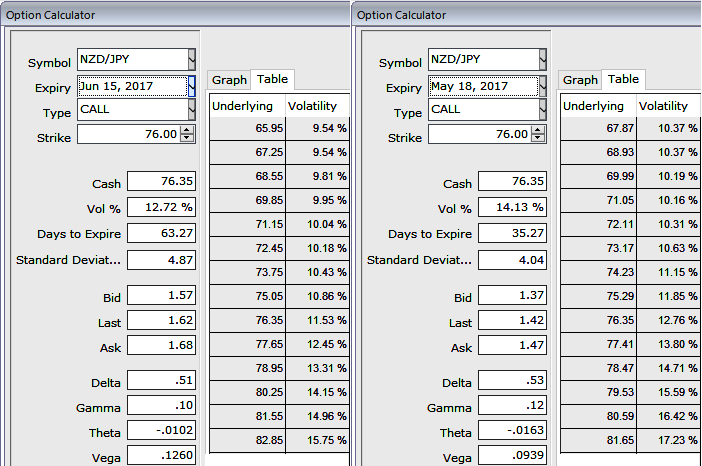
ATM IVs of this pair is trading at 14.13% and 12.72% for 1 and 2m tenors respectively. While 1m ATM puts are trading just at 8.97% more than NPV.
Compared to short selling of the underlying spot FX, it appears to be more appropriate to bet against underlying spot by adding longs in ATM put options as the investor does not have to borrow the underlying outrights to short.
Moreover, the risk is capped to the extent of initial premium paid, as opposed to unlimited risk when short selling the underlying outright.
However, put options have a limited lifespan. If the underlying FX price does not move below the strike price before the option expiration date, the put option will expire worthlessly.
Sell NZDJPY 1Y 25D RR and buy a 2m 75 NZDJPY OTM put, sell a 1m in premium-rebate notionals.







