


 David Schwartz to Reveal XRP Ledger Future at Ripple Swell 2026
  Litecoin Marks 15 Years as Grayscale Backs LTC ETF Push
  Zcash Privacy Demand Rises as AI Exposes Bitcoin Transactions
  Bitcoin Rebounds to $82K as Trump Eases Iran War Fears
  XRP Whale Activity Drops 27% in Eight Days Amid Market Sell-Off
  XRP Ledger Activates New Security Feature for Banks and Stablecoins
  Bitmine to Stop Ethereum Buying After Reaching 5% ETH Supply
  Solana User Growth Jumps 33%, Outpacing Ethereum and Chainlink
  US Government Moves $1 Billion in Bitcoin Amid Sale Speculation
  U.S. Government Moves Over $100M in Bitcoin and BNB
  Robinhood Buys $25 Million in Bitcoin for Corporate Treasury
  Chainlink Price Drops 3% Despite New CCIP Vault Launch


 Add as a preferred source on Google
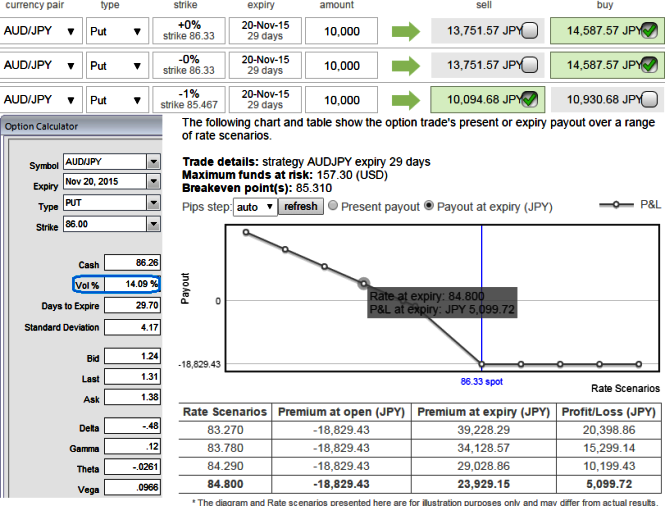
Traders tend to view the put ratio back spread as a bear strategy, because it employs puts. However, it is actually a volatility strategy. The implied volatility of 1M ATM AUDJPY put contract is at 14.09% and it is quite higher side which is good sign for option writers.
Options with a higher IV cost more. This is intuitive due to the higher likelihood of the market 'swinging' in your favour. If IV increases and you are holding an option, this is good. You should also note short-dated options are less sensitive to IV, while long-dated are more sensitive.
As we expect the underlying currency exchange rate of AUDJPY to make a larger move on the downside. As shown in the figure purchase 1M 2 lots of At-The-Money -0.52 delta puts and sell 1W one lot of (1%) In-The-Money put option.
So far we all know that the position uses long and short puts in the ratio, such as 2:1 or 3:2 and so on to maximize returns depending upon risk appetite and returns expectations.
In most long/short spreads, you make money if the underlying price moves, but you lose if it remains in the middle loss zone. Now with increased volatility option shorter can get benefitted from this.
A ratio put back spread is different because it creates a net credit, so even if the underlying price does not move very much, you keep the credit if all of the puts expire worthless.
Entering into this AUDJPY position which has higher implied volatility at 14.09% and expecting for the inevitable adjustment is a smart approach, regardless of the direction of price movement.
Based on volatility and time decay, the strategy is a "price neutral" approach to options, and one that makes a lot of sense.

- News

- Economy

- Central Banks
- Investing
- Research
- Roundups
- Digital Currency
- Insights
- Technical Analysis
- Technology
- Business
- Law
- Health
- Nature
- Fintech
- Science
- Topic
- Opinions
- ©Econometrics LLC . All Rights Reserved.
FxWirePro: Shorts in AUD/JPY backspread to beat higher IV
Thursday, October 22, 2015 7:19 AM UTC
Editor's Picks



- Market Data
Most Popular




