
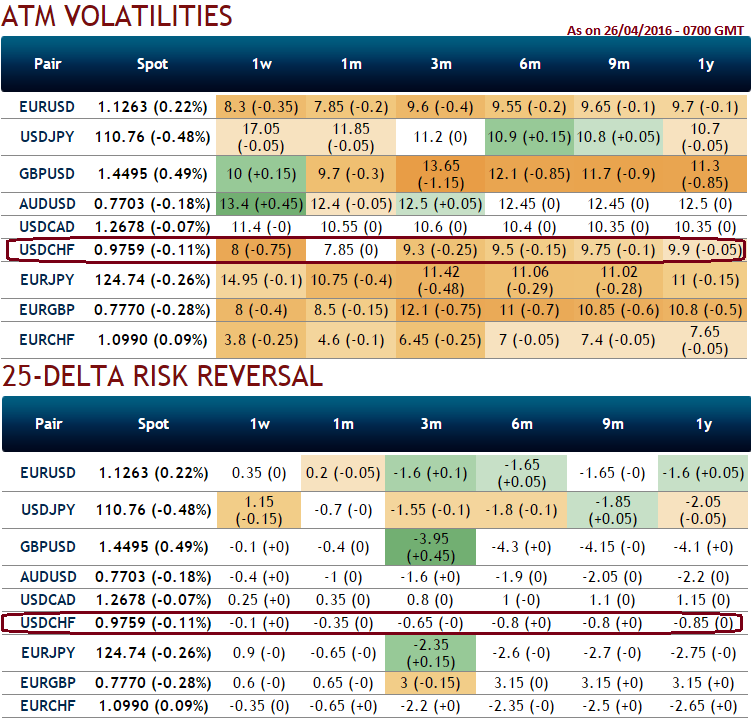
1W ATM IVs of this pair have not been encouraging the ongoing bearish indications, vols have reduced below 8% despite tomorrow’s Fed’s monetary policy meeting which is likely to remain unchanged.
Despite the bearish neutral risk reversals and significant economic event (Fed’s Funds Rate), IVs have been adamant to inch higher.
Yesterday, the pair has rejected the stiff resistance at 0.9786, break-out above would have dragged little upside potential upto 0.9823. But failure swings have now facing southward targets upto 0.9713 for the day which is a next strong support at 7DMA. Trend is now sliding in sloping channel with mildly bearish momentum, prices rejected stiff resistance at 21EMA on weekly plotting.
Contemplating on technicals, IVs and risk reversals USDCHF’s bear swings have to go in narrow range, as result we could foresee the range bounded trading opportunity in prevailing range of 1.0096 and 0.96 levels in short term.
Thus, smart approach USDCHF is that to deal with this lower implied volatility times, we eye on collecting credits or short for premiums, and hope for a contraction in volatility which OTC market has already signalling.
On speculative basis short strangles are the best suitable than any other strategy in prevailing lower IVs condition of USDCHF, hence, we recommend shorting 1W (1%) OTM puts as well as 1W (0.5%) OTM calls for a net credit.
The strategy not only gives you the advantage of an anticipated volatility crush, but also give us some room to be on competitive advantage because we may short premium narrowing strikes while in greed of collecting more credit than when IV is low.


