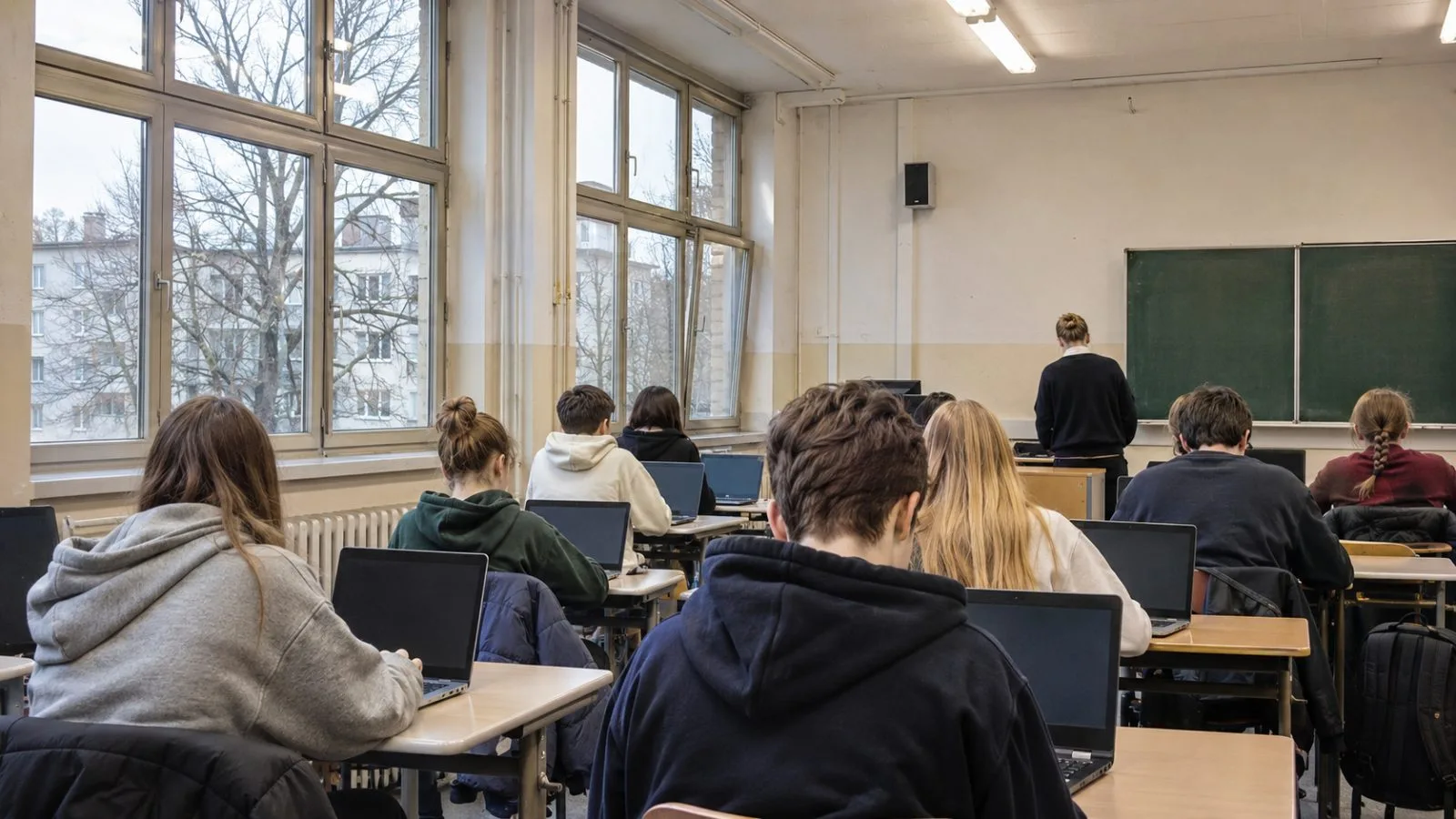
A German survey found 92% of teenagers had used artificial intelligence at least occasionally, underscoring the scale of student adoption as New York City limits student-facing generative AI for younger pupils.
The Medienpädagogischer Forschungsverbund Südwest released the JIM 2026 survey Nov. 13. It questioned 1,200 German-speaking people ages 12 to 19 from May 27 to July 6. The JIM findings show academic use is widespread: among teenagers who had tried AI, 75% used it for homework or learning, while 47% used it in school or lessons.
International testing offers a more complicated picture of what that use means for learning. The Organisation for Economic Co-operation and Development (OECD) said 46% of students in OECD countries used AI chatbots for learning at least weekly in the 2025 Programme for International Student Assessment.
Students who used chatbots to condense assigned reading, research topics or prepare written assignments averaged about 20 points less on the science test than students who did not use AI for those activities. The OECD said the gap does not demonstrate that AI harmed learning: students already having trouble with schoolwork may be more inclined to seek chatbot help.
The results differed for broader use. After the OECD accounted for socioeconomic background, science scores for students using AI at least weekly as a general learning aid were close to those of nonusers. Frequent users of AI specifically to help them learn who also had classroom lessons on assessing AI-generated information scored slightly higher than peers. That comparison cannot establish cause and effect.
Access to those lessons was uneven. Disadvantaged students were less likely to report receiving them, the OECD found.
Germany's education ministers adopted an AI skills framework Oct. 16 that includes checking AI output against primary sources and identifying AI-generated contributions. New York City has imposed a one-year moratorium on student-facing generative AI from 2-K through eighth grade for the 2026-27 school year. The city allows specified assistive uses and limited high school pilots directly supervised by trained educators.
In a January assessment, the Brookings Institution judged that risks to children outweighed benefits under current patterns of generative AI use. Its researchers also identified possible benefits from tools designed to support learning.
New York City says a coalition will assess the moratorium and high school pilots during the school year, then publish recommendations for future years. The city has given no publication date.