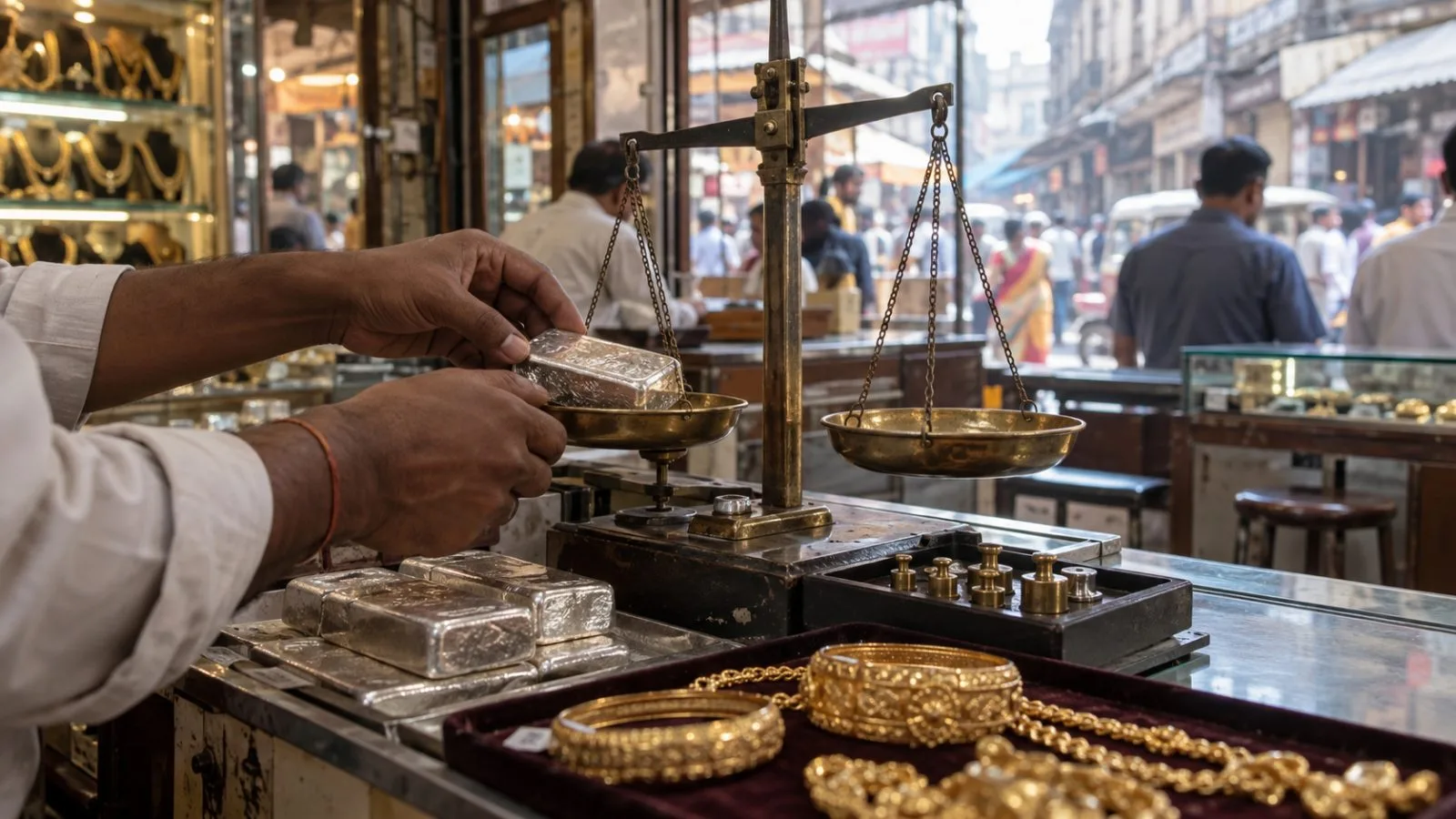
Reuters reported that silver’s Oct. 30 selloff widened its price gap with gold to an 11-month extreme, while Indian futures data show the drop needed for equal-value weights remains a scenario rather than a forecast. The agency put the gold-silver ratio at 79:1, meaning 79 troy ounces of silver equaled the value of one ounce of gold. The ratio was 46:1 in January, when silver reached a record $122 an ounce.
MCX listed its Dec. 4 gold futures contract at ₹138,419 per 10 grams and its Dec. 4 silver futures contract at ₹178,900 per kilogram on Oct. 30. If gold stayed at that price, silver would need to fall about 22.6% for those weights to have equal value.
The India Bullion and Jewellers Association’s (IBJA) Oct. 30 benchmark rates showed ₹140,054 per 10 grams for 999-purity gold and ₹181,344 per kilogram for 999-purity silver. Those rates exclude 3% goods and services tax and making charges. Matching the IBJA prices would require a silver decline of about 22.8%, assuming gold held steady. Using Reuters’ global ratio, a move from 79:1 to 100:1 would imply a roughly 21% silver drop under the same assumption; the calculations use different price benchmarks.
At 100:1, one kilogram of silver and 10 grams of gold have equal value when priced in the same currency. Reuters’ Oct. 30 snapshot at 2:13 p.m. ET (18:13 UTC) put spot silver at $49 an ounce, down 6.5%, and gold at $3,880.97, down 3.5%. Reuters linked the declines partly to falling technology shares and investor questions about returns from artificial intelligence spending. The agency also reported that Commerzbank analysts said the equity-market drop may have triggered forced selling and margin calls.
The Silver Institute’s World Silver Survey 2026 recorded a 107:1 ratio in April 2025, followed by a reading below 55:1 in December. The survey attributed silver’s later gains relative to gold to physical buying, scarce inventories and firm industrial-metal prices.
The Federal Open Market Committee maintained the federal funds target range at 3.75% to 4% on Oct. 28; two members favored an immediate quarter-point increase. The committee’s next scheduled meeting is Dec. 8-9, 2026.