Greenpeace’s satellite analysis showed a slick off Russia’s Black Sea coast after the Aframax Rio fire, while officials reported shoreline cleanup and no estimate of how much oil, if any, entered the sea.
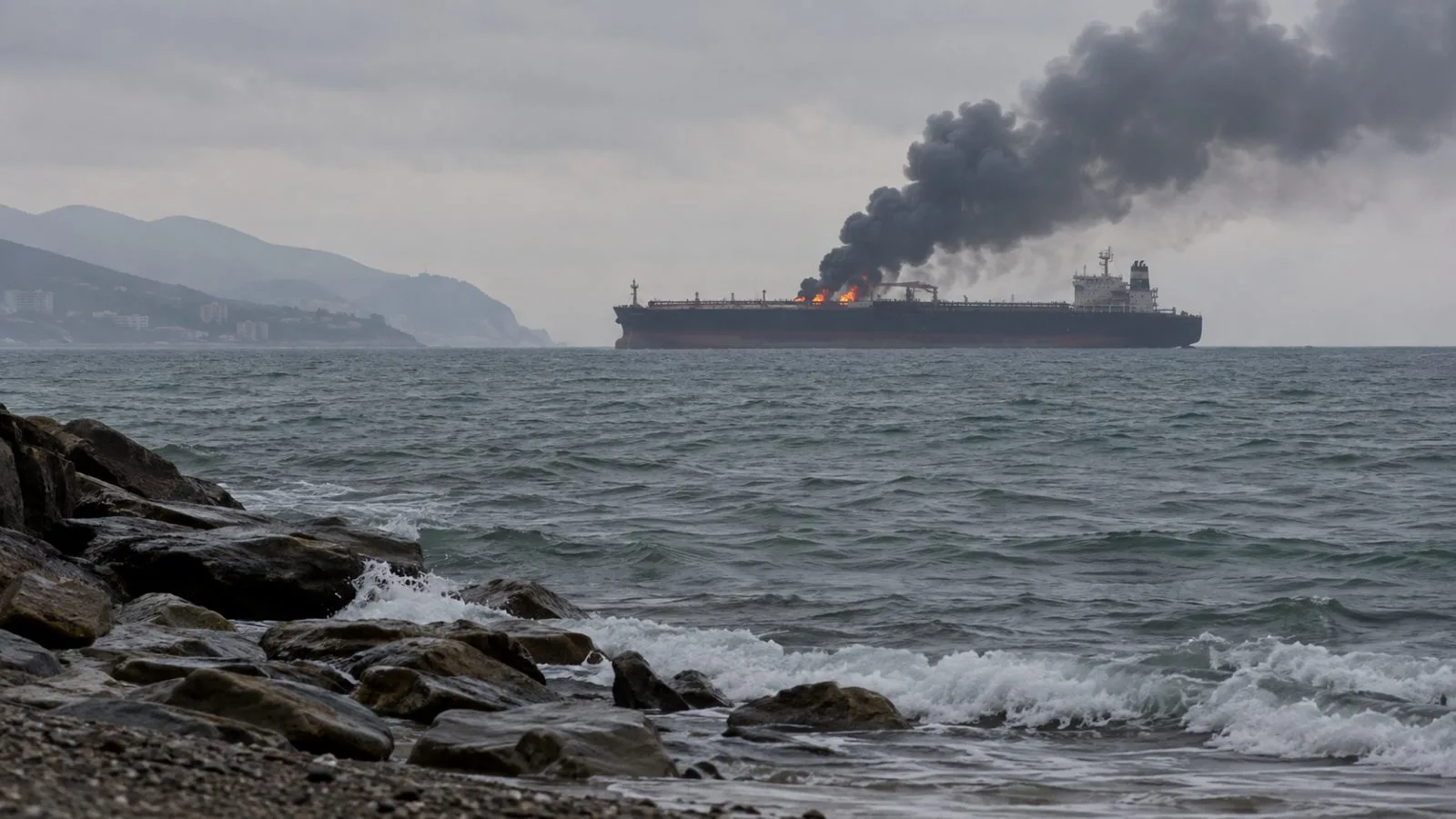
Russia’s Transport Ministry said the Liberia-flagged Aframax Rio was carrying oil when unmanned boats attacked it off Sochi on Oct. 6. The tanker caught fire, and all 23 crew members, all Indian nationals, were rescued without injuries, the ministry said.
On Oct. 7, Russia’s Federal Service for Supervision of Natural Resources (Rosprirodnadzor) said it had detected no pollution in the Black Sea or along the coast and had no data indicating a spill or threat to shore.
Greenpeace estimated the slick at about eight square kilometers in satellite imagery captured around 5 a.m. ET (09:00 UTC) on Oct. 7, when the tanker was about 13 kilometers from Lazarevskoye. Images from around the same time on Oct. 8 showed a slick of about 25 square kilometers.
Transparent World separately identified a possible pollution trail in a radar image dated Oct. 10 between Arkhipo-Osipovka and Novorossiysk; the image did not establish its source. On Oct. 13, Krasnodar’s regional operations headquarters, citing the Marine Rescue Service, said petroleum pollution had not been confirmed in that sea area.
The regional headquarters reported minor deposits on the Novorossiysk shoreline on Oct. 14 and said they were not the oil products carried by the damaged tanker. It also said testing was underway to identify the deposits’ composition and origin; the update gave no test results. Cleanup involved 42 people and 11 vehicles.
On Oct. 16, the headquarters said cleanup was complete at Abrau Beach and Myskhako, covering about 300 meters of shoreline in total. It reported that 53 people and six vehicles had taken part. Krasnodar Governor Veniamin Kondratyev had ordered heightened readiness in Gelendzhik and Novorossiysk on Oct. 13. The regional headquarters said the measure would help authorities monitor environmental conditions and prepare to respond to a possible spill.
The Novorossiysk port captain’s Oct. 14 order directed Rio Enterprises, the tanker’s owner, to secure the vessel and reduce the risk of a cargo leak. The federal port authority listed the order as remaining in force through Oct. 31.
A previous tanker accident in the Kerch Strait occurred in December 2024. The International Oil Pollution Compensation Funds said the Volgoneft 212 and Volgoneft 239 carried 8,450 tonnes of mazut combined; estimates of the amount spilled ranged from 2,400 to 5,000 tonnes. Krasnodar’s regional headquarters said monitoring would continue, but gave no date for the shoreline sample results.