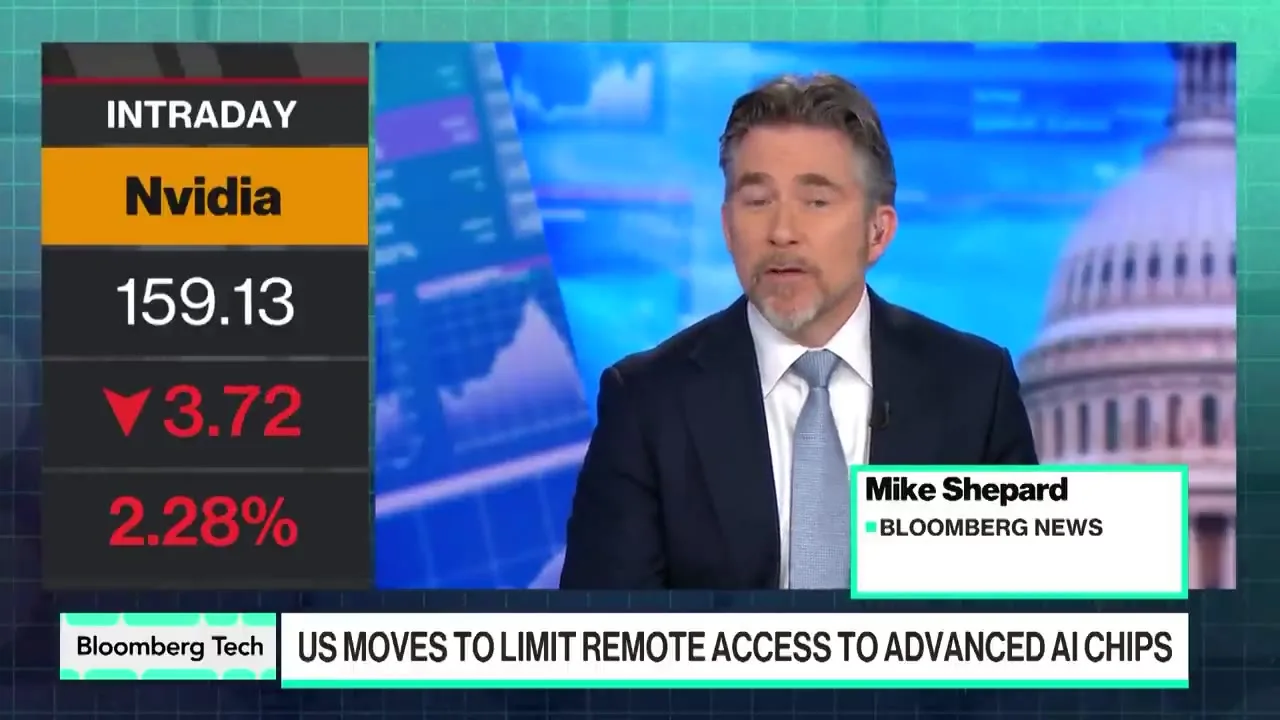
Nvidia could still reach a $1 trillion market value by 2030 despite its leadership upheaval, Beth Kindig, chief executive and lead technology analyst at I/O Fund, said on Monday.
Her projection depended on demand for artificial intelligence computing exceeding supply and Nvidia building recurring software revenue. It did not depend on who ran the company.
Kindig spoke on Bloomberg Technology, published Nov. 16, in an interview about Nvidia’s prospects following Jensen Huang’s departure and the company’s search for a successor.
“That thesis was not dependent on the CEO,” she said. She identified autonomous vehicles and robotics as businesses that could expand Nvidia’s software sales toward the end of the decade.
Memory suppliers were giving unusually long visibility into orders, with their output essentially sold out through the end of the decade. She cited that demand as support for her view that customers still needed more computing capacity than suppliers could provide.
The second part of her case concerned software that generates revenue repeatedly, rather than a single sale. She expected autonomous vehicles and robotics to become a larger part of the discussion about Nvidia as the decade drew to a close.
Turning to the company’s immediate prospects, Kindig saw no evidence that the leadership change had disrupted its product plans. She described its next chip platform as on schedule and cited talk of 70% growth next year.
She did not identify the source of that growth figure or specify what it measured. She also gave no revised earnings estimate or timetable for appointing a successor.
“There is no evidence of a product roadmap disruption,” she said. Her assessment treated the leadership uncertainty as a temporary setback to the business.
Kindig then addressed Nvidia’s valuation relative to earnings. She began covering its AI business in 2018 and described the current valuation as the lowest she had seen in eight years.
She gave no numerical price-to-earnings ratio, which compares a company’s share price with its earnings. Her argument returned to computing demand and the opportunity to sell software into additional markets.
She also questioned whether investors would see a similarly low valuation over the next five years. She presented that view as an assumption based on the period since valuations had last been this low.
On rival AMD, Kindig expected its Helios systems to bring competition to Nvidia in complete racks of AI computing equipment next quarter. She also described AMD as having a way around constraints in high-bandwidth memory, which supplies data to AI processors.
She ended by rejecting the idea that tighter U.S. chip export controls changed her assessment of the opportunity. With supply limited, she expected buyers elsewhere to absorb chips that some countries could no longer purchase.