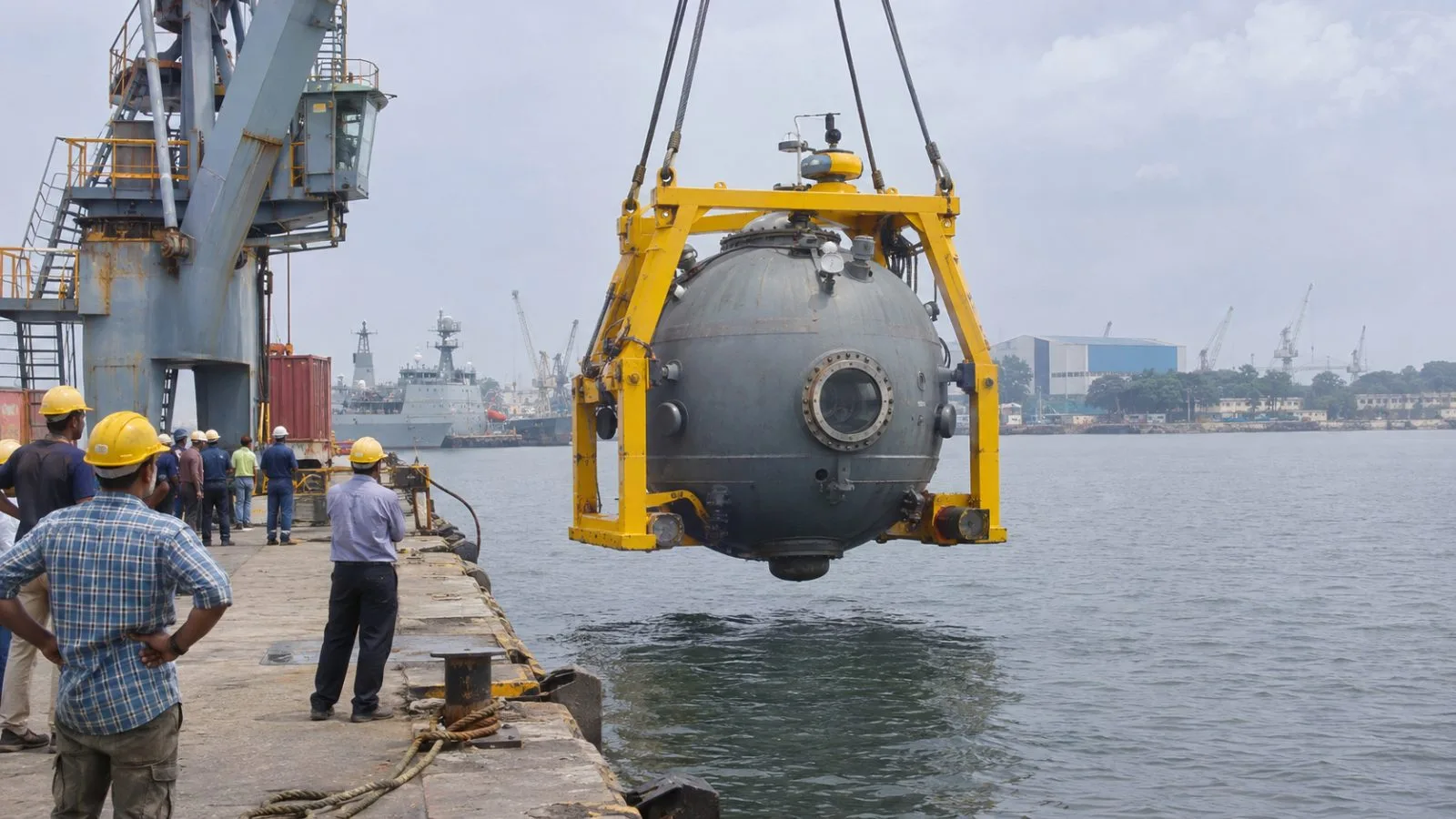
India’s MATSYA-6000 underwent unmanned trials at a Tamil Nadu shipyard on Nov. 6, IANS reported, marking a testing step in a government program to study ocean life and seabed resources.
India’s Ministry of Earth Sciences targets a human mission to a depth of up to 6,000 meters by 2028. The submersible is designed to carry three people.
IANS reported that the trials checked flotation, underwater stability and ballast systems. It described the trials as successful but gave no test depth. The ministry said, as reported by IANS, that the evaluations followed its prescribed protocol.
The National Institute of Ocean Technology is developing MATSYA-6000 under Samudrayaan, part of India’s Deep Ocean Mission. Launched in 2021, the wider program has a stated investment of ₹4,077 crore over five years and includes ocean surveys and biodiversity research.
The Indian Space Research Organisation (ISRO) says the craft’s titanium-alloy crew sphere is designed to withstand external pressure of up to 600 bar. The ministry said the sphere endured 720 bar in a pressure test. It gives the vehicle a planned operating period of 12 hours and an emergency endurance rating of 96 hours.
The broader mission also covers seabed resources, though MATSYA-6000 is separate from India’s mining machine. The ministry estimates that India’s 75,000-square-kilometer exploration area in the Central Indian Ocean Basin contains 366 million metric tons of polymetallic nodules by dry weight. The nodules contain cobalt, nickel, copper and manganese.
India tested the mining machine’s mobility and power systems at a depth of 5,270 meters in 2021. The ministry said in August that activity in international seabed areas remained limited to exploration and that its contracts include environmental baseline studies and impact assessments.
The ministry reported earlier harbor trials in January and February 2025. Balaji Ramakrishnan, then director of the National Institute of Ocean Technology, said in May 2025 that he expected the 6,000-meter mission by the end of 2026. The ministry now targets a human mission by 2028. In March, it said syntactic foam was not yet ready and was expected by the end of May, with a 500-meter shallow-water dive planned for the final quarter of 2026 after integration and testing.