
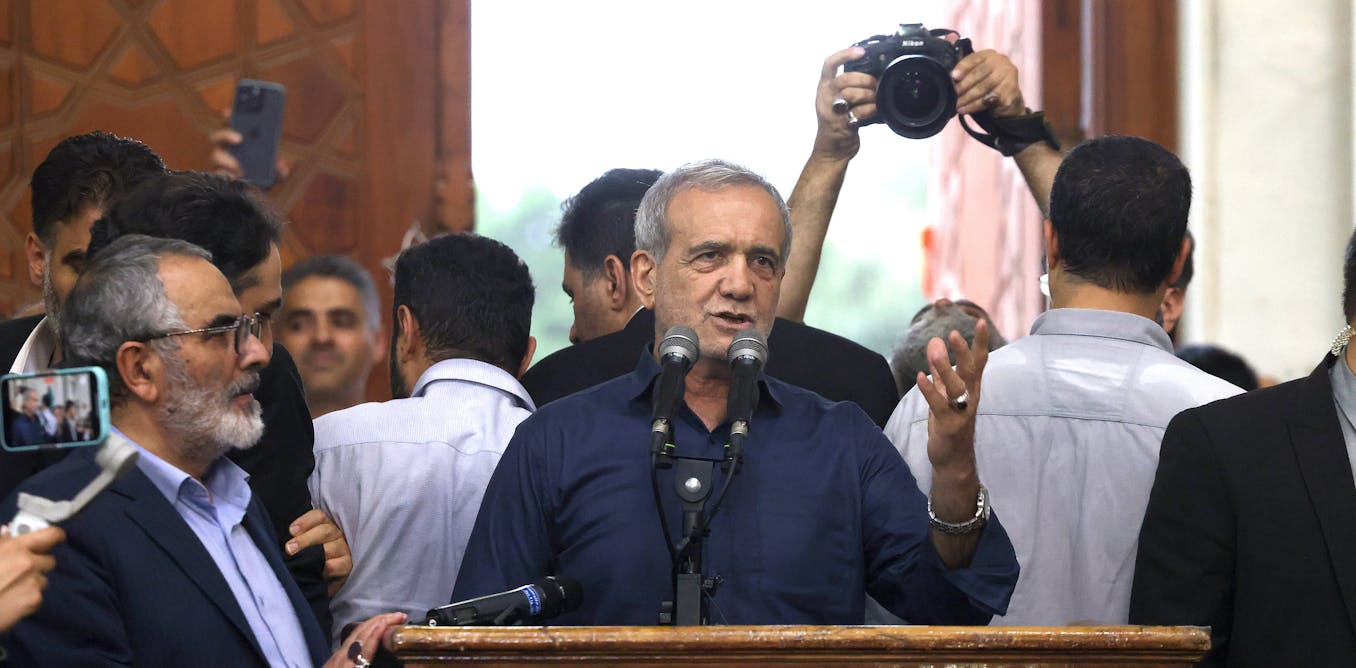
Good news for democracy in Iran – words which in recent times, particularly in western news reports, are rarely seen in the same sentence. But the election of Masoud Pezeshkian as president of Iran must be seen as a positive development.
Pezeshkian is a known democrat with a track record as the health minister in the government of the reformist Mohammad Khatami between 2001 and 2005. More recently he strongly criticised the brutal crackdown on mass popular demonstrations in 2018 and 2022.
Pezeshkian defeated his conservative opponent, Saeed Jalili, the former lead nuclear negotiator, by a margin of 2.7 million votes in the run-off vote held on July 7. Turnout was 49.7% of the 61 million eligible voters, ten points more than the first ballot where fewer than 40% voted.
Pezeshkian, 69, was born in the city of Mahabad in Iran’s West Azerbaijan Province and speaks fluent Kurdish and Azeri. He trained as a cardiac surgeon and enlisted as a medic in the Iran-Iraq war from 1980 to 1988. A vocal proponent of civil rights for Iranian women, Pezeshkian ran for president unsuccessfully in 2013 and 2021 (he was disqualified by the Guardian Council in the latter election).
Pezeshkian is known to be in favour of better relations with Europe, even the US. Speaking from the mausoleum of Ayatollah Ruhollah Khomeini, the leader of Iran’s Islamic Revolution in 1979, where he went to pray after the election result was announced, he said: “I have come … to seek lasting peace and tranquillity and cooperation in the region, as well as dialogue and constructive interaction with the world.”
But can Pezeshkian deliver the social equality, democratic accountability and human rights that millions of Iranians crave and have been risking their lives to protest for? Don’t forget, these were the lofty ideals that were at the heart of the revolution of 1979. And they have been bitterly betrayed, in particular in recent years.
The relative lack of enthusiasm for the elections, at least in the first round, suggests a high level of disillusionment in the electorate. But the ten-point increase in the number of voters, when it appeared that they just might end up with a reformer in the presidency, is revealing. Iranians have rallied one more time.
No false promises
Pezeshkian is aware of the trauma and letdown felt so commonly by ordinary Iranians. He made this clear in his speech from Khomeini’s mausoleum. “In this election, I didn’t give you false promises. I did not lie,” he said. “It’s been many years after the revolution that we come to the podium, we make promises and we fail to fulfil them. This is the biggest problem we have.”
But the new president and his administration will need to navigate the many layers of power that compose the complex state apparatus in Iran. At the moment, these institutions are dominated by the conservative right.
Previous efforts to reform the political system – most notably under Khatami in the early 2000s – were squashed by the conservative faction support by the supreme leader, Ali Khamenei, who functions as the ultimate head of state. Having been part of this government, Pezeshkian knows how tough it will be to bring real reform. He also knows that he only has a short window to bring about changes. Iranians have become increasingly impatient with their leaders and the new president will be no exception. The push towards reform will continue, if necessary with more demonstrations.
In from the cold?
But there is cause for optimism, also in the sphere of foreign affairs. There is the potential for a constructive dialogue with Washington, as long as Donald Trump isn’t the next US president. The same goes for the UK and the European Union.
One of Pezeshkian’s key supporters is Javad Zarif, now an academic, but formerly foreign minister under the reformist former president Hassan Rouhani. Zarif joined Pezeshkian on the campaign trail, making speeches at rallies around country in support of his friend. The US-educated Zarif was particularly close to John Kerry, Obama’s secretary of state from 2013 to 2016. Their relationship was hugely important in the negotiation of the nuclear deal, Joint Comprehensive Plan of Action (JCPOA) in 2015 – the first direct talks between Iran and the US since the Iranian revolution of 1979. Such personal relationships matter.
So there is an opportunity for Pezeshkian to reopen a new chapter in Iran’s international affairs and domestic politics. And, interestingly, this – and the signal it gives to the fractured and unhappy Iranian electorate that they do have a degree of democratic choice – is why he was allowed to run in the election. This is how he is meant to function for the system – as a source of legitimacy domestically and in international relations, especially with the US and Europe.
After all, he was the only reformist candidate permitted to run in this election by the hardline Guardian Council – the same body that barred him from the presidential elections in 2020.
So this new Iranian president is a signal to the world that Iran can be talked to and to Iranian society that there is a degree of political choice in this Islamic Republic.
Mass demonstrations after the death of Mahsa Amini, the 22-year-old Kurdish-Iranian woman who was killed in September 2022 by the morality police for wearing her hijab incorrectly had caused lingering discontent and resentment, a major cause of concern for the regime.
This was followed by a dangerously low turnout at the 2024 legislative elections, where only 40% voted. Both were interpreted by the core state institutions as an indication of a serious political crisis in Iran.
Pezeshkian’s candidacy is a sign from the establishment to demonstrate sensitivity to the lack of broad public support that had begun to threaten its legitimacy.
In many ways, Pezeshkian holds a historic mandate to finally deliver a system that is accountable to the Iranian people. But it will not be easy, and all the while he will be conscious of pressure from the conservative right. Pezeshkian could be a true democrat and a visionary reformer, or yet another betrayal of the will of the majority of Iranians, who are desperate for change.


