
After long struggle, European Central Bank's (ECB) asset purchase program of € 60 billion per month along with crucial reform pursued by Italian government seem to have restarted the Italian economy.
After Markit economics PMI report showed improvement, Italy's national business group revised upwards its estimates for GDP. The group raised the forecast by 0.3% for this year and next, estimating growth to be 0.8% in 2015 and 1.4% in 2016.
Though it might take years for Italy to reach its former glory, it certainly creates opportunity to go long on Italian stocks which are cheap compared to their historical standards.
However significant contagion risk lies, if Greece choose to exit the Euro zone, which might tumble the forecasts and derail the economy once again.
Moreover Italy still needs to pursue crucial reforms and manage its debt which stands at more than 130% of GDP, second worst in Euro area.
- Italy's economy grew for the first time in seven quarters, but growth is still fragile at 0.3% and unemployment remains high at 12.4%. Naturally it calls for further reforms.
Signs of recovery, makes Italian stocks cheaper when compared to historical standards.
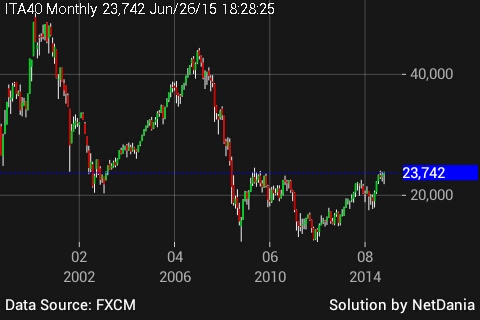
Italian benchmark stock index is currently trading at 23670, much lower than 50,000 in 2001 and 44000 in 2008.
As of now the index is trying to break out of 24000/25000 area, support lies at 22000, 18000 and 14000.
Buy FTSE MIB index fund, with very longer term view and higher return.


