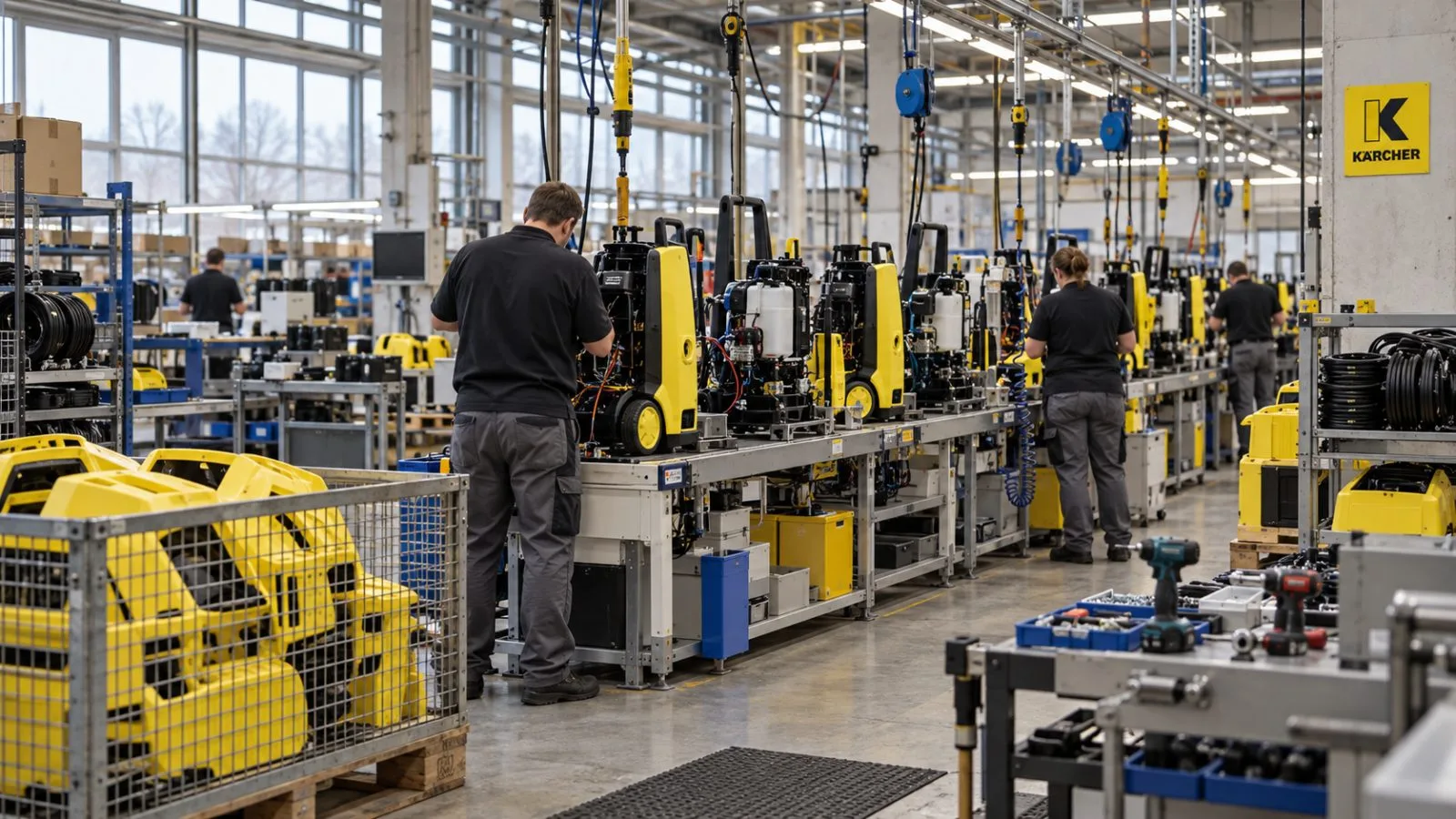
Rising structural and employee costs are making added capacity or more jobs in Kärcher’s German production uneconomic, CEO Hartmut Jenner said, as Germany forecasts 1.3% growth in 2026.
In a commentary published by Euronews on Saturday, Jenner urged reforms to reduce regulation and business costs. He argued that public spending and subsidies underpin the government’s 2026 outlook, which he called “borrowed growth.” Jenner also cited energy costs and international competition as strains on European industry, saying the pressures had converged into a “perfect storm.”
Kärcher’s latest annual results show a large international footprint. The cleaning-equipment maker reported 2025 revenue of €3.483 billion, up 1.1% from 2024 and 3.2% after currency adjustments. It described the total as its highest to date and said 86% of revenue came from abroad. The company profile lists 17,000 employees across more than 170 companies in 87 countries.
The German Federal Ministry for Economic Affairs and Energy projects real GDP growth of 1.3% in 2026 and 1.1% in 2027. The Joint Economic Forecast Autumn 2026 also puts growth at 1.3% this year. In its October assessment, the ministry said the recovery had temporarily lost momentum in the third quarter; industrial production in July and August averaged 1.4% below its second-quarter level.
Separate research indicates bureaucracy is a cost for businesses. A Deutsche Bundesbank analysis of a survey of about 7,000 firms found average bureaucracy costs rose from around 5% of annual turnover in 2022 to around 7% in 2024. The Bundesbank estimated that increase may have reduced productivity growth by about 0.5 percentage point over the period and said the burden relative to turnover was higher for small firms.
The ifo Institute said half of companies responding to a July 2026 survey identified bureaucracy and regulation as Germany’s biggest business-location problem. The analysis covered 4,449 responses, and companies could select multiple problems.