
Ever since Vice President Kamala Harris became a presence on the national scene, her name – a common one for women in India – has attracted a lot of attention, most specifically for its pronunciation.
The three-syllable word should be pronounced “Come-a-laa” (Kamalā), with the final long “a” signaling a feminine noun in Sanskrit. In the United States, it is often enunciated with stresses placed on the first or second syllable.
However, the pronunciation of “Kamala” is the least interesting thing about this lovely name, which is only one of many words in Sanskrit for the radiant, fragrant, large-petaled pink lotus, or Nelumbo nucifera , that is ubiquitous in the Indian subcontinent. As a scholar of South Indian religions, I’d like to explain the deep symbolism and the many meanings of the kamala, or lotus, which are shared by different faith traditions in the subcontinent.
The ‘kamala’ in Indian literature
In many Indian love poems, the wide, shapely eyes of beautiful women are compared to the lotus, while in devotional poetry it is the God’s eyes that invite the comparison.
The simile is not confined just to the eyes but can be used to praise the beauty, softness and radiance of a lover’s or the divine’s face, feet or hands. The ninth-century Tamil poet, Nammalvar, in his magnum opus, the “Tiruvaymoli,” uses the simile to describe the beauty of the god Vishnu:
You are faultless light
You are unsullied wisdom
that neither blooms nor withers.
You are everything. You rule it all.
If the king of the beautiful gods
worships you, won’t it dim
the radiance of your lotus feet?
In some cases, love, whether mystical or human, is described as a lotus that blooms in the day, responding to the warmth and brightness of the sun. At night, the lotus closes its petals, much as one might withdraw in the absence of the beloved. Equally, the lotus can be evocative of desire and intimacy, drawing a bee to drink from its nectar.
The lotus, both as whole flower or even a single curved petal, is a pervasive motif in Indian art. A famous 18th-century Indian miniature painting depicts the divine couple, Radha and Krishna, facing each other, clothed entirely in lotuses.
The lotus’s divine symbolism

Goddess Lakshmi. Raja Ravi Varma, via Wikimedia Commons
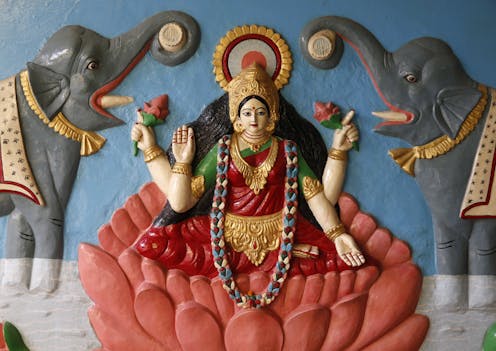
Most significantly, the kamala, or lotus, is closely associated with Sri-Lakshmi: the goddess of sovereignty, auspiciousness, fecundity, wealth and good fortune, who is worshiped by Hindus, Buddhists and Jains. In fact, Kamala is simply another name for Sri-Lakshmi. This goddess either sits or stands on a fully bloomed lotus and holds them in her hands as well.
In Hindu temples in Southern India, she will often be adorned in a garland of lotuses, so complete is her association with this flower. Lakshmi’s divine husband, Vishnu, is also closely connected to this flower. A lotus emerges from his navel to birth the god Brahma, who in turn births the whole universe.

A lotus grows out of Vishnu’s navel, from which God Brahma is born. Gift of John and Berthe Ford, 2002, CC BY
Although Sri-Lakshmi’s association with the lotus is most obvious, the religious traditions of Jainism and Buddhism also integrate the bloom. Buddhist and Jain divine figures may hold the lotus in their hand, like the Buddhist goddess Tara or the male Buddhist deity Avalokiteshvara. The sixth great teacher of the Jain tradition, Padmaprabhu, is named after a lotus, with “padma” being another name for the flower. Sometimes the lotus serves as a pedestal for the divine being in the Jain, Buddhist and Hindu traditions.

Statue of Avalokiteshvara. Hideyuki Kamon via Flickr, CC BY-SA
In all cases, the lotus is rarely a bud and almost always a lush, open bloom. This gestures to its deep meaning as a symbol of wisdom, of one’s awakening into knowledge from the torpor of ignorance. The kamala’s symbolic meaning is rooted in the fact that the lotus blooms in swampy waters but remains untouched by the dirt around it. Similarly, enlightenment and wisdom arise and blossom from the murk of desire and attachment. But when one attains wisdom, like the lotus, one remains above and untouched by the dirt of deluding ignorance.
That is why the kamala is always pictured and described not as a bud, suggesting only potential for wisdom, but as a large, open, unfurled flower.
Kamala Harris’ name is a reminder of its significance in these religious traditions. One could argue that a lotus by another name is still a lotus, but as these traditions show, it is also so much more.


