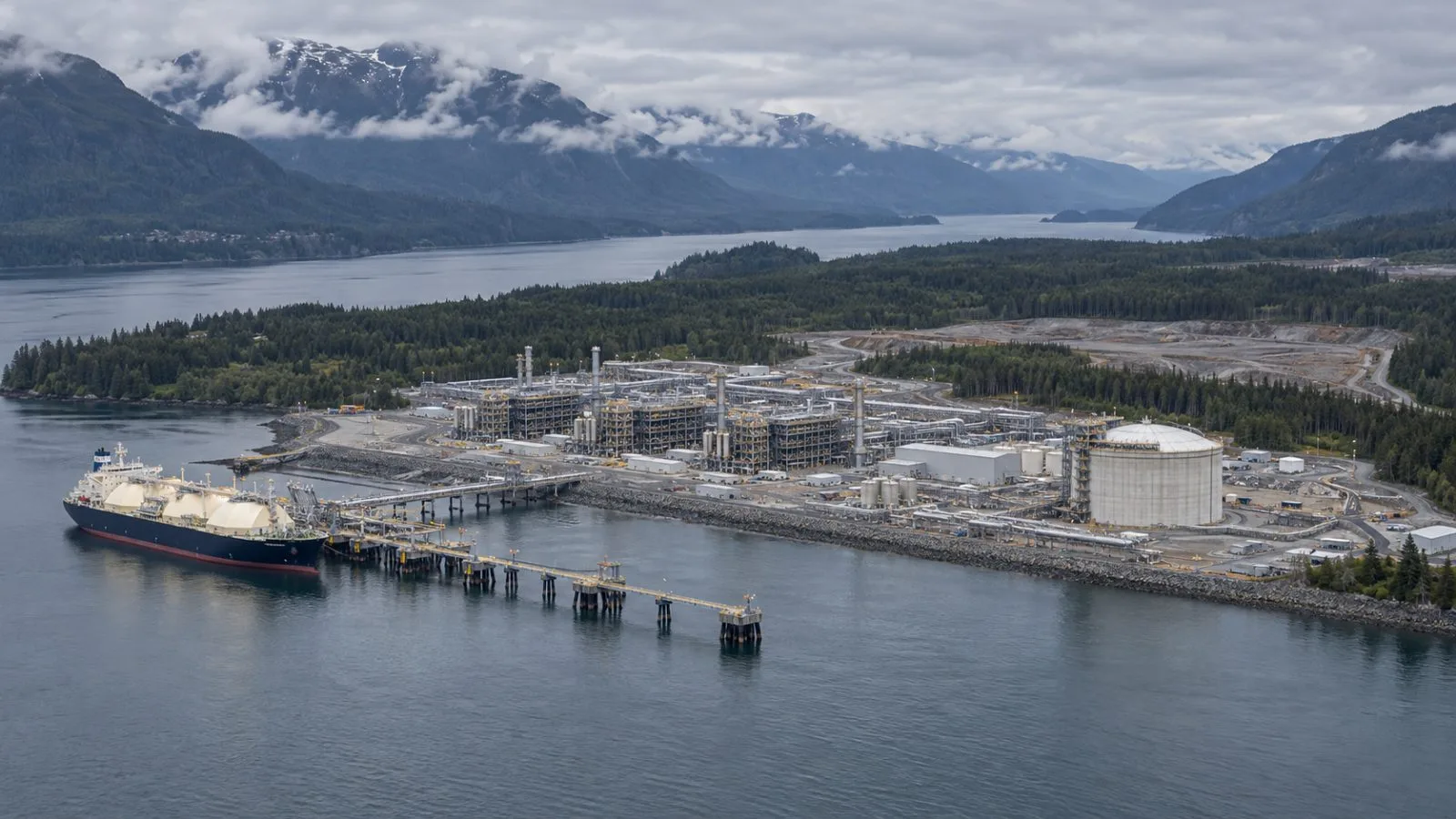
LNG Canada’s planned Phase 2 expansion would double the Kitimat terminal’s capacity to 28 million tonnes per year, advancing Canada’s export plans as regulators and Indigenous groups scrutinize its local effects.
LNG Canada announced its partners’ final investment decision Sept. 28. The federal government welcomed it the next day and valued the private investment at $33 billion, without specifying the currency in its release. The project would add two processing trains, a storage tank, a condensate tank, a loading berth and five compressor stations along the existing 670-kilometer Coastal GasLink pipeline. Capacity would rise from 14 million tonnes per year.
The federal government expects Phase 2 to create more than 4,000 direct construction jobs. LNG Canada estimates it may generate more than $50 billion in government revenue over the project’s lifetime; both figures are projections. A separate option would let five First Nations invest up to C$1 billion in a special-purpose entity that would purchase the expansion’s storage tank.
Phase 1 began direct LNG exports from Canada in June 2025, according to the federal government, which presents the expansion as a way to broaden trade links with Indo-Pacific markets.
The B.C. Energy Regulator said LNG Canada’s report described 20 black-smoke events at Kitimat from April 22 to July 31, 2026, including events the company identified as non-compliant. LNG Canada reported four more events for August. The regulator found the submitted report satisfactory but kept its oversight order in force, requiring LNG Canada to submit monthly effectiveness reports from October 2026 through March 2027. It said Kitimat air quality has stayed below provincial objectives since the facility received its emissions permit in 2024.
Amnesty International Canada says at least two planned compressor stations would be on Wet’suwet’en territory and that the Nation’s hereditary chiefs have not consented to the pipeline or its expansion. TC Energy says the existing pipeline was built with support from 20 elected Indigenous communities along its route. Its account of support from elected communities differs from the hereditary chiefs’ position described by Amnesty.
Al Jazeera reported criticism of Shell’s Nigerian operations, quoting York University professor Anna Zalik as calling the company’s portrayal of itself as responsible in Canada “disingenuous.” The outlet said Shell rejected her assessment and cited oil theft, sabotage and illegal refining as factors shaping conditions in Nigeria. Shell holds a 40% stake in LNG Canada.
TotalEnergies has a separate Canadian LNG connection: it owns a 5% stake in Western LNG, developer of the proposed Ksi Lisims LNG project, and has a conditional agreement to buy two million tonnes of LNG per year for 20 years, subject to a final investment decision. In November 2025, the European Center for Constitutional and Human Rights filed a criminal complaint in France alleging TotalEnergies’ complicity in war crimes, torture and enforced disappearances in Mozambique. TotalEnergies said it “firmly rejects all such accusations.”
TC Energy expects construction of Coastal GasLink Phase 2 to begin in early 2027, with the expansion entering service in the early 2030s.