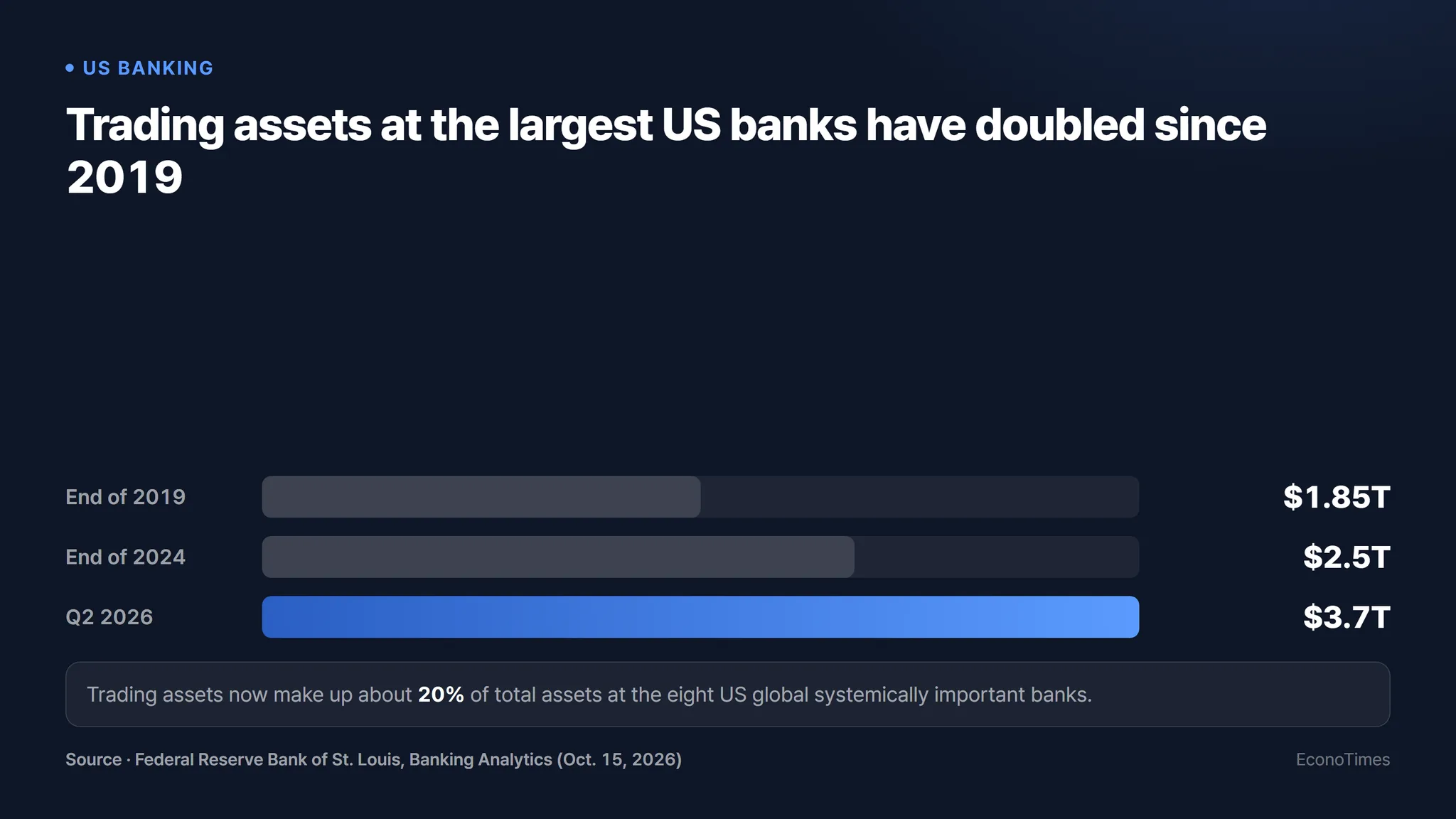
Trading assets at the largest U.S. banks neared $3.7 trillion in the second quarter of 2026, almost 50% above the end of 2024, the Federal Reserve Bank of St. Louis said.
The bank published “Banking Analytics: Largest Banks’ Trading Assets Surge in Recent Quarters” on Oct. 15 in its On the Economy series. The analysis found that trading assets had doubled since the end of 2019.
Trading assets rose from $2.5 trillion at the end of 2024 and now represent about 20% of assets at U.S. global systemically important banks, the analysis said. The group comprises eight of the country’s largest and most complex financial institutions.
Those banks are Bank of America Corp., Bank of New York Mellon Corp., Citigroup Inc. and Goldman Sachs Group Inc. They also include JPMorgan Chase & Co., Morgan Stanley, State Street Corp. and Wells Fargo & Co., the analysis said.
Trading revenue, which provides most revenue from capital-markets activity at the banks, reached $117 billion in 2025, the author found. Revenue had risen for several years after dropping to $62 billion in 2022, the analysis said.
The analysis defined trading assets mainly as securities that banks intend to resell soon to profit from short-term price movements. It said the category can include U.S. Treasury and mortgage-backed securities, equities, loans, derivatives, and foreign-exchange and interest-rate contracts.
Banks report those assets at fair value on their balance sheets and record unrealized gains or losses in their income statements, the analysis said. Securities held for investment belong to a separate portfolio, it said.
The author tied the size of trading books partly to the scale of debt and equity markets, which affects the supply of tradable assets. The U.S. stock market was valued at $75.3 trillion on July 1, 2026, according to Siblis Research figures cited in the analysis.
U.S. fixed income outstanding reached $51.4 trillion in the second quarter, the analysis said, citing the Securities Industry and Financial Markets Association. The author said both markets had grown rapidly in recent years.
The analysis also connected potential trading capacity to a November 2025 rule adopted by the Federal Reserve Board, Federal Deposit Insurance Corp. and Office of the Comptroller of the Currency. The rule reduced enhanced supplementary leverage ratio capital requirements for U.S. GSIB holding companies and their subsidiary depository institutions, the author said.
That change allowed the firms to expand their potential balance-sheet capacity, including their capacity for trading activities, the analysis said. It did not quantify how much of the recent increase in trading assets resulted from the rule.
Michelle Clark Neely, a visiting scholar in the St. Louis Fed’s Supervision, Credit and Learning Division, wrote the analysis. The publication said the views expressed were not necessarily those of the St. Louis Fed or the Federal Reserve System.