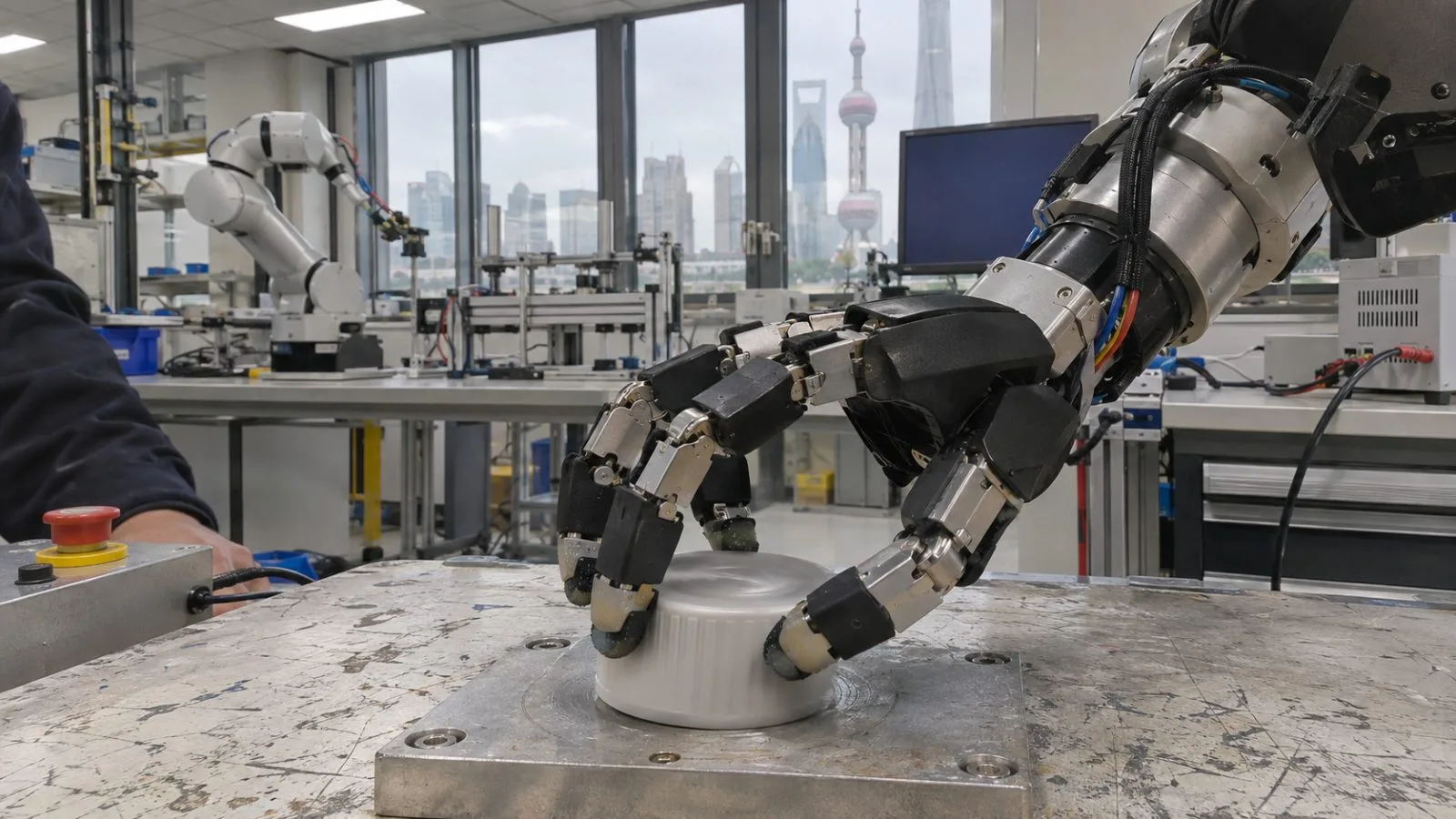
Researchers behind LingBot-Touch have developed a way for robot manipulation policies to use touch readings from different sensor designs, addressing a data compatibility problem the authors identify in tactile robotics.
The paper, Learning Heterogeneous Tactile Representation for General Dexterous Manipulation, was posted Nov. 9. The authors say tactile sensors have different strengths and drawbacks, and their sensor-specific physics makes it hard to combine readings across devices. LingBot-Touch is aimed at that mismatch, so manipulation systems can draw on touch data from more than one sensor design.
Sensor-specific tokenizers feed a shared Transformer, which predicts latent representations that can serve as tokens for manipulation policies. Using tactile context across space and time, the Transformer predicts latent representations that can serve as tokens for manipulation policies.
The paper names π₀.₅ and LingBot-VLA as systems able to use those tokens. The setup is intended to let downstream manipulation models work with a common tactile representation while incoming data still reflects each sensor’s design.
The authors report improved performance in complex manipulation across simulated tasks and deployments on multiple robot platforms, with computational efficiency preserved. The paper presents manipulation tasks and policies as potential beneficiaries of the shared format.
The paper says the representation can be extended to additional tactile sensor types. The project’s official GitHub repository lists the implementation under the Apache License 2.0.
The work joins broader activity around robotic touch and hand systems. EconoTimes has previously covered Samsung and LG teams working on robotics hand research and components. LingBot-Touch addresses how manipulation systems can use information from touch hardware built on different sensing approaches.