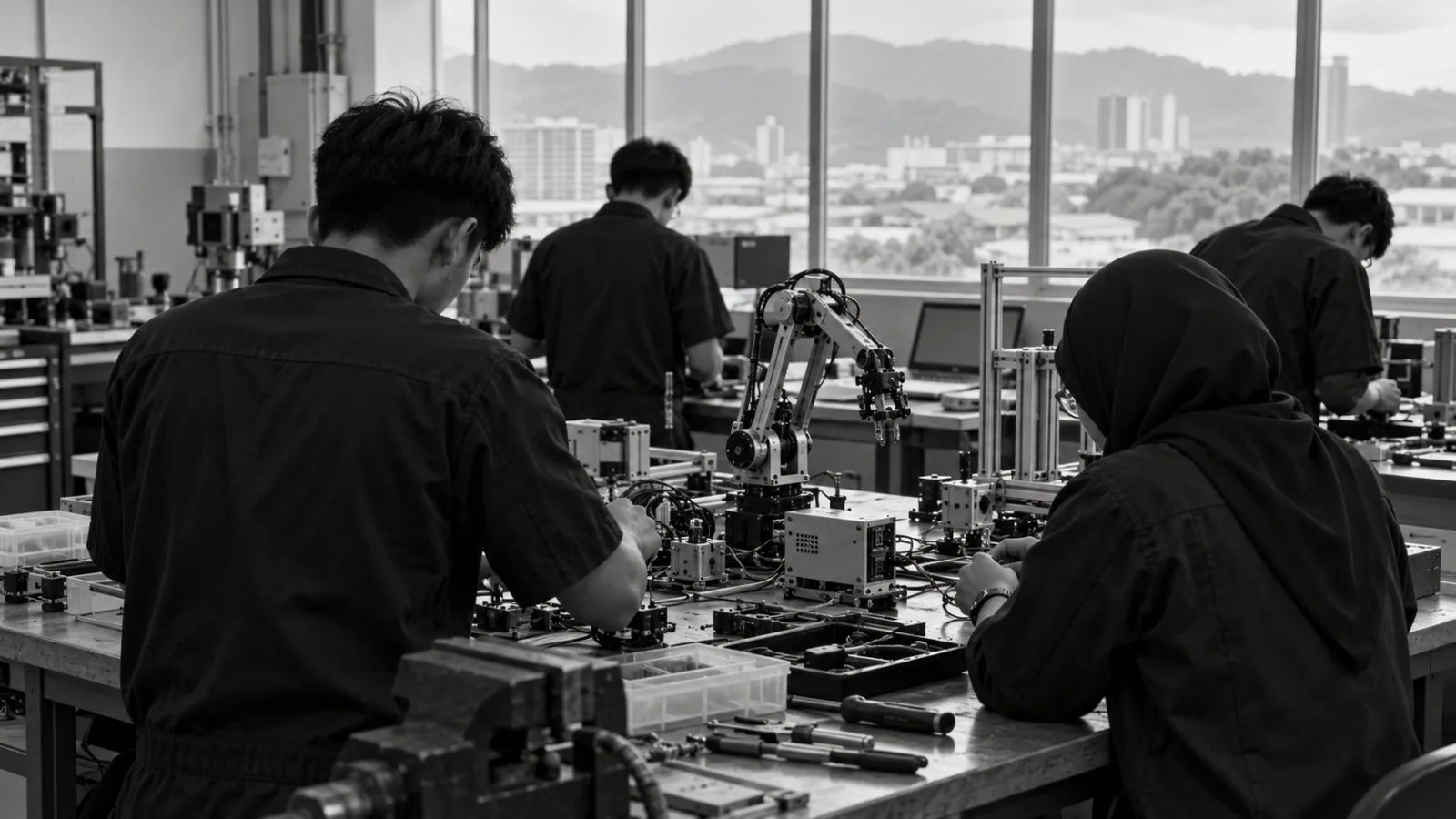
Malaysia has proposed RM8 billion for vocational training in its 2027 budget as it seeks workers for higher-value industries and presses employers to take a larger role in training.
The allocation spans ministries and covers technical and vocational education and training (TVET). The National TVET Council secretariat counted 459,558 students enrolled in 2025. Malaysia’s Ministry of Higher Education said nearly 57% of Malaysian Certificate of Education (SPM) and equivalent school leavers chose TVET that year.
Deputy Prime Minister Ahmad Zahid Hamidi has set a target of at least 650,000 students in TVET programs by Dec. 31, 2026. Apprenticeships account for about 3% to 4% of enrollment, CNA reported, citing National TVET Council data.
Prime Minister Anwar Ibrahim has argued that companies benefit when they hire workers trained largely at public expense. At the June 6 launch of TVET 2.0, he said up to RM50 million from an existing fund could support the program if employers and industry worked with the government.
On June 6, Deputy Prime Minister Ahmad Zahid Hamidi launched the GITC TVET Placement Centre (GTPC) to coordinate workplace learning, apprenticeships and job matches. The Penang Skills Development Centre’s Malaysian Meister Program Level 1 in Mechatronics provides one model: 75% of its training takes place at a host company and 25% in classrooms. Host companies pay course fees, and trainees receive an allowance, the center says.
Malaysia’s National Semiconductor Strategy aims to train and upskill 60,000 highly skilled local engineers by 2030. That is an industry target, rather than one assigned solely to TVET. The Department of Statistics Malaysia’s advance gross domestic product estimate showed manufacturing grew 7.5% year over year in the third quarter of 2026. Export-oriented electrical, electronic and optical producers supported the increase.
Welding inspector Nur Adham Syamsuzzaman told CNA that starting pay for TVET graduates should improve. The budget proposes raising the general minimum wage from RM1,700 to RM2,000 a month in June 2027, with an exemption for micro, small and medium-sized enterprises whose annual sales are below RM50 million.
It also proposes a separate RM2,500 monthly floor for semi-skilled workers and graduates. The budget gives no start date or detailed eligibility rules for that measure, including which TVET qualifications would qualify.
The Dec. 31, 2026, enrollment target is the next stated marker. Employer placements and the terms of the pay measures are further tests of the expansion, ahead of the proposed general minimum-wage change in June 2027.