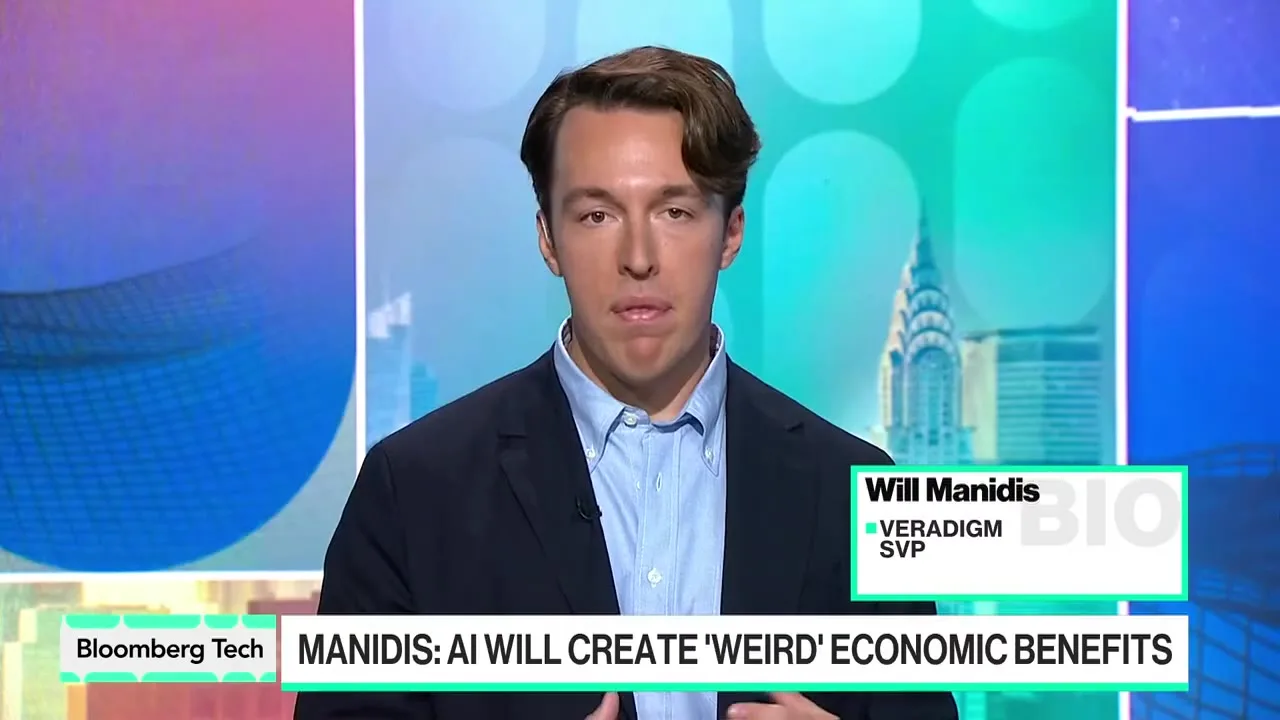
Companies that distribute artificial intelligence could capture disproportionate economic gains as the technology becomes cheaper, Will Manidis, Science.io founder and coauthor of “The Commanding Heights,” said in an interview.
The argument puts businesses connecting AI to customers and commerce at the centre of its economic benefits. It also leaves room for model developers to prosper: Manidis described OpenAI and Anthropic as “great businesses.”
Speaking on Bloomberg Technology, published Nov. 2, Manidis said lasting advantages could come from controlling the networks through which AI and related commerce move. His argument rests on the technology becoming widely available at lower cost.
The cost of a token, a unit of data processed by an AI model, used in work involving the most advanced models had fallen about thirteenfold over the past twelve months, Manidis said. He expects models to improve while their output becomes cheaper.
Those changes could produce “weird knock-on effects across the economy,” he said. The benefits could reach businesses far from San Francisco, with companies distributing the technology gaining disproportionately as more firms put it to work.
He divided potential beneficiaries into two groups. Businesses that currently depend on large amounts of human mental work could increase profit margins by using AI. A second group could benefit from handling payments and commerce generated by wider adoption.
Manidis called that second idea the “neodollar,” arguing that AI is an American business and that its services are priced in dollars. He expects greater use to increase demand for dollar transactions and commerce involving the United States.
He drew a distinction between inventing technology and capturing its economic benefits, using railroads as an example. Companies bringing AI into everyday business could account for an overwhelming share of the economy over the next decade, he said.
Manidis said he built and sold Science.io, a company developing AI models. He was 19 when the paper “Attention Is All You Need” appeared. He wrote the essay with Joe Roberts, a special situations investor, over the past year.
He said investors had focused on successive shortages in areas such as memory and storage without fully accounting for how AI could change the structure of the U.S. economy. He argued that the technology would change valuations across all stocks.
Manidis did not claim to have all the answers or present the argument as a certain outcome. He pointed to Meta as a business able both to train advanced models and distribute their capabilities globally while handling the resulting commerce.