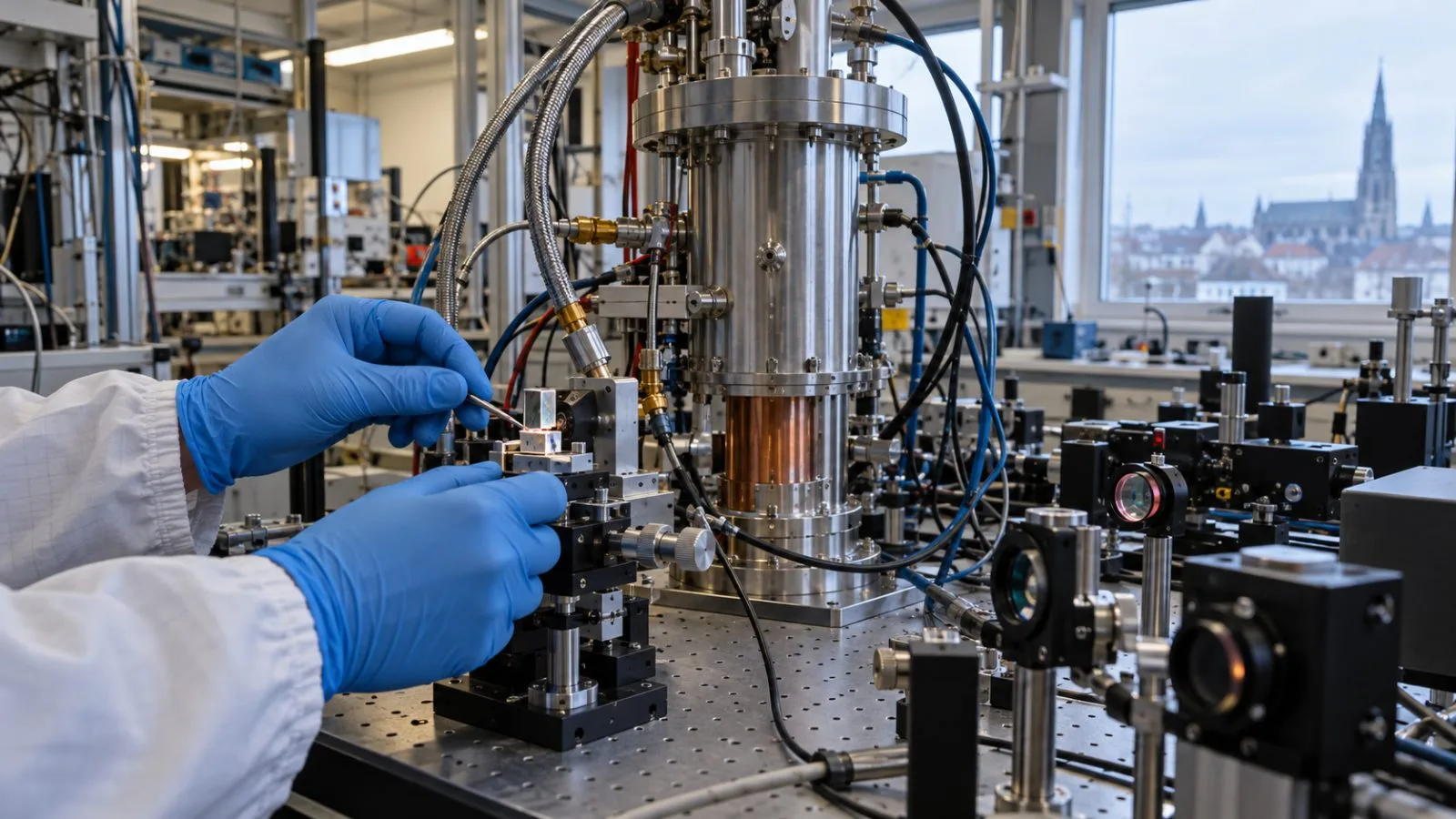
Researchers demonstrated a single molecule whose electron spin was controlled with microwaves and initialized and read using light, a step toward linking quantum information with photons.
The results appeared online Oct. 28 in Nature. The team included researchers affiliated with NVision, Ulm University and the Hebrew University of Jerusalem. They placed a carbene molecule inside a crystal with a matching structure and showed it could be addressed one molecule at a time.
At 4.5 kelvins, microwave pulses controlled the molecule’s electron spin, while light was used to initialize and read it. Under an XY8 dynamical-decoupling sequence, spin coherence measured 2.2(3) milliseconds. A separate measurement put spin relaxation at 21(2) milliseconds.
The paper also reports an optical linewidth of 38 MHz and spectral stability of 2.4–2.6 MHz for more than an hour. The molecule’s spin-selective optical transitions were separated by 1.555(1) GHz.
The paper describes links between spin qubits and photons as important for quantum networking and distributed information processing. It says earlier molecular-qubit work with optical readout used bulk ensembles; the new result demonstrates control at the single-molecule level.
NVision CEO Sella Brosh said the findings support the company’s belief that organic chemistry offers a “fundamentally better building block for quantum.” Nature’s competing-interests disclosure says several authors work for NVision and some, including Ilai Schwartz, hold company shares.
NVision said May 13 that its $55 million Series B round, anchored by Abbott, brought its total capital raised to $120 million. The company has identified entangling separate molecules and developing error correction as further research goals.
NVision has announced plans to work with U.S.-based photonics company HyperLight on a chip platform incorporating films that contain molecular qubits. The Nature experiment did not demonstrate an integrated chip, entanglement between separate molecules or error correction. NVision says it expects its first integrated chip prototypes in Q4 2026.