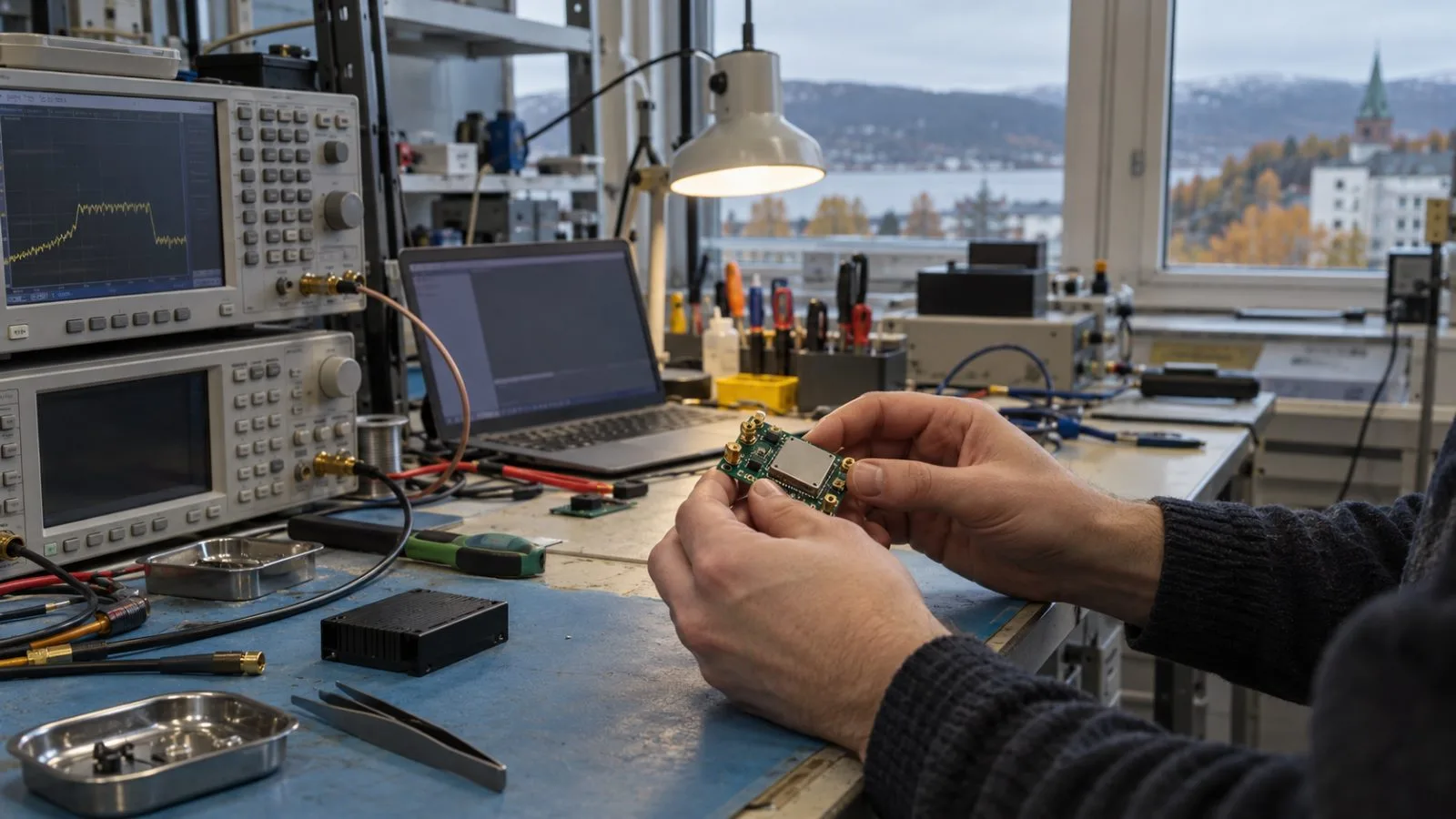
Nordic Semiconductor introduced its nRF71 chip family for battery-powered connected devices, claiming a sharp reduction in standby power and adding on-device AI for products that can maintain multiple wireless links.
Kjetil Holstad, executive vice president of Wi-Fi and Power Management at Nordic Semiconductor, described the power constraint this way: “Wi-Fi has demanded a power budget they could not afford.”
Nordic says the series can use up to 20 times less standby power than its current nRF70 Wi-Fi products. Its Nov. 3 announcement did not provide an absolute power figure or explain the conditions used for the comparison.
The first models are the nRF7120, with dual-band Wi-Fi 6, and the nRF7120E, which adds tri-band Wi-Fi 6E and an Axon neural processing unit (NPU). Each contains four megabytes of on-chip nonvolatile memory and one megabyte of user-accessible RAM. The series also supports Bluetooth Low Energy (LE) and Thread.
Nordic says the chips have two radios that can receive at the same time. One can maintain a Wi-Fi connection as the other monitors Bluetooth LE or Thread signals. The company names smart-home products, wearables and industrial IoT devices as target applications, including hubs, locks and sensors.
For the nRF7120E, Nordic says the Axon NPU gives machine-learning models a speed advantage of 10 to 17 times over a standalone Arm Cortex-M33 running at 256 MHz. The company lists keyword spotting, anomaly detection and image classification as potential tasks for on-device processing.
Nordic’s nRF Connect SDK 3.4.99 documentation calls Wi-Fi support for the series experimental and lists station and scan modes. CNX Software reported that both chip models were fully supported in the SDK, a description that differs from Nordic’s documentation.
Nordic says it has started sending early units to selected customers. The company plans to show the series at Electronica in Munich, scheduled for Nov. 10-13.