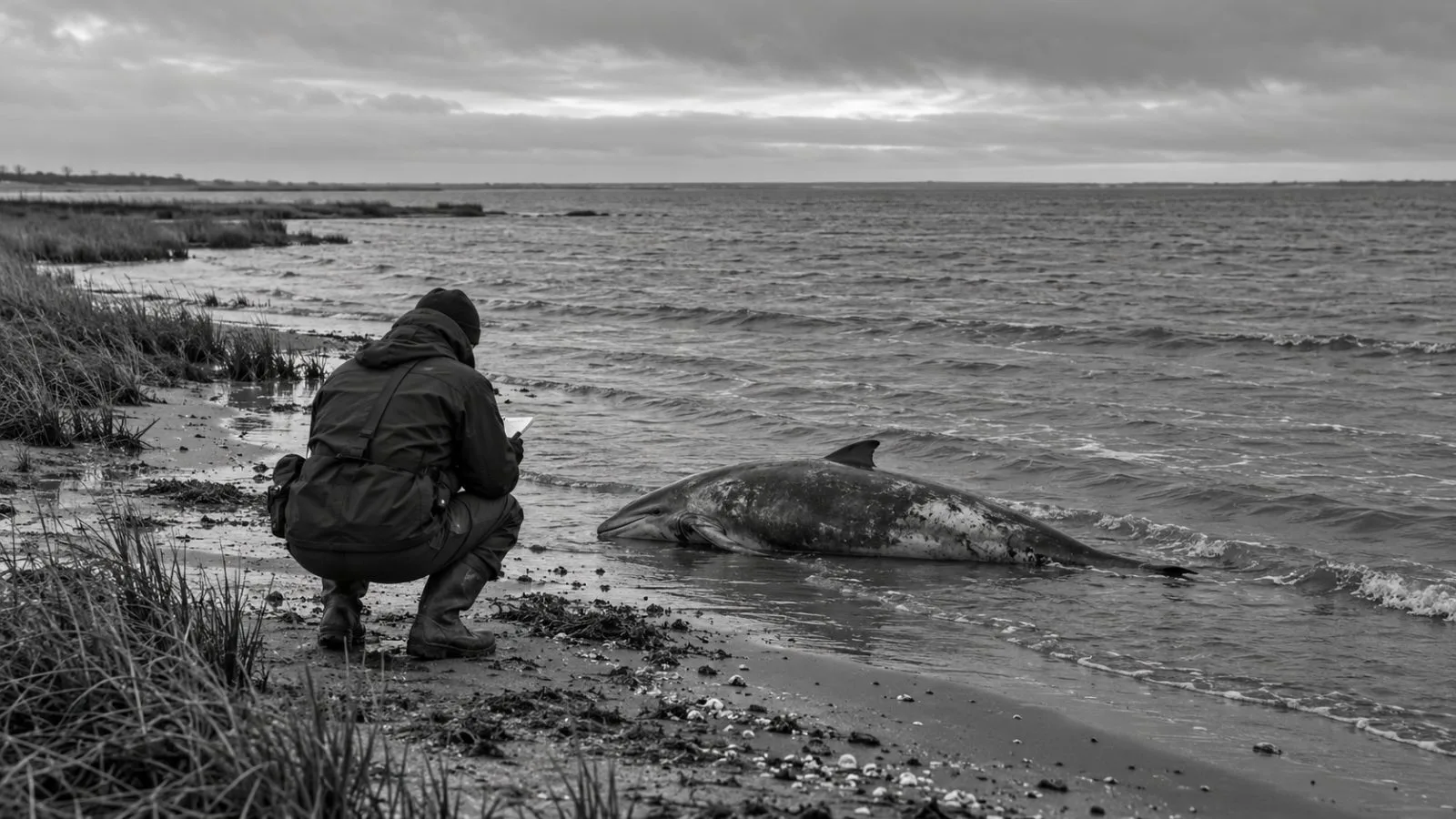
A Ukrainian researcher estimates at least 120,000 Black Sea cetaceans have died during Russia’s full-scale war, a shoreline-based calculation that highlights the scale and uncertainty of marine losses.
Ivan Rusev, head of research at Tuzly Lagoons National Nature Park, gave the estimate in a Sept. 6 interview with the Center for Journalistic Investigations. It includes bottlenose dolphins, common dolphins and harbor porpoises. Rusev applies a 20-fold multiplier to shoreline carcasses, based on his assumption that 5% of dead animals reach land.
A 2023 Biology Letters study coauthored by Rusev estimated 37,500 to 48,000 deaths between April 27 and July 31, 2022. The researchers first extrapolated about 2,500 reported carcasses along 4,800 kilometers of coast to roughly 3,000 for the full 5,800-kilometer coastline, then applied estimated recovery rates of 6.2% to 8%.
A European Cetacean Society conference abstract recorded 914 stranding cases across Bulgaria, Romania, Türkiye, Georgia and Ukraine from January to October 2022. It said each country’s tally was at least double its 2019-21 average. A 2025 research brochure by Pavlo Goldin and Viktor Komorin also cited 914 cases, putting 2022 mortality at 2.2 times the 2019-21 average but below the 2017 mass-mortality year.
The Agreement on the Conservation of Cetaceans of the Black Sea, Mediterranean Sea and contiguous Atlantic Area (ACCOBAMS) reported more than 600 observed deaths along the coasts of Bulgaria, Romania, Türkiye and Ukraine in 2022, with the cause still under investigation. The conference abstract leaves the cause unresolved, with possible explanations ranging from disease and acoustic trauma to displacement, stress and degraded habitat. ACCOBAMS says military noise and explosions can harm cetaceans and identifies bycatch as a major ongoing threat to harbor porpoises. These records cover different periods and kinds of evidence, so they do not independently confirm Rusev’s cumulative estimate or establish one cause for the 2022 increase.
The 2025 brochure says destruction of the Kakhovka dam on June 6, 2023, reduced salinity and changed plankton composition in parts of the Black Sea. It reports that conditions in Odesa Bay later returned to multi-year averages and says war-related environmental effects may reach other Black Sea countries and, indirectly, the Danube and Mediterranean regions.
Researchers behind a 2024 aerial-survey study recommend repeating large-scale surveys at least every six years. Their 2019 survey covered 52% of the Black Sea, and its results were not extrapolated to the entire basin.