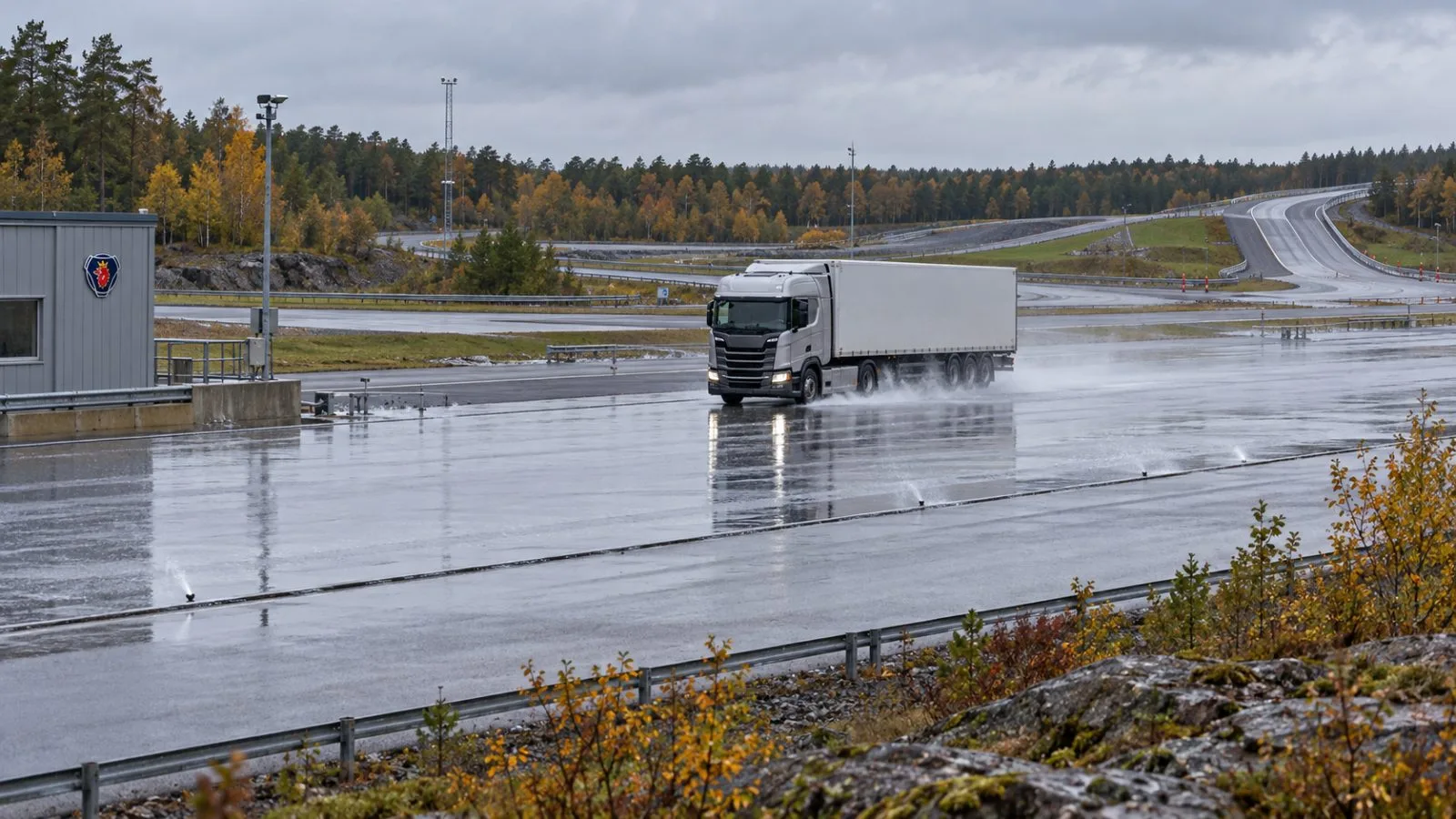
Scania opened a vehicle proving ground in Södertälje, Sweden, on Oct. 19, saying it will bring more electric and autonomous vehicle testing in-house for the truckmaker and its parent, TRATON Group.
Scania put the investment at approximately SEK 975 million and the site's area at roughly 85 hectares. Paved routes run for 13 kilometers; gravel routes add another four kilometers.
The site also contains 230,000 square meters of paved test surfaces and 54,000 square meters of gravel surfaces. Scania said the facility adds to TRATON Group's research and development capacity while giving engineers more room to test vehicles.
Its three water-fed braking tracks use asphalt, concrete and basalt tiles to provide different grip conditions. The basalt track includes a curve for testing how vehicles brake while turning, Scania said.
Engineers can set up trials of automatic emergency braking, lane support and blind-spot warnings, as well as autonomous-driving systems. The company said some tests previously required external facilities.
Banked curves have gradients of up to 22%, while the road surface was designed for repeatable tests over time, according to Scania. The company also identified vehicle dynamics and conventional technologies among the site's test areas.
Scania announced the planned investment in February 2022, when it cited demand for more testing of electrified and autonomous vehicles. Its proposal included a new track and extensions to existing tracks in Södertälje. At the time, Scania expected work to continue until at least 2026, subject to approval of its application.
Scania Chief Technology Officer Sara Forsberg said, “New technology only creates value when it performs in the real world.”
The company estimated that using ECO asphalt and HVO100 fuel for transport, among other construction choices, avoided approximately 30,900 metric tons of carbon dioxide equivalent emissions.