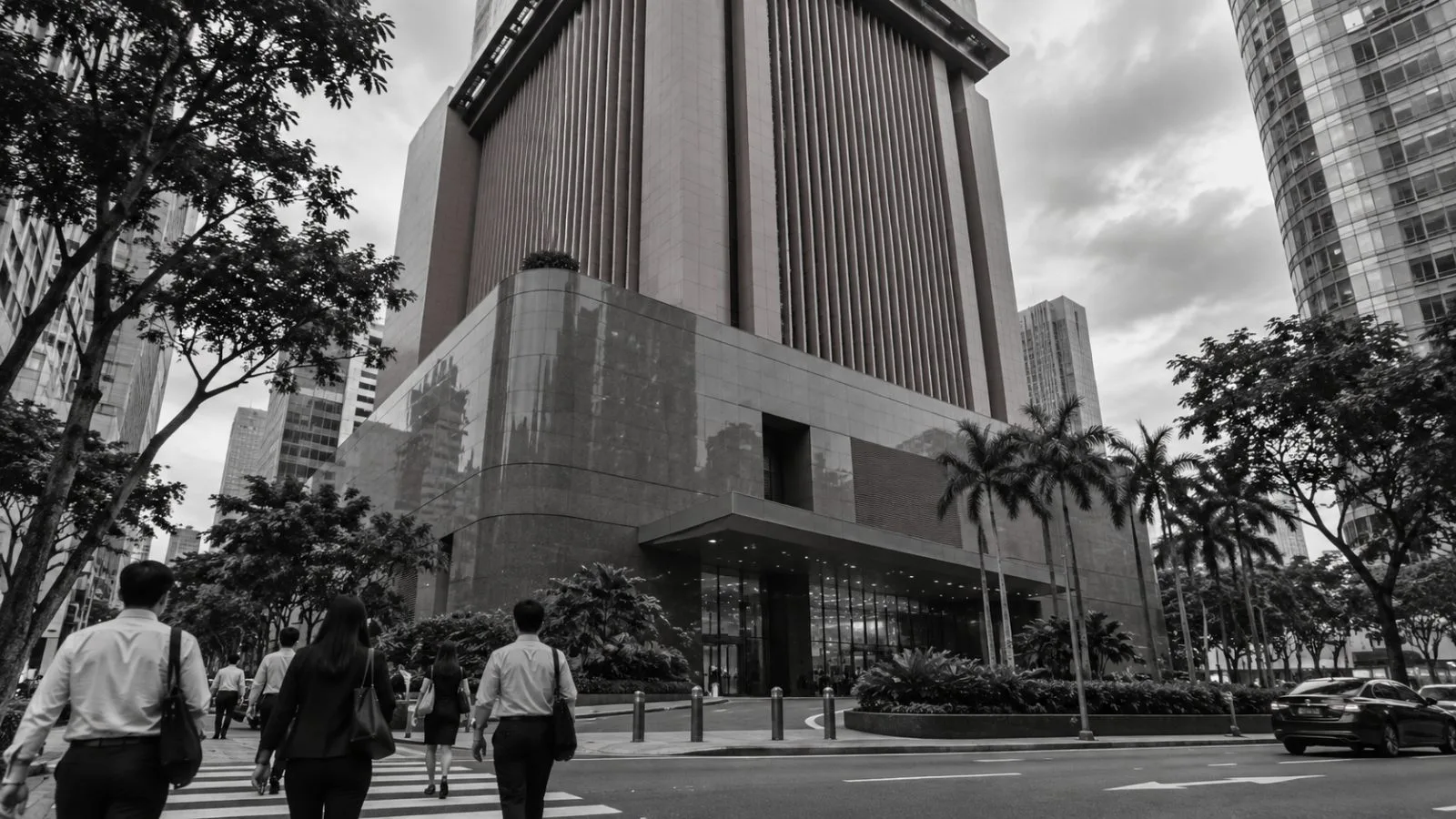
Monetary Authority of Singapore (MAS) Deputy Managing Director (Economic Policy) and Chief Economist Edward S. Robinson said Oct. 20 that demand from AI investment warrants appropriately restrictive policy until wider productivity gains support easing.
Speaking at the Beijing Financial Street Forum, Robinson urged policymakers to adjust gradually as evidence develops. Stronger activity driven by AI spending, he said, does not yet demonstrate that the wider economy can produce more without adding inflation pressure.
Robinson attributed much of the growth in industries producing AI technology to new investment and heavier use of equipment. Early evidence suggests efficiency gains in some applications, he said, but a broad improvement in productivity has yet to emerge.
MAS raised the appreciation rate of its exchange-rate policy band in April and July, then left the setting unchanged Oct. 14. MAS reported core inflation of 2.0% year over year in July and 2.2% in August, averaging 2.1% across the two months, compared with 1.5% in the second quarter. The central bank warned that AI demand spreading through more of the economy could keep inflation elevated if unit labor costs rise more rapidly.
Asian electronics exporters have benefited from that demand. Robinson cited a figure presented July 28 by MAS Managing Director Chia Der Jiun showing that AI-related electronics accounted for more than 70% of Asia’s export growth year to date at that point. Robinson also warned that uneven gains could displace workers and increase income uncertainty.
An Organisation for Economic Co-operation and Development paper projected that AI could contribute 0.25 to 0.6 percentage point annually to total factor productivity growth in the United States over a 10-year horizon. Robinson cited the projection while discussing the investment and adoption needed for wider gains. He drew a comparison with electrification, whose larger productivity benefits followed changes in how factories operated.
MAS is scheduled to release September consumer price data Oct. 23. Its next monetary policy statement is due no later than Jan. 29, 2027.