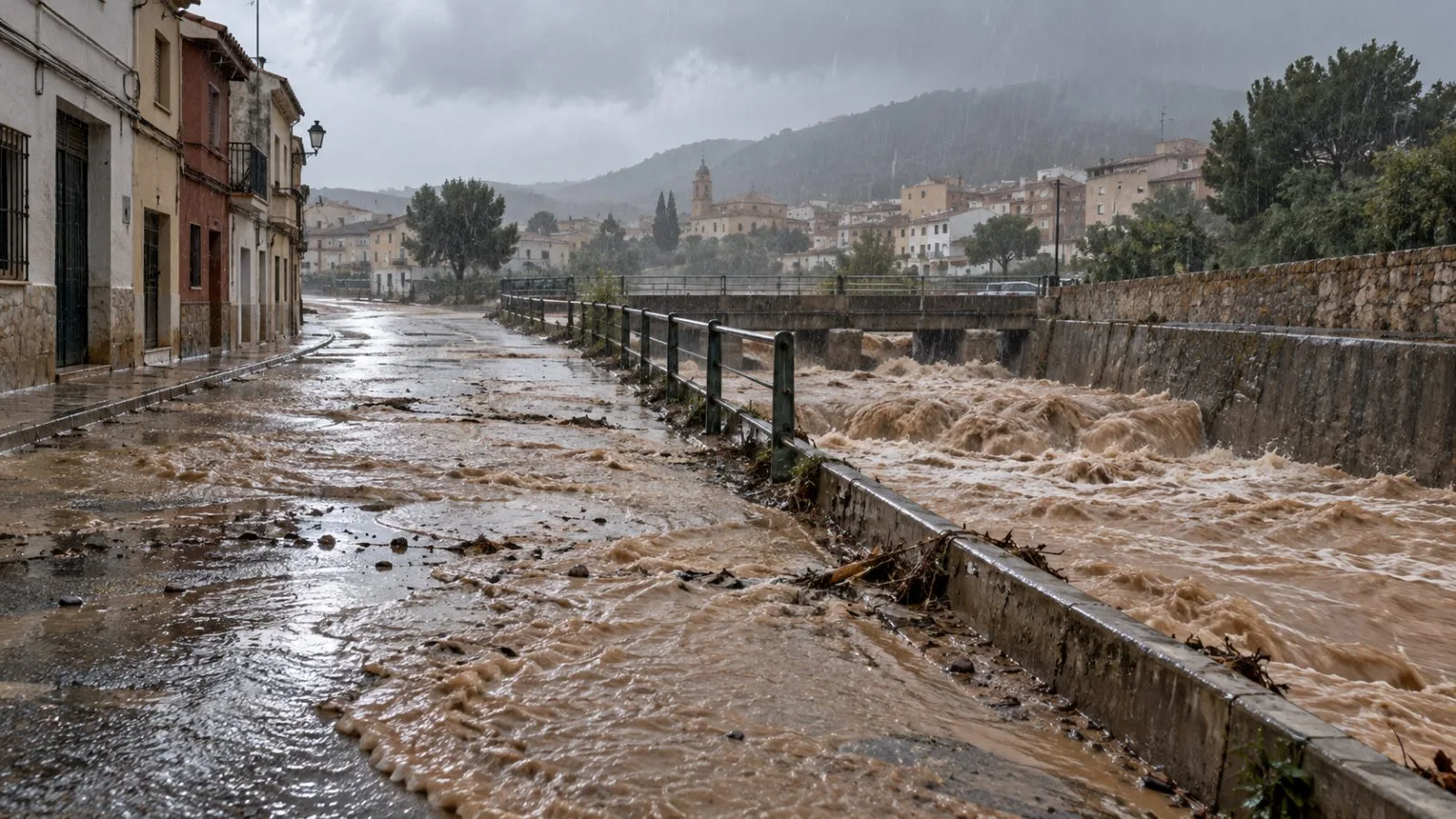
A February 2026 study estimates that human-caused warming intensified rainfall in Spain's deadly 2024 floods, but cannot show whether the weather systems involved are becoming more frequent.
Researchers writing in Nature Communications compared simulations of a storm like the one on Oct. 29, 2024, under present-day and preindustrial conditions. They estimated that warming raised its six-hour rainfall rate by 21%, expanded the area receiving more than 180 millimeters over 24 hours by 55%, and increased total rainfall in the Júcar River basin by 19%.
Those estimates depend on the 2024 storm pattern used in the simulations. The study does not determine whether warming changes how often the atmospheric systems known as DANAs form or the routes they take.
Spain's government lists 241 confirmed deaths across the regions affected by the 2024 disaster, including 233 in the Comunitat Valenciana. It reported about €9.93 billion in recovery resources used through Oct. 19, 2026, across aid, financing or guarantees, and direct works.
At Turís in Valencia, Agencia Estatal de Meteorología (AEMET), Spain's state weather agency, measured 771.8 millimeters of rain in 24 hours on Oct. 29, 2024. That included 184.6 millimeters in one hour, a Spanish record. AEMET's records put the 24-hour total below the 817 millimeters measured at Oliva, Valencia, on Nov. 3, 1987.
DANA stands for Depresión Aislada en Niveles Altos, an upper-level low-pressure system separated from the prevailing atmospheric flow. AEMET says such a system does not always cause major damage. In eastern Spain, Mediterranean moisture can rise over inland terrain and fuel heavy rain; AEMET also documented successive thunderstorms crossing the same areas during the 2024 storm.
AEMET named another high-impact DANA, Adam, on Oct. 16. The Secretaría General de Protección Civil y Emergencias warned that intense rain could affect Spain's Mediterranean coast and the Balearic Islands from Oct. 17 through at least Oct. 19, with Oct. 18 and 19 expected to be the most severe days.
A separate rapid analysis by World Weather Attribution estimated that comparable one-day rainfall extremes in central and southeastern Spain during September through December were about 12% more intense and twice as likely in a climate 1.3 degrees Celsius warmer than preindustrial conditions. Its researchers said the analysis was not a formal attribution study. Neither analysis estimates warming's contribution to Adam's rainfall.