


 Australia Consumer Confidence Plunges as RBA Rate Hike Hits Households
  German Industrial Orders Plunge 10.6% in August
  Samsung, SK Hynix Shares Fall Ahead of Q3 Earnings
  Wall Street Rises as Oil Prices Ease, Nasdaq Hits Record
  RBI Raises Repo Rate to 5.50% in Hawkish Shift on Inflation Risks
  Gold Prices Fall as Stronger Dollar Weighs on Bullion
  Dollar Retreats From 18-Month High as Euro Rebounds
  Iran Tanker Attacks Surge as Hormuz Oil Flows Near Prewar Levels
  Japan Real Wages Rise 1.5%, Supporting BOJ Rate Hikes
  China Shuts 670 Banks as Bitcoin Eyes Financial Risks
  S&P 500 Hits Record High as AI Rally Lifts Wall Street
  Trump Opens Tax-Exempt Dyed Diesel Access as Fuel Prices Surge
  Indian Stocks Fall as RBI Hikes Rates to 5.50%
  Oil Prices Fall as Middle East Exports Recover, G7 Eases Supply Fears
  Nasdaq Hits Record High as Tech Stocks Lift Wall Street
  Thailand Plans Dual-Class Shares to Revive IPO Market
  Ukraine Faces $56 Billion Budget Gap as War Costs Soar


 Add as a preferred source on Google
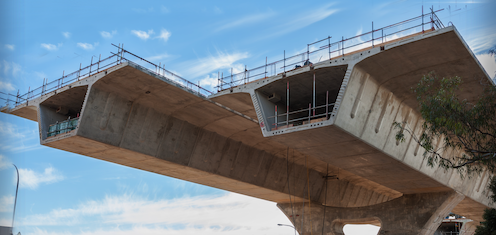

The federal government has just announced a list of projects to be abandoned as a result of an independent strategic review of its infrastructure investment program.
The review found the cost of the A$120 billion, ten-year program had blown out by $32.8 billion, half of which was in projects not yet under construction.
But the flaws in national infrastructure planning go much deeper than the question of whether or how projects are listed on a spreadsheet, and how much their costs blow out.
A national framework built around Infrastructure Australia was supposed to resolve differences between the states and the federal government on projects before they get approved.
In the late 1990s and early 2000s, as Australia was recovering from recession, demands for new infrastructure funding grew.
Sydney, which had been “full up” according to then NSW Premier Bob Carr and had economised on spending in the runup to the 2000 Olympics, desperately needed new infrastructure.
With their budgets constrained, states began pitching projects to the federal government, but incoherently and without a national framework.
The Rudd Labor government went to the 2007 election promising to bring coherence and rationality to national infrastructure planning.
Independent advice was meant to fix things…
Rudd and the then infrastructure minister Anthony Albanese established Infrastructure Australia as an independent statutory authority to provide advice on national needs and project priorities. The idea of it being independent came from technocratic bodies such as the Reserve Bank and the Productivity Commission.
Infastructure Australia was diligent in its approach.
It undertook national infrastructure audits to determine key areas of need, prepared uniform criteria by which projects should be assessed, and compiled priority lists of projects assessed on merit against those criteria.
Final decisions on funding would rest with ministers, but they would have the benefit of Infrastructure Australia’s independent advice.
…but big projects are inherently political
But large infrastructure projects addressing public and business needs are unavoidably political.
As desirable as an independent body assessing projects on merit seems, retail politics militate strongly against delegating decisions to technocratic bodies.
But conversely, a minister who is seen to reject official independent advice is politically exposed. This gives both the agency and the minister strong imperatives to preserve each other’s modesty.
From the mid-2010s to the early 2020s, the Australian public service became increasingly politicised, resulting in hollowing out of expertise, loss of independence, and scandals such as robodebt.
‘High priority’ versus mere ‘priority’
Infrastructure Australia, while independent of the core public service in the same way as is the Reserve Bank, became subject to political pressure.
This is exemplified by the case of Victoria’s East-West Link toll road. The Abbott Commonwealth government committed to the project ahead of the 2014 Victorian election, despite the project having a benefit-cost ratio of less than one, meaning that its benefits were less than its costs.
Under the pressure to resolve the contradiction, Infrastructure Australia created a “high priority” list in addition to its existing “priority” list.
The new “high priority” list would include only the projects assessed as having the greatest value to the nation. The existing repurposed “priority” list could house the politically important but less meritorious projects, allowing politicians to claim these projects were “priorities”, even if their absolute merit was doubtful.
East-West Link funded then cancelled
The 2014 Victorian election result rescued some modesty after the newly elected Dan Andrews abandoned the East-West Link, but the interplay between political needs and technical rationality has if anything gotten worse.
Andrews’s $200 billion Suburban Rail Loop was endorsed electorally at the 2018 and 2022 state elections despite not appearing in any formal metropolitan or statutory transport plans.
At the time of the 2022 federal election, it hadn’t been submitted to Infrastructure Australia for assessment. But the federal Labor opposition, now the government, committed $2.2 billion to it.
Victoria has since submitted the Suburban Rail Loop to Infrastructure Australia, but the assessment is unfinished. Yet it appears on the updated federal infrastructure funding list released by the minister today.
Is Infrastructure Australia independent enough to reject the Suburban Rail Loop if it fails its assessment criteria?
‘Not demonstrably merit-based’
The Suburban Rail Loop is not alone as an infrastructure project promoted well in advance of its assessment. In the leadup to the 2019 election, the Morrison government released proposals for car parks at suburban rail stations.
This scheme was never submitted to Infrastructure Australia and was later found by the Commonwealth Auditor General to be “not demonstrably merit-based”, a finding Labor categorised as “sports rorts on steroids”.
The Independent Strategic Review of the national infrastructure program released on Thursday responds in part to these concerns.
It recommends that 86 projects deemed of lower merit be stopped, and supports another 156, with 32 to be determined through further assessment.
The review also offers advice about how to improve infrastructure planning. It recommends each state prepare an annual infrastructure plan identifying priority projects over ten years, and their proposed sequencing.
The federal government would provide an annual overview of infrastructure planning and priorities to inform assessment and decisions. Funding would usually be split 50:50 between the federal government and the states.
These are useful improvements but they still leave infrastructure open to gaming. There’s more that could be done.
The beginning of a way forward
A first option would be to raise the value threshold for individual projects the Commonwealth should even begin to consider, say $1 billion. Others could be funded through a bulk annual grant to each state.
A second option would be to require a higher merit threshold for considering a project. This would involve assessing regulatory, pricing or taxation alternatives before considering an infrastructure solution.
If after this assessment, infrastructure is deemed appropriate, alternative types of projects should be openly considered. Only after that’s done should the preferred project be considered for funding.
If this had applied to the Suburban Rail Loop, the Victorian government could have been told to assess other options, such as the tram and bus put forward by researchers at the University of Melbourne.
For projects worth more than $1 billion, open parliamentary inquiries could be held to transparently assess their merits and allow for expert and public opinion to be aired on the record.
A further option would be to require rigorous carbon emission analysis of all projects and reject those that conflict with national climate goals.
This would make big infrastructure less attractive, given the carbon content of concrete and steel, and in transport would favour rail freight over roads, and public transport, walking and cycling over driving.
Lastly, all projects funded through Infrastructure Australia should be subject to independent public after-the-event analysis to create an accessible database of what worked and what did not.
Infrastructure is costly. Cheap politics and getting it wrong adds to inflation.








