Imagine a house is on fire, and someone is actively pouring gas on the fire. They then pour a little less gas and want credit for doing so, despite still feeding the fire. Perhaps they claim they are now “fire neutral”.
We’d rightly be very sceptical of such claims. Yet that is more or less what some influential supporters of the livestock industry have done.
I’m referring to eye-catching and influential recent studies published in peer-reviewed livestock science journals which claim that the meat and dairy industries are or can easily be “climate neutral”.
For example, one study claims that the US dairy industry could reach climate neutrality by 2050 through reducing its annual methane emissions by just 1%-1.5%. Another declares that some US livestock sectors are “already part of a climate solution” and that the Californian dairy industry could “induce cooling” under annual methane reductions above 1%.
Several industry bodies have recently adopted and widely publicised goals based on these reports. For example, the National Cattlemen’s Beef Association in the US has stated its ambition to reach climate neutrality by 2040, while consumers in Australia are told that their lamb has a neutral, or even negative, climate footprint.
The claims are especially striking because methane is a potent greenhouse gas that accounts for 0.5°C of global warming so far, and we know that livestock production accounts for about one-third of human-caused emissions. That methane is a product of the digestion processes in cattle, sheep, and other ruminants, emitted when they belch.
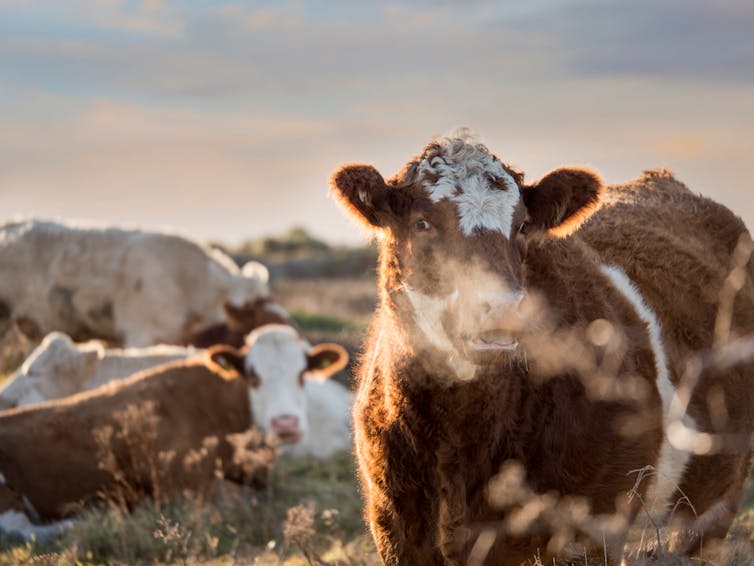
Moothane emitters. mark gusev / shutterstock
So these claims certainly deserve scrutiny. In a paper now published in the journal Environmental Research Letters, my co-author Donal Murphy-Bokern and I argue that these claims represent a distorted understanding of the science. There’s a risk that they could be used for greenwashing and undermining confidence in this area of climate science.
We show how easily subtle shifts in definitions, combined with overlooking key facts, can distort understanding to the point where significant emitters of greenhouse gases are presented as “climate neutral”.
Changing definitions and climate metrics
The term “climate neutral” was first coined by policy makers to refer to net-zero emissions of greenhouse gases. These gases were measured using a long-established scale that represents their warming effect over a 100-year period, expressed in CO₂ equivalents – this is the so-called “global warming potential” or GWP100 and it was used in the preparation of the Paris agreement.
But GWP100 is still imperfect because while most methane is in the atmosphere for only a couple of decades, carbon dioxide can linger for centuries. That’s why in 2018 some academics introduced a new metric called GWP* to better represent the warming impact over time.
But the reports we examine have used GWP* to subtly shift the meaning of the term climate neutral from net-zero emissions to net-zero additional warming, where “additional” refers to warming on top of that already caused by the livestock sector, not warming compared to if the sector stopped entirely. This means a historically high emitter such as the beef industry can get off easily.
Using GWP*, a livestock sector with high but declining methane emissions can claim to be climate neutral since it adds less additional methane to the atmosphere – and therefore less additional warming – each year. This is referred to in some of these studies as a “cooling effect”, which is misleading since it’s not cooling the atmosphere, only warming it slightly less.
These studies also fail to make clear that, like methane itself, this “cooling” effect of methane reductions is temporary. And the level at which they stabilise will likely still be high enough to cause significant warming.
GWP* certainly has merit when applied at the global level. However, even the scientists who developed it agree it shouldn’t be used to assess a particular region or sector such as livestock.
Our investigation shows how its use here could be used to support greenwashing. This risks undermining climate science by confusing businesses, consumers and policy makers. These recent climate neutral claims distract us from the urgent challenge of reducing emissions of all greenhouse gases from all sectors, including agriculture.