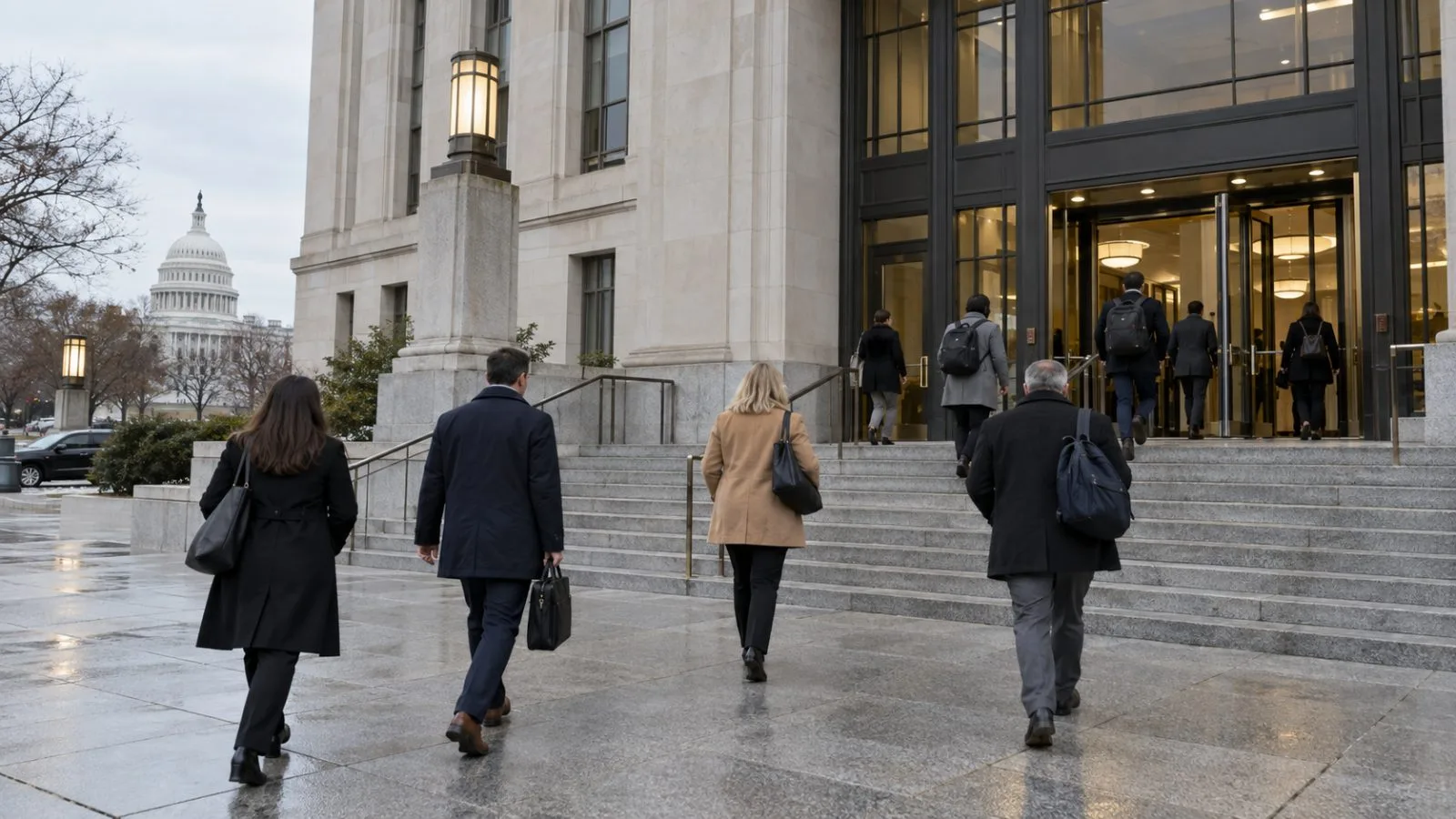
The share of U.S. wage-and-salary workers employed in the public sector fell from 1994 to 2022 even as headcount rose, leaving workforce share an incomplete gauge of government capacity.
A Bureau of Labor Statistics analysis of Current Population Survey data found that public-sector workers made up 15% of wage-and-salary employment among people age 16 and older in 2022, down from 17% in 1994. The number of public workers rose over the same period, from 18.34 million to 21.30 million.
Nonprofit employment also grew, from 5% of wage-and-salary workers, or 5.44 million people, in 1994 to 7.2%, or 10.22 million, in 2022. The analysis does not show that nonprofits replaced government jobs. Its nonprofit category includes workers in fields such as hospitals, education and religious organizations, and does not isolate government contractors.
In an Oct. 23, 2023, essay published by Noahpinion, writer Noah Smith argued that using nonprofits and consultants to perform public functions can leave agencies without enough expertise to oversee the work or assess providers’ costs. In Smith’s account, outside providers may gain public work while taxpayers bear the risk of waste. The BLS analysis does not measure contracting, costs or service performance.
Smith made a separate argument about environmental review, saying judicial involvement can delay infrastructure projects. The employment data do not assess that claim. Economists Noel D. Johnson and Mark Koyama describe state capacity in terms of a government’s ability to raise revenue, maintain public order and provide shared goods and services. They distinguish those abilities from the size of the state, so workforce totals alone do not establish whether capacity has weakened.
A separate BLS historical series, based on nonfarm employment, put the government share at 9.5% in 1920 and 19.1% in 1975; it was 18% in the first quarter of 1981. That series uses a different employment measure from the 1994-to-2022 analysis.
The Organisation for Economic Co-operation and Development reported that general government accounted for an average 18.4% of employment across member countries in 2023, up 0.3 percentage points from 2019. Its measure also includes nonprofits controlled by public authorities, so it is not directly comparable with the BLS figures.
A 2021 Niskanen Center report by Brink Lindsey identified the federal workforce, tax collection, federal information technology, environmental review and public health as areas for rebuilding capacity. Lindsey cited World War II mobilization, the Manhattan Project and Project Apollo as historical examples of government capability.