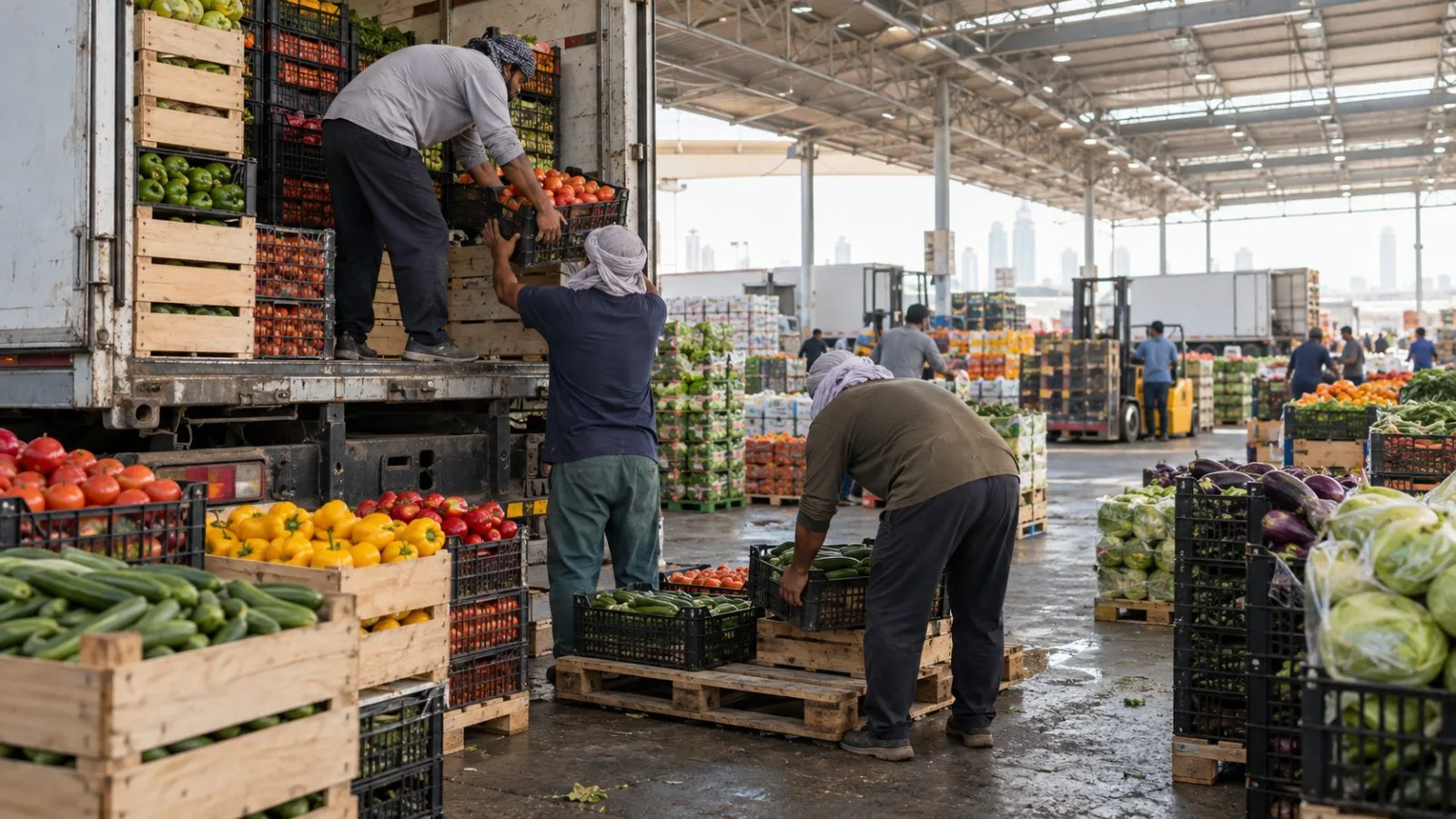
The United Arab Emirates is seeking to reduce exposure to food supply disruptions through a strategy that calls for three to five alternative sources for each major food category.
Presented in November 2018, the National Food Security Strategy 2051 identifies a basket of 18 main food types. The basket reflects domestic consumption, production capacity, processing requirements and nutritional needs, and the strategy contains 38 short- and long-term initiatives, according to a Federal Competitiveness and Statistics Centre report.
The UAE government portal says the framework combines diversified food imports with domestic production and strategic reserves. It also aims to make the UAE the world’s best in the Global Food Security Index by 2051.
Gulf News reported Sunday, Oct. 25, that the Ministry of Climate Change and Environment (MOCCAE), in comments to the Emirates News Agency (WAM), described a review of food supply resilience. It considers the diversity of countries of origin and suppliers, stock levels relative to consumption, and the time needed to secure alternatives. Gulf News also reported that officials assess trade routes, transport and storage efficiency, and food loss and waste.
Gulf News said that if a source or route is disrupted, officials would coordinate with suppliers, private businesses and transport partners, while adjusting shipments and bringing alternatives into use.
At a MOCCAE dialogue in New York on Sept. 27 during the United Nations General Assembly, Minister of Climate Change and Environment Dr. Amna bint Abdullah Al Dahak said, “Food security cannot be measured by production alone.” WAM reported that officials discussed risks to food and water systems, including trade and energy disruptions and reduced availability of fertilizers and agricultural inputs. WAM said better preparation could reduce disruption effects on farmers, consumers and communities.
MOCCAE’s national food loss and waste initiative aims to reduce food waste by 50% by 2030, according to a ministry guide.