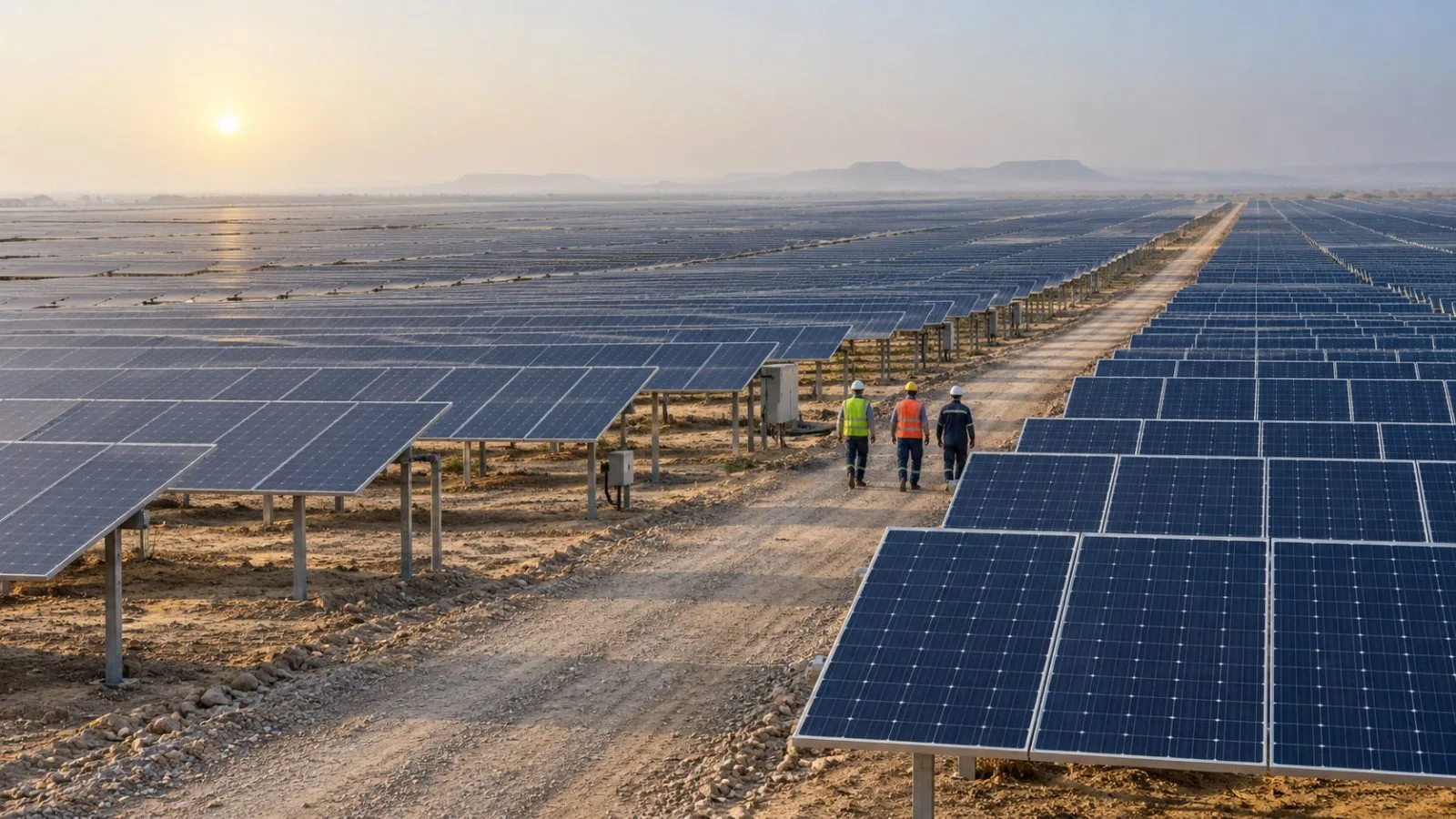
The UAE is projected to lead the global ranking for solar photovoltaic (PV) generation per resident in 2031, amid broader renewable growth across the region, the International Energy Agency (IEA) said.
The agency’s Renewables 2026 report, published Nov. 6, places UAE output above 4,000 kilowatt-hours per person. Australia, Oman, Bulgaria and Qatar follow in the chart. The comparison measures generation per capita; it does not establish which country will produce the most solar electricity overall.
The IEA raised its UAE outlook after accounting for stronger clean-energy targets and plans to expand Dubai’s Mohammed bin Rashid Al Maktoum Solar Park. Dubai Electricity and Water Authority says the park has 3,860 megawatts of production capacity, with plans to exceed 8,000 megawatts by 2030.
The UAE aims for clean energy to supply 35% of electricity generation by 2031. The target covers nuclear power as well as renewable sources. Sharif Al Olama, Undersecretary for Energy and Petroleum Affairs, said clean energy accounted for 32.4% of the country’s electricity generation in 2025, according to a Ministry of Energy and Infrastructure release.
The regional forecast points to a wider expansion: renewable capacity in the Middle East and North Africa is expected to reach almost 200 gigawatts by 2031, more than twice its current level. The IEA also projects global renewable capacity to gain more than 4,770 gigawatts during 2026-2031, a 57% increase over the 2020-2025 period. Solar PV is expected to provide three-quarters of that growth.
The IEA cites energy security concerns, supportive policies and stronger cost competitiveness for wind and solar among the forces behind the expansion. It says renewable energy can reduce countries’ exposure to imported fuels and volatile prices. The agency also notes that the UAE imports more natural gas than it exports despite its position as a major hydrocarbon producer.