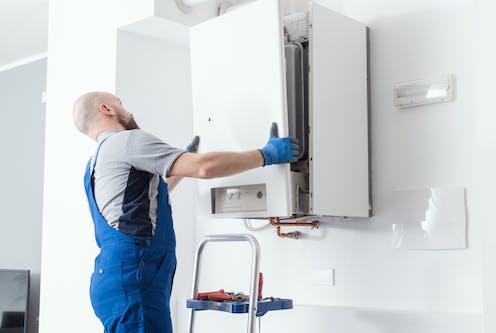
Boilers will be banned in new-build homes in the UK from 2025, according to a long-awaited government consultation on energy efficiency standards in the housebuilding industry. The report said that there is “no practical way” that installing boilers of any type will “deliver significant carbon savings and ‘zero-carbon ready’ homes”.
What’s more surprising is that hydrogen has also been ruled out as a potential heating source. Previously, hydrogen had been touted by both the government and the energy industry as a logical replacement for the natural gas (a fossil fuel and contributor to climate change) that is pumped through the national grid and burned in boilers throughout the UK.
Provided it is made without emitting carbon, typically by using renewable electricity to separate water molecules, hydrogen is a “clean” fuel. But the vast majority of the hydrogen used worldwide is produced using fossil fuels, making it a dubious green alternative.
A report in March 2023 by a UK government advisor recommended blending up to 20% hydrogen into the gas grid. Some of the biggest boiler manufacturers called for “all boilers to be hydrogen-compatible as of 2025”. And, as recently as December 2022, the government considered making all gas boilers sold to homes from 2026 capable of one day burning hydrogen instead.
Three towns, Whitby in Cheshire, Redcar in North Yorkshire and Levenmouth in Fife, were even chosen to host trials where several homes would be heated with hydrogen.
Outside of the bubble inflated by the government and industry figures, few thought that using hydrogen for home heating was a good idea. Hydrogen won’t solve either of the two biggest energy challenges: cost and carbon emissions. The process of making hydrogen is significantly more expensive than pumping natural gas and there simply is not enough “clean” hydrogen available.
A 2022 report by Dr Jan Rosenow from the University of Oxford reviewed 32 international studies on the use of hydrogen for heating and concluded that its widespread use was not justifiable. “Hydrogen use for domestic heating is less economic, less efficient, more resource intensive, and associated with larger environmental impacts” than alternatives such as heat pumps, it said.
Heat pumps are rapidly becoming the default choice for heating (and cooling) globally. Using the same technology as a refrigerator or air conditioner, heat pumps powered by electricity extract and transfer heat to where it is needed.
Did COP28 burst hydrogen’s bubble?
The timing of the consultation is intriguing. It was originally scheduled to be published in late 2020 but was postponed several times. It was finally released on December 13 2023, on the same day that nearly 200 countries agreed to “transition” away from fossil fuels at the COP28 climate summit in Dubai.
A few days prior to this on December 8, a broad range of government, industry and voluntary organisations launched a joint declaration at COP28 on the Responsible Deployment of Renewables-Based Hydrogen.
The declaration includes a pledge to prioritise clean hydrogen for “displacing the current use of fossil-based hydrogen” where a lot is already needed, or for “hard-to-abate sectors” such as heavy industry where a lot more will be needed. It went on to state that its use for heating would be “potentially cannibalising renewable electricity”. This is because you end up with only two-thirds of the energy in the hydrogen that you started with from the electricity.
As for the three trial projects, two have already been cancelled due to protests and a lack of uptake by residents. It is hard to see how the one remaining in Fife could sensibly proceed – especially as the Scottish government signed the Responsible Hydrogen declaration.
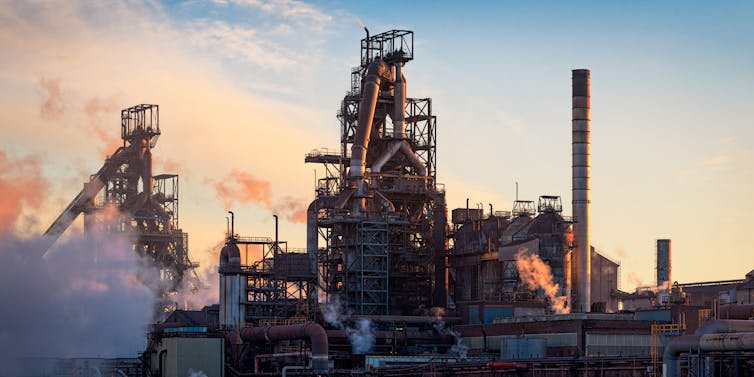
Port Talbot Steelworks in south Wales. Chris Goddard/Shutterstock
What the future holds
This is just a consultation. In other words, a government policy document submitted for public feedback. There is no guarantee that the ban on hydrogen boilers will be implemented by parliament. It is probable that energy industry groups will lobby for changes through the consultation process, and ultimately it will be the politicians who decide.
But the direction of travel has been set. This is “the beginning of the end” of the fossil fuel era according to the UN Climate Change Executive Secretary Simon Stiell in his closing speech at COP28.
Germany’s climate envoy Jennifer Morgan said: “Now the signals are clear. If you’re an investor, the future is renewable. Fossil fuels are stranded assets.” Clean hydrogen will be a part of that transition but only where no viable alternatives exist.
Regardless of whether the recommendations of the Future Homes consultation become law, we can safely say a few things:
- Hydrogen will not be used for home heating in any meaningful way. Even if the government ignores the consultation, there is neither scientific nor public support for its use and it will not reduce energy costs.
- Assume that all new-build homes will be fitted with heat pumps starting within the next few years. The reality is they are cost-effective to install and operate, especially as insulation levels are increased such that the need for space heating becomes minimal.
- The only real alternative to heat pumps, especially for apartments, are district heat networks where hot water gets pumped around a whole neighbourhood from a central source. These are commonplace in many cold countries, so we should expect to see a lot more of them in the UK.
The other certainty is that home boilers will very soon move into the realm of nostalgia.