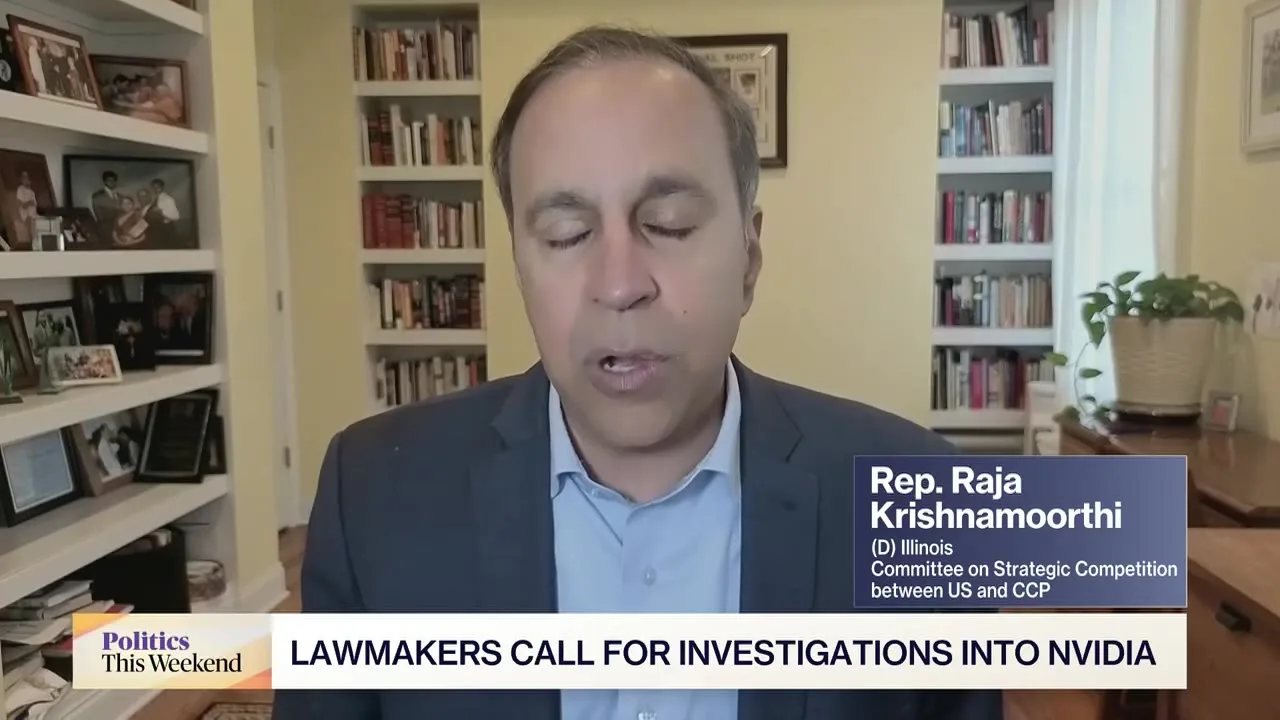
Congress must tighten chip export controls before year-end and investigate possible national security damage involving Nvidia and China, U.S. Representative Raja Krishnamurthy said in a Bloomberg Television interview published Nov. 15.
The Democrat said legislation he had steered through the House remained pending in the Senate. He wants Congress to pass it before its December finish, without waiting for the next Congress.
Krishnamurthy, who serves on the House Intelligence Committee and the Select Committee on the Chinese Communist Party, identified possible damage to national security as his first question for Jensen Huang.
He wants to establish what Alice Wong learned about U.S. secrets and what Huang knew about her potentially moving advanced Nvidia chips to China. His questions also cover possible remote access through her data centers for Chinese entities barred from receiving the technology.
“I think that she's probably closer to somebody who was an asset,” he said of Wong. He alleged that China's Ministry of State Security had learned important secrets concerning Nvidia and Huang.
He described the suspected access as potentially “the tip of the iceberg,” saying the routes by which other advanced chips reached China remained unclear. He argued that such chips could go into Chinese military systems.
He then accused the administration of giving Huang favorable treatment because of his access to President Donald Trump. Krishnamurthy put Huang's donation to Trump's ballroom project at about $25 million.
He alleged that Trump and Commerce Secretary Howard Lutnick had refused to blacklist Mega Speed, which he described as a large Nvidia customer controlled by Wong. Blacklisting would restrict the company's access to U.S. technology.
Asked whether Lutnick should leave office, Krishnamurthy made his answer conditional on whether Treasury Secretary Scott Bessent's account was accurate. If Lutnick had refused to enforce export controls in this case, he should go.
Krishnamurthy said he did not know what Huang's security advisers had told him. He called for an investigation, accountability for anyone involved in a possible breach and legislation closing gaps in the controls.
He wants the chip issue included in Trump's forthcoming talks in China and hopes Huang will not accompany him. He also wants artificial intelligence regulation discussed, while arguing that U.S. enforcement should proceed without waiting for Chinese cooperation.
He extended his criticism to corporate oversight, saying other executives and boards should scrutinize the risks surrounding their chief executives. He alleged that Nvidia's board had allowed Huang too much freedom.
Turning to congressional oversight, he listed investigations into the Epstein sex trafficking ring and alleged failures to scrutinize corporate interests and billionaires. He also called for scrutiny of alleged corruption in the administration.
He said Democrats should connect that work to voters' concerns about the cost of gas, groceries, rent and health care. He argued that economic circumstances drove voting decisions alongside concerns about corruption.
His proposed investigation would still need to establish the extent of any security breach, Huang's knowledge and how chips reached China. He gave no bill number or detailed provisions for the legislation he wants passed.