
US retail sales statistics for June will be released at 12:30 GMT, today.
Why retail sales and US consumers are important?
- Domestic consumption of goods contribute about 25% of GDP or around $ 4 trillion as of 2014. Among this Durable goods such as vehicles, furniture account for only $1.3 trillion. Buying of non-durables such as food, clothing account for $2.7 trillion.
- Moreover services, which is not covered by retail sales account for 45% of the GDP and mainly consumed at home.
Past trends -
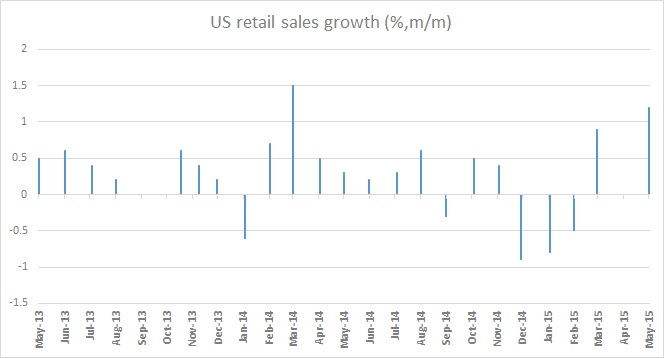
- Retail sales as well as personal consumption expenditure have been growing in last few years, however pace of growth is yet to turn robust. Since December sales growth has been in negative, which is showing signs of comeback in the second quarter.
- After failing to grow in April, retail sales grew 1.2% m/m in May.
Expectations today:
- Retail sales are expected to grow at 0.3% and excluding vehicles about 0.5% for March.
Impact:
- Dollar is already performing strong this week, might get further boost if retail sales beat expectations. Euro, Yen and Franc remains most vulnerable against dollar.
- Dollar index is currently trading at 96.66, down -0.15% today.
- However weaker sales data might push stronger pound to break above 1.562 against dollar.


