
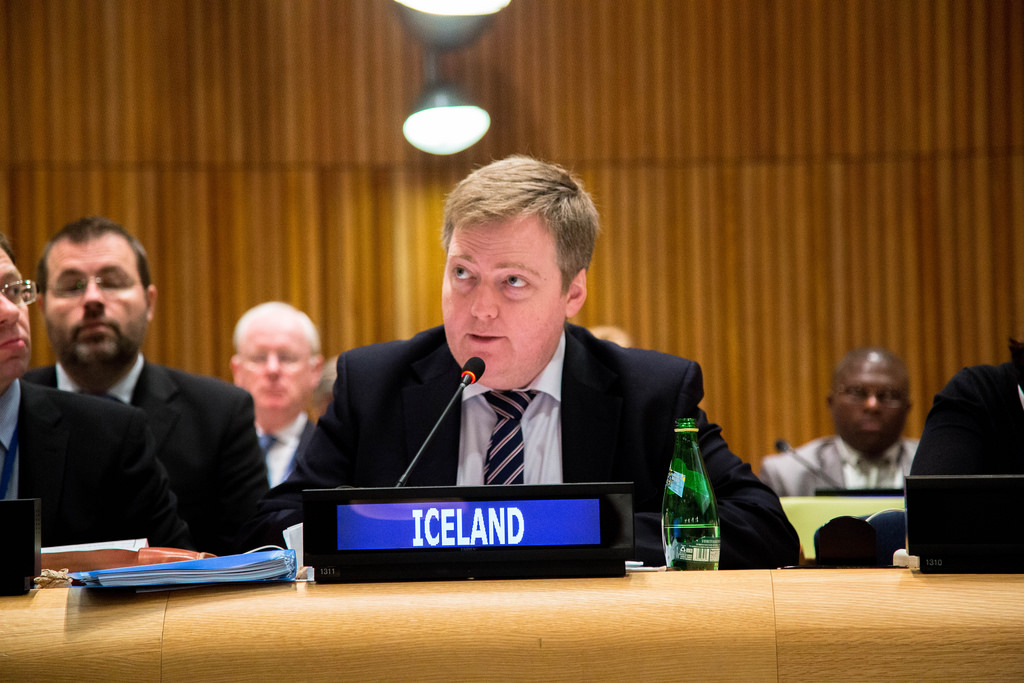
The release of the Panama Papers will have a huge impact around the world. But Iceland deserves some particular attention.
According to documents leaked from Panamanian law firm Mossack Fonseca, several Icelandic politicians, former bankers and government advisers have had links to anonymous offshore companies. Among them, are three members of the Icelandic government: prime minister Sigmundur Davíð Gunnlaugsson, finance minister Bjarni Benediktsson and interior minister Ólöf Nordal.

The public reaction has been rapid and vehement. Within hours of the revelations, protests were being planned. Off the back of these accusations, these three politicians face the potential collapse of their right-wing coalition government, even though Gunnlaugsson has said he does not intend to resign.
Turbulent times
The Icelandic political landscape has changed drastically since October 2008, when the remote island was hit by the global recession. Back then, three of Iceland’s largest banks, Kaupthing, Landsbanki and Glitnir, faced default as a result of their aggressive expansion strategies.
In response, the Icelandic parliament passed an emergency act enabling the authorities to intervene in their operations. The Icelandic króna dropped in value against other currencies and the government of the time (a coalition between the right-wing Independence Party and the left-wing Social Democratic Alliance) decided not to intervene.
As a result of the collapse, the country entered a recession. Inflation and unemployment skyrocketed. Peaceful protests known as the “pots and pans revolution” started on the streets of Reykjavik. A new political party, the Citizen’s Movement (later renamed The Movement), emerged from these protests and included Birgitta Jónsdóttir, who would later co-found the Icelandic Pirate Party.
The government collapsed in January 2009 and early elections were held. The Citizen’s Movement entered parliament and the Independence Party, which had been in power for 18 consecutive years, lost nine of its 27 seats. The Social Democratic Alliance formed the first left-wing government in Iceland’s history as part of a coalition with the Left-Green Movement.
The new government applied to join the European Union, bankers were jailed, and most importantly, a Constitutional Assembly composed of Icelandic citizens was formed in 2011 to draft a new constitution.
However, the left-wing government proved unpopular. It was defeated in referendums over the Icesave dispute and unemployment remained high by Iceland’s standards. The application for EU membership divided the population, and there were internal disputes between coalition partners.
The government lost the 2013 elections, and a right-wing coalition composed of the Progressive and Independence parties, led by Gunnlaugsson, was formed.
But this administration has taken a series of extremely unpopular decisions. It froze the constitutional reforms and EU accession talks, despite promising a referendum on the latter. In May 2015, thousands of protesters called for the government to resign and listed a series of 99 reasons including allegations of corruption.
What next?
The Panama Papers will exacerbate tensions between politicians and the population. It is inconceivable that Gunnlaugsson can hold onto power given the allegations against him.
Sigmundur Davíð Gunnlaugsson walking out of an interview with SVT about offshore dealings.
Early elections are a real possibility, especially since a motion of no confidence is being prepared by opposition parties.
And, surprising as it may sound, that could mean the Pirate Party will form at least part of the next government. Despite currently only holding one seat in parliament, the group is polling miles ahead of the pack.
The most recent poll (conducted before the release of the Panama leaks) suggests the Pirate Party would get 36.1% of the votes if an election were called. That’s more than the coalition’s Progressive and Independence parties combined.

That could well mean that this group, which campaigns for direct democracy, transparency, net neutrality and freedom of expression, could form a government.

Birgitta Jónsdóttir of the Pirate Party. Pirátská strana, CC BY-SA
The likely success of the Pirate Party in Iceland could inspire other Pirate Parties across Europe. So far, the electoral success of these groups has been limited to Iceland and, to a lesser extent, Sweden and Germany. They have tended to be seen as single-issue parties. Julia Reda is currently the only Pirate elected in the European Parliament.
However, should the people of Iceland begin a peaceful revolution, it could increase the visibility of other Pirate parties across Europe, and possibly lead to the emergence of a successful transnational political movement.
 Benjamin Leruth does not work for, consult, own shares in or receive funding from any company or organization that would benefit from this article, and has disclosed no relevant affiliations beyond the academic appointment above.
Benjamin Leruth, Research Associate in Politics and Social Policy, University of Kent
This article was originally published on The Conversation. Read the original article.


