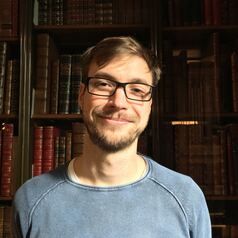
Senior Lecturer in Early Modern History, University of Manchester I am an early modern historian working on material culture, cultural encounters, and global history. In September 2023, I will start as Deputy Director and Scientific Lead of the John Rylands Research Institute. I explore new interdisciplinary collaborations between the humanities and the sciences, and new methodological trajectories in material culture studies like the use of digital microscopes and scientific analysis, remaking experiments, and historians' collaboration with artisans and artists. I was awarded a British Academy Rising Star Engagement Award to organise Microscopic Records, and a Philip Leverhulme Prize in recognition of research achievements in early modern material culture studies and global history. As the research group leader of The Bodies, Emotions and Material Culture Collective, I co-organise Affective Artefacts and run The Manchester Material Culture Lab reading group. Before joining the University of Manchester in 2018, I held postdoctoral positions at the University of Cambridge and the Research Centre Gotha, University of Erfurt. I received the PhD from the Freie Universität Berlin and studied in Berlin, Venice, and at the Warburg Institute London. I was also an intern and research assistant at the Freie Universität Berlin, the Duchess Anna Amalia Library Weimar, and the German Historical Institutes in Rome and London. My current monograph project focuses on the history of hair in Reformation Germany and the broader Habsburg world. I explore what it meant to live in a 'hair-literate society', and how hair was linked to early modern identities. My History Workshop Journal article examines Habsburg and Ottoman captives' descriptions of forced hair removal in the early modern Mediterranean and their societal, religious, medical, and sexual meanings. Bringing gender history, the history of the body, and art history into a conversation with material culture studies, my Gender & History article argues that the sudden fashionability of beards in Renaissance Europe has been intricately linked with a culture of material and visual experimentation. Focusing on how people made hair matter, I suggest working with the concept of face-work. I also published on haircare and hair dyeing in early modern Germany, and run an interdisciplinary research project to conduct scientific analysis of early modern haircare recipes.
Lecturer, Master of Screen Producing, Victorian College of the Arts, The University of Melbourne Stephen Luby has been a film and television producer for 30 years. His work includes documentary, comedy and drama across film, television and streaming. Highlights include iconic feature film comedy 'Crackerjack', acclaimed ABC mini-series 'The Secret River', based on Kate Grenville's best selling novel of the same name, and 'Rostered On' a comedy series which found its way from 2017 viral YouTube success to Netflix. Since 2017 Stephen has also lectured in the Master of Producing degree at the Victorian College of the Arts, Faculty of Fine Arts and Music, University of Melbourne
Professor of Medieval Literature, University of Otago My PhD from the University of Sydney focused on Middle English Literature by women. Since then, my interests have developed, so that more broadly, I research how our understanding of the world around us is directly shaped by texts: religious, scientific, literary, legal, historical, political. Within my research platform, I have six programmes of research: Medieval Race, Geoffrey Chaucer, Medievalisms, Medieval Women, Medieval Literary Anonymity, and Medieval Manuscripts. The programmes overlap and interconnect, but each seeks to bring to light a feature or characteristic of how texts shape our world.
Casual Academic, Physiotherapy, La Trobe University Sarah Warby is a shoulder physiotherapist with the Melbourne Shoulder Group, researcher(PhD) and university sessional tutor. Sarah Warby is a shoulder physiotherapist with the Melbourne Shoulder Group, researcher(PhD) and university sessional tutor.
Associate professor, Deakin University Dr Sagarika Mishra is an Associate Professor in the Department of the Finance at Deakin Business School. Sagarika completed her PhD in Applied Economics from Western Michigan University in the USA. She has over ten years of experience in research and teaching, with six publications in ABDC A* journals and many more in other reputable journals.
Associate Professor, University of Auckland I research why and how people created all the amazing languages around us, and what they tell us about human prehistory. I use (mainly) Bayesian phylogenetic methods to tackle these questions and have investigated everything from how the Austronesian peoples settled the Pacific, to modelling the co-evolution of linguistic structure. And I have built a number of large-scale databases to help answer these questions.