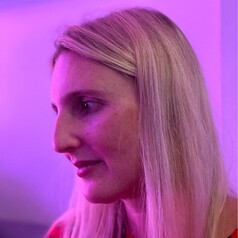
Reader and Associate Professor in Performing Arts, University of East London I am an educator, researcher, performer, choreographer and writer: a dance nerd. My dance research focuses on race, gender, sexuality, and nation in apartheid and post-apartheid South Africa, the politics of hybridity, and the use of practice as a research methodology. I have performed in and choreographed dance works, for example at JOMBA! Contemporary Dance Festival (South Africa) and The Playhouse (South Africa). I serve on a number of editorial and organisation boards, such as The South African Dance Journal and HOTFOOT. I have published research on dance and South Africa, for instance in Viral Dramaturgies (2018) and Narratives in Black British Dance (2018), and in journals such as The African Performance Review, Dance Theatre Journal, Animated, African Performance Review, and The South African Theatre Journal. I am interested in researching and documenting dance and performance practices that are often marginalised by the global north. I am currently working on a monograph on contemporary dance in South Africa during the early periods after the end of the apartheid regime. My book aims to explore when and how, and to what effect, the body in South African contemporary dance post-apartheid is a toyi-toying body. Toyi-Toying is a South African dance motif that occurs at protests and is a powerful piece of choreography that creates a charged atmosphere. My research makes apparent the relationship between political action and the dancing body and shows how South African contemporary dance choreographers makes visible the complex, fluid, multiple, and contradictory nature of South African identity politics. My story: I was born in Pietermaritzburg, South Africa in the 1970s, and was sent to ballet at the age of four to cure my duck walk; I had teaspoons thrown at me by my ballet teacher because I wouldn't stop growing; I developed a love for Brenda Fassie and township jive thanks to the wise gogo who cared for me when my mom was working at the hospital; I landed up at the University of KwaZulu-Natal in the 1990s; during the most important election in South African history, I loved dancing the toyi-toyi up and down the voting lines with my fellow South Africans. I learnt from Paul Datlen that everything was dance, including throwing yourself onto the floor, which I had no problem with, except the getting up. From Lliane Loots, I learnt that not only was everything dance, but dance was political, and dancing bodies are thinking bodies. I danced for Flatfoot when it was 'unofficial', and I takes pride in saying that I remember dancing on the top of a construction site with fibreglass wings on for a photo shoot. I likes to think that the photo in the local Sunday Paper made me famous when I was clubbing in Point Road. During this time, I made other dancers dance with chickens and got really irritated that there weren't enough books about dance in South Africa on the library bookshelves. In 2001, I left the sunny shores of the East Coast to go to London and ended up completing a practice-based doctoral research project supervised by Jen Harvie at Queen Mary, University of London, which was funded by the United Kingdom's Arts and Humanities and Research Council. Today, I am a practice-based researcher based at the University of East London but I have one foot in the United Kingdom and one in South Africa - I do have big feet. I love working with my students at UEL and I love working with the student dancers in UKZN (University of KwaZulu-Natal), such as with the Flatfoot Dance Training Company, or even bringing students from UEL together with students from UKZN on Khuluma – the dance writing residency project that is part of JOMBA! Contemporary Dance Festival. I invite you to join the Dance Revolution: Dance Nerds Unite!
Foundation Professor of Psychology, Arizona State University Steven Neuberg is a Foundation Professor in the Department of Psychology at Arizona State University. He received his bachelor's from Cornell University, a master's and doctorate from Carnegie Mellon University, and had a NATO Fellowship year at the University of Waterloo, Canada. Neuberg integrates social-cognitive and evolutionary approaches in his research exploring the origins, nature, and nuances of prejudices and stereotypes, and the ways that fundamental motivations shape cognition and social behavior. He is the director of the Evolution, Ecology, and Social Behavior Lab and co-director of the Kenrick-Neuberg Social Cognition Laboratory. He also founded the ASU Global Group Relations Project, a multidisciplinary and global study of factors, including religion, which shape intergroup conflict. His research has been published in outlets such as Proceedings of the National Academy of Sciences, Psychological Review, Advances in Experimental Social Psychology, Journal of Personality and Social Psychology, Psychological Science, Handbook of Social Psychology, and Perspectives on Psychological Science, and has been supported by the National Science Foundation, National Institute of Health, and Army Research Institute. His research has received the Gordon Allport Intergroup Relations Prize and the Daniel M. Wegner Theoretical Innovation Prize, and he is a fellow of multiple scientific societies, including the American Association for the Advancement of Science. He is the recipient of several ASU teaching honors, including the Outstanding Doctoral Mentor Award and the CLAS Outstanding Teaching Award, recently served as Chair of the Department of Psychology, and directs the Department’s Psych for Life® enterprise.
Lecturer in Biomechanics, Edith Cowan University My area of expertise involves the measurement of human movement. This includes extensive experience in the design and development of custom 3-D musculoskeletal models that have been used to assess performance, fatigue, joint function, and injury risk in professional and Olympic-level athletes. My PhD thesis was focused on exploring the influence of fatigue on sprint gait and hamstring injury risk. I previously employed at the Queensland Academy of Sport as a Performance Scientist (Accredited Sports Scientist – Level 2 (ESSA)) where I worked closely with Olympic-level athletes and coaches in Athletics and BMX Freestyle to optimise performance.
Associate Professor, School of People, Environment and Planning, Massey University I am a public anthropologist informed by feminist and decolonial practices. I apply an anthropological lens to address issues of internal colonialism, gender, poverty, social oppression and structural violence within the postcolonial and neoliberal contexts of South Asia and settler Aotearoa New Zealand
Professor of English, Clemson University Susanna Ashton is a Professor of English at Clemson University. She holds a B.A. from Vassar and M.A. and Ph.D. from the University of Iowa. Among other awards, she has been a Faculty Fulbright scholar in Ireland; a Faculty fellow at Yale University’s Gilder Lehrman Center for the Study of Slavery, Resistance, and Abolition; a Mark Twain Fellow for the Mark Twain Society; and held archival fellowships at the University of South Carolina, Emory University, and the Houghton Library of Harvard University. For 2021-2022, she was a W.E.B. Du Bois Fellow at the Hutchins Center for African and African American Research at Harvard University. Ashton has published peer-reviewed work on the topic of life writing written by enslaved people as well as scholarship on book history, authorship, anonymity, archival theory, libraries, copyright, studies of the novel, and American literary realism. Her biography of John Andrew Jackson, _A Plausible Man. The True Story of the Escaped Slave Who Inspired Uncle Tom's Cabin_ is published with NY: The New Press, 2024. Her website and research webjournal, "The Runaway Chronicles" are available at www.susannaashton.com ORCID #0000-0002-1652-2239