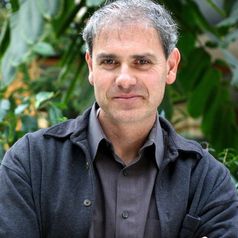
Prof. Vandervelde has two B.S. degrees in both Astronomy and Physics from the University of Massachusetts Amherst and an M.A. and Ph.D in Physics from the University of Virginia. Tom has extensive research experience in optoelectronics and photonics. His research group, The Renewable Energy and Applied Photonics (REAP) Labs, at Tufts University works on developing new optolectronic materials and devices to garner a better understanding of how light and matter interact while creating a better future for us all. Tom is an Associate Professor of Electrical and Computer Engineering, Adjunct Professor of Mechanical Engineering, and Adjunct Professor of Physics at Tufts University. His research group is the Renewable Energy and Applied Photonics Laboratories (REAP Labs) at Tufts. He is also the Director of the Tufts Epitaxial Core Facility, which is a user facility dedicated to providing semiconductor epitaxial services to the local, national, and international community for most semiconductor materials systems.
Mundell - Professor of Extragalactic Astronomy - is an observational astrophysicist who specialises in astrophysical phenomena outside of our own galaxy, including gamma ray bursts and active galactic nuclei.
Professor Peter Wells has vast experience of research into the global automotive industry around which he has developed his academic and theoretic interests in socio-technical transitions, business models, cultures of automobility and sustainability. Research interests: - Alternative local economies - Automotive industry - Celebrities, wealth and sustainability - Corporate strategy - Government transport and environment policy - Mobility - Sustainable business models - Transitions to sustainability
Hugh Martin is the coordinator of the Masters of Journalism Innovation program at La Trobe University. Hugh has worked in a variety of digital editorial and publishing roles with Australia’s biggest news publishers. He was Editor of theage.com.au, Editor of News.com.au at News Corp and General Manager of APN Online, a division of APN News & Media. He received a Walkley Award in 2004, and is a winner of two Melbourne Press Club Awards. In 2014 he was a recipient of the Google/Walkley Foundation Grant for Innovation in Journalism.
My training is in community psychology and public health epidemiology. My main expertise is the theory, methods, ethics and economics of complex, multi-level community and population-level interventions to promote health and prevent disease. I'm best known for my publications in health promotion evaluation, social capital, and using complexity thinking to design more effective interventions and more appropriate evaluation methods. My main empirical work is in schools and neighbourhoods. I spent 10 years in Canada where I had the opportunity to help shape the Canadian Institutes of Health Research's strategy to move from descriptive and analytic health research to more solution-focused investments in population health intervention research. I am currently a Professor of Public Health at the Menzies Centre for Health Policy at the University of Sydney and a lead investigator of the NHMRC Australian Prevention Partnership Centre (TAPPC) . My focus of interest in TAPPC is in implementation science and communication of the science underpinning public policy.
Pep Canadell is a research scientist in CSIRO Oceans and Atmosphere, and the Executive Director of the Global Carbon Project, an international research project to study the interactions between the carbon cycle, climate, and human activities. Pep focuses on collaborative and integrative research to study global and regional aspects of the carbon cycle, the size and vulnerability of earth carbon pools, and pathways to climate stabilization. He publishes in the field of global ecology and earth system sciences http://goo.gl/Ys7vdF