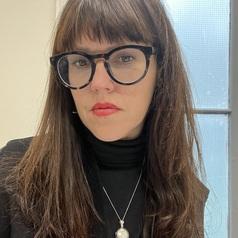
Professor of Public Policy, University of Liverpool Catherine is Professor of Public Policy, and Co-Director of the Heseltine Institute for Public Policy, Practice and Place at the University of Liverpool. She is recognised as a leading expert on urban governance and public policy, and has written widely on policy design and implementation, devolution, urban transformation, social and democratic innovation, and participation. Empirically, her work has focused at urban, city-regional, local, and neighbourhood levels. Catherine is particularly well-known for her work on co-production, how bringing together different forms of expertise can provide an innovative means of addressing complexity and uncertainty in governance and policy.
Associate Professor of Biology, Indiana University The Picard Lab’s research is focused on the understanding and correlations between genotype and phenotypes specifically related to insects. Many of the insects studied in the lab are forensically relevant insects (i.e. blow flies), with the goal of using whole-genome data to extract variations in the genome related to forensically relevant traits such as development time and rate. Additionally, The Picard Lab has expanded to include species of insects for development as sustainable, alternative protein sources for human food and animal feed consumption. The lab uses a combination of traditional genetic and bioinformatics techniques to mine data for the characterization of important traits.
Associate Professor of Analytics and Operations, University of Richmond Shital Thekdi is an Associate Professor of Analytics & Operations in the Robins School of Business at the University of Richmond. She has earned a Ph.D. in Systems & Information Engineering at the University of Virginia; and has earned an M.S.E. and B.S.E. in Industrial & Operations Engineering at the University of Michigan. She teaches courses in analytics and decision-making. Her research focuses on risk analysis and management in operations.
Instructor of Information Systems Management, Auburn University Dr. Asim Ali holds a bachelor’s degree in software engineering, a master’s degree in information systems management, and a Ph.D. in adult education from Auburn University. As the Executive Director of the Biggio Center for the Enhancement of Teaching and Learning, Dr. Ali advances the center’s mission of providing professional development programs, services, and resources to enhance instructional innovation and support scholarly and creative activities. Dr. Ali oversees a team of more than 90 professionals, graduate students, and staff members across the center’s various units, which include Auburn Online, Biggio Teaching, Biggio Technology, Biggio Testing, and Engaged and Active Student Learning, or EASL, classrooms, and classroom buildings. Dr. Ali also co-leads work on artificial intelligence for the Office of the Provost to build faculty capacity for understanding and implementing AI in teaching and learning. Dr. Ali has modeled implementation of generative AI for students in the introduction to information systems course he teaches to business students. He has been an invited keynote speaker and presenter at national conferences and by several universities. As the founding Director of Auburn Online from 2014-2019, Dr. Ali strengthened the University’s role in eLearning by providing central resources to support faculty in the development and instruction of online education, expanding the University’s online course offerings by more than 300 percent. I'm 2023, Dr. Ali led the development of a fully-online, self-paced course for the higher education community, "Teaching with AI" which has been licensed by the Southeastern Conference for all 14 member institutions in a first-of-its-kind partnership. The course is also used at about 15 other universities and colleges by hundreds of faculty.
Distinguished Professor in Pest Management and Conservation, Lincoln University, New Zealand My primary research focus is predicting the risks arising from plant invasions and recent work has examined the traits that underpin the success of invasive species; clarifying the main routes by which these species are introduced to a region; assessing their rates of spread; gauging the vulnerability of habitats to invasion, quantifying the impacts of invasive species and predicting the potential impact of climate change on invasive species distributions. However, my research also includes wider assessments of biological invasions and increasingly the importance of human perspectives such as the role of trade and wealth creation on invasion rates as well as the importance of appreciating the non-market costs of alien species impacts. I apply a wide range of approaches to address these issues including modelling, experiments and field surveys with research undertaken across the world from the forests of North America and East Africa to the montane ecosystems of Italy and New Zealand. I am a Fellow of the Royal Society of New Zealand.
Professor, La Trobe University Melodie McGeoch is an ecologist that works on biodiversity change, combining theory and analytics to address central environmental challenges, including climate change impacts and biological invasions. She works across taxa and regions, including in the Antarctic, is active in the translation of science for biodiversity policy and holds multiple professional leadership positions in Australia and internationally.